


You're sitting at the kitchen table with your phone in one hand, wondering whether an unusual discharge, rash, pain or contraception question is serious enough to justify a clinic appointment. You'd like a qualified answer, but you may not want to discuss something intimate aloud or wait for a face-to-face slot.
Sexual health online chat can provide a private route into care, but it isn't a replacement for every examination, test or urgent assessment. In the UK, it may mean asynchronous messaging with an NHS sexual health service, or a secure consultation with a private UK-registered pharmacy and pharmacist prescriber. The important question isn't whether chat is available. It's whether your concern is suitable for messaging and what safeguards the provider has in place.
Safety first: Online chat is a triage and treatment route for appropriate cases. Severe symptoms, time-sensitive prevention needs and concerns requiring examination need the right in-person service.
Table of Contents
- What Sexual Health Online Chat Actually Means
- How a Sexual Health Chat Consultation Works
- Benefits and Limitations of Chat-Based Care
- Preparing for a Safe and Private Chat
- When Symptoms Need In-Person Care Instead
- How to Choose a Trustworthy UK Provider
- What to Expect from XO Medical
- Key Takeaways and Safety Reminders
What Sexual Health Online Chat Actually Means
Sexual health online chat is a clinician-led conversation through secure text messages. It's different from a live video appointment, a telephone consultation or a general online forum. You write what's happening, a healthcare professional reviews the information, and they may ask further questions before recommending the next step.
In the NHS, sexual health services include clinics, contraception support, STI testing and treatment. You can use the NHS sexual health service finder to locate local care. Some NHS services use messaging portals for triage, test results, follow-up and advice. These conversations are often asynchronous, meaning you send a message and wait for a response rather than having an instant exchange.
Private services can use a similar model. A GPhC-registered online pharmacy may collect your symptoms and medical history through a secure form or message thread. A UK-registered pharmacist prescriber can then assess whether a prescription-only treatment is clinically appropriate, ask for clarification, recommend self-care or refer you elsewhere.
You shouldn't confuse this with a symptom checker, an automated chatbot without prescriber oversight or an anonymous health forum. Those tools may help you form questions, but they don't replace an assessment by a qualified clinician. General information about sexual health is also different from a personal consultation. XO's guide to what sexual health means can help with basic concepts, but symptoms still need individual clinical judgement.
The format is useful precisely because it has boundaries. It can make low-acuity concerns easier to discuss, while a responsible service should recognise when text isn't enough.
How a Sexual Health Chat Consultation Works
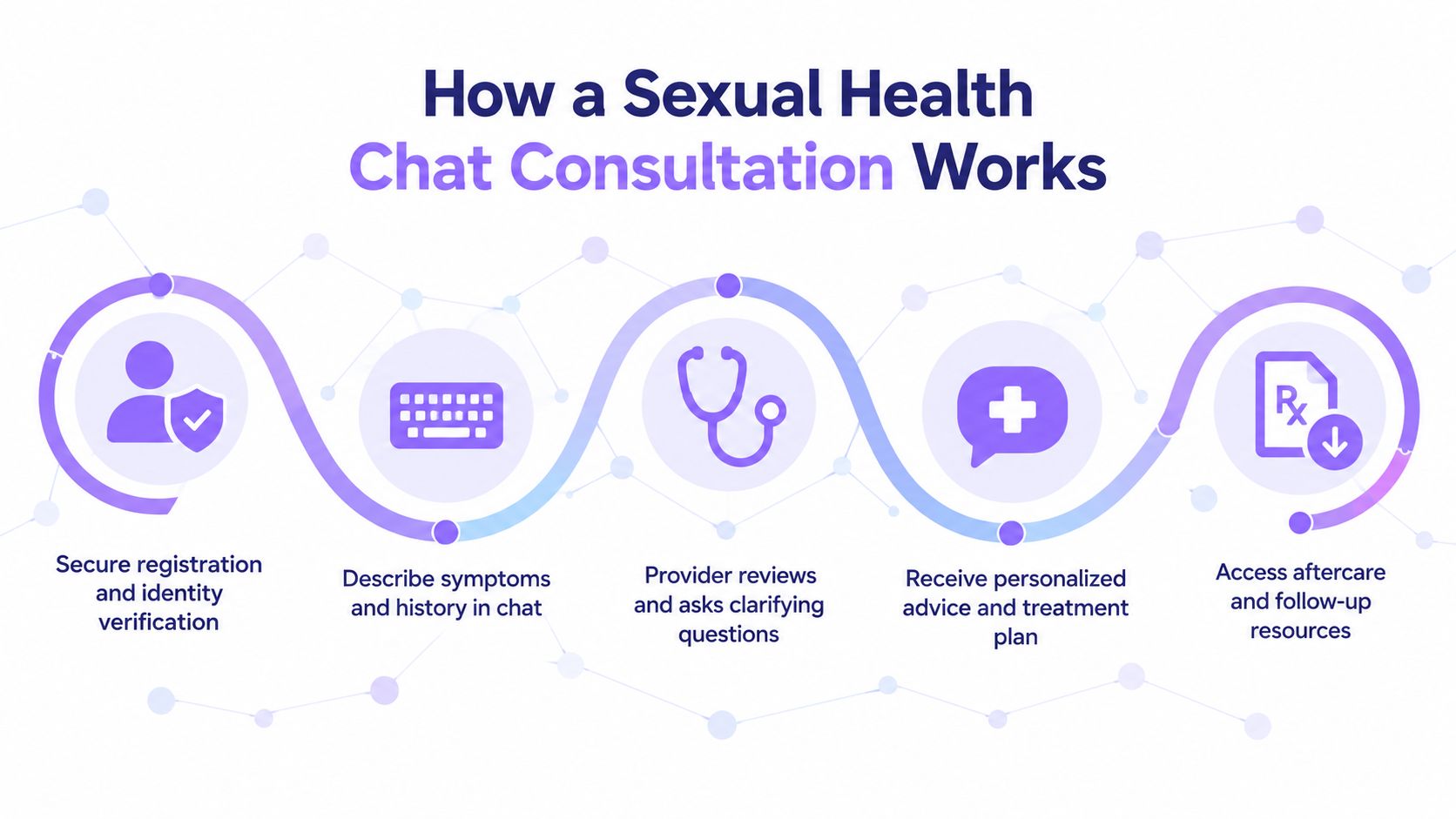
A legitimate consultation usually starts with registration and identity checks. The provider may confirm your name, date of birth, address, mobile number or other details, depending on the service. These checks protect patients, support safe prescribing and help the clinician match the consultation to the correct person.
You'll then complete an intake form or begin a secure message thread. Expect questions about when your symptoms began, what they feel like, recent sexual contact, contraception, allergies, existing conditions and current medicines. Give clear, accurate information. A prescriber can only make a safe remote decision from the details available.
What the clinician does with your answers
A pharmacist prescriber or another qualified clinician reviews the submission and may ask follow-up questions in the same thread. Some platforms allow photographs when they're clinically useful, although an image can't always provide the same information as a physical examination.
The clinician then decides whether remote care is suitable. Possible outcomes include advice, a request for an STI test, referral to an NHS clinic or GP, self-care guidance, or a prescription where treatment is appropriate. Prescribed medication isn't automatic, and a prescription-only treatment should only be supplied after a clinical assessment.
If medication is prescribed, the pharmacy dispenses it and arranges delivery according to its normal process. The consultation and messages may form part of your clinical record, so write as though you're speaking directly to a healthcare professional. For general non-clinical chat workflows, you can also try Expressify AI chat, but an AI service isn't a substitute for a regulated sexual health consultation.
Response times vary. NHS examples include asynchronous services that aim to answer messages within stated weekday hours, with some services responding within 24 hours and another specifying 48 hours during weekday opening hours. Check the provider's hours before relying on chat for anything time-sensitive.
Benefits and Limitations of Chat-Based Care
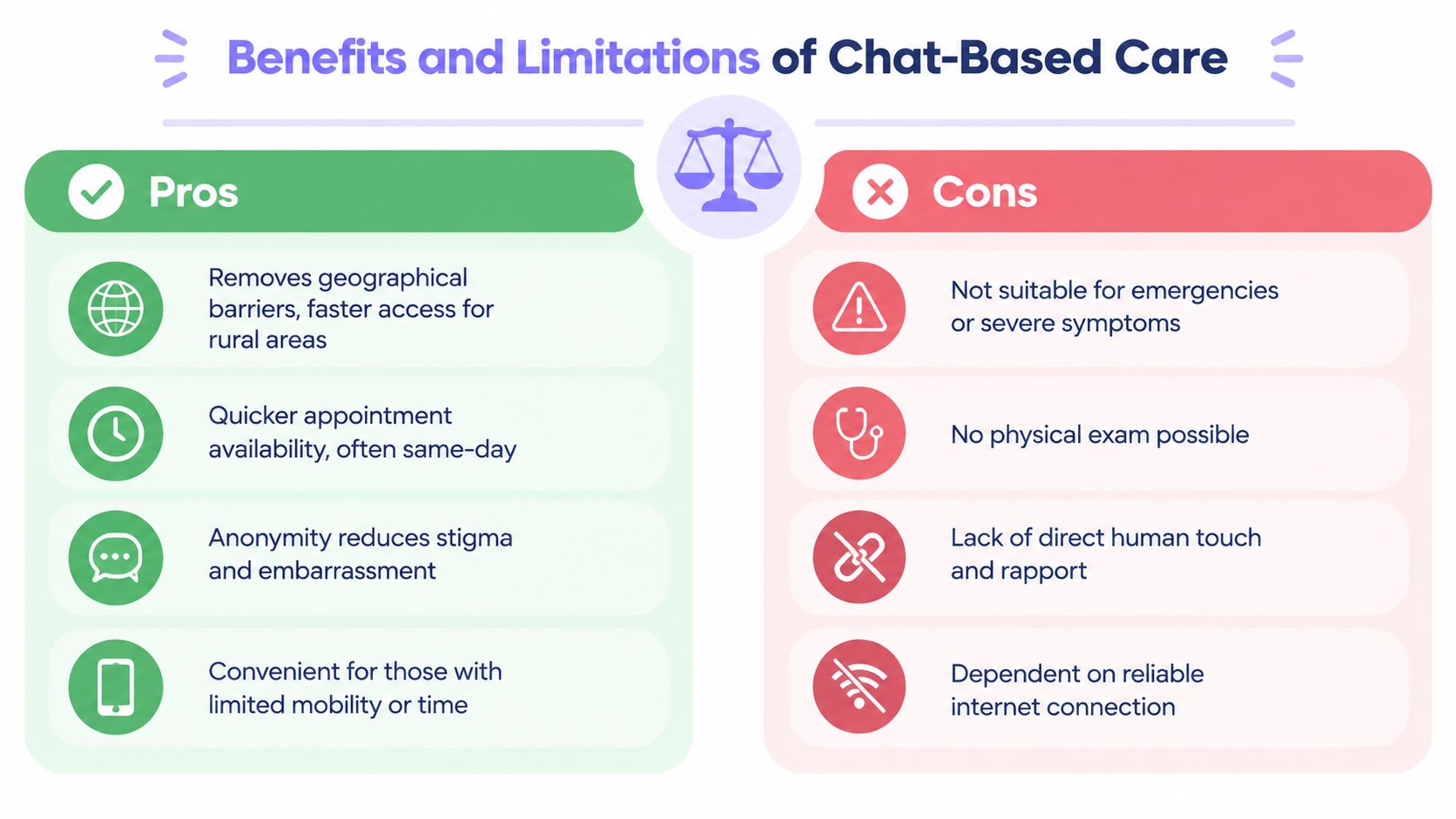
Chat-based care solves a practical access problem. You don't need to travel, arrange time away from work or explain a sensitive concern aloud at a reception desk. Written questions can also give you time to describe symptoms carefully, check dates and ask about issues you might forget during a short appointment.
The NHS data shows how significant online routes have become. In England, sexual health services delivered 4,450,076 consultations in 2025, and 42.2%, or 1,875,777 consultations, were delivered online rather than face-to-face or by telephone, according to the NHS sexual health information. Online access is therefore not a niche convenience. It's part of the way many people now enter sexual health care.
What chat handles well
Online messaging is often suitable for lower-acuity questions, routine follow-up and access arrangements. NHS online services may be available around the clock for ordering STI test kits and, in some areas, emergency contraception, free condoms and PrEP, although clinical support operates during the stated working hours, as explained in the NHS service directory.
It can also reduce embarrassment and geographical barriers. Wolverhampton's CHAT Sexual Health service launched in August 2020 as a confidential texting service offering information and advice from healthcare professionals. Local reporting recorded 631 contacts in 2020/21, 1,811 in 2021/22 and 1,638 in 2022/23, with outgoing messages averaging over 1,000 per quarter in 2022/23. The most common reasons included STI concerns, genital symptoms and contraception, according to the UK Parliament research briefing.
Where chat stops
Messaging can't perform an examination, take a swab or blood sample at that moment, or assess a rash or lesion with the same reliability as a clinician seeing you in person. It also depends on how accurately you can describe the problem.
Online routes do handle symptomatic patients. In England, 4,284,975 STI tests formed part of an online consultation in 2025, and 14.7% were requested by people with symptoms, according to the 2025 STI report. That doesn't mean every symptom can be managed remotely. Chat works best as one part of a wider pathway, not as a complete substitute for hands-on care.
Preparing for a Safe and Private Chat
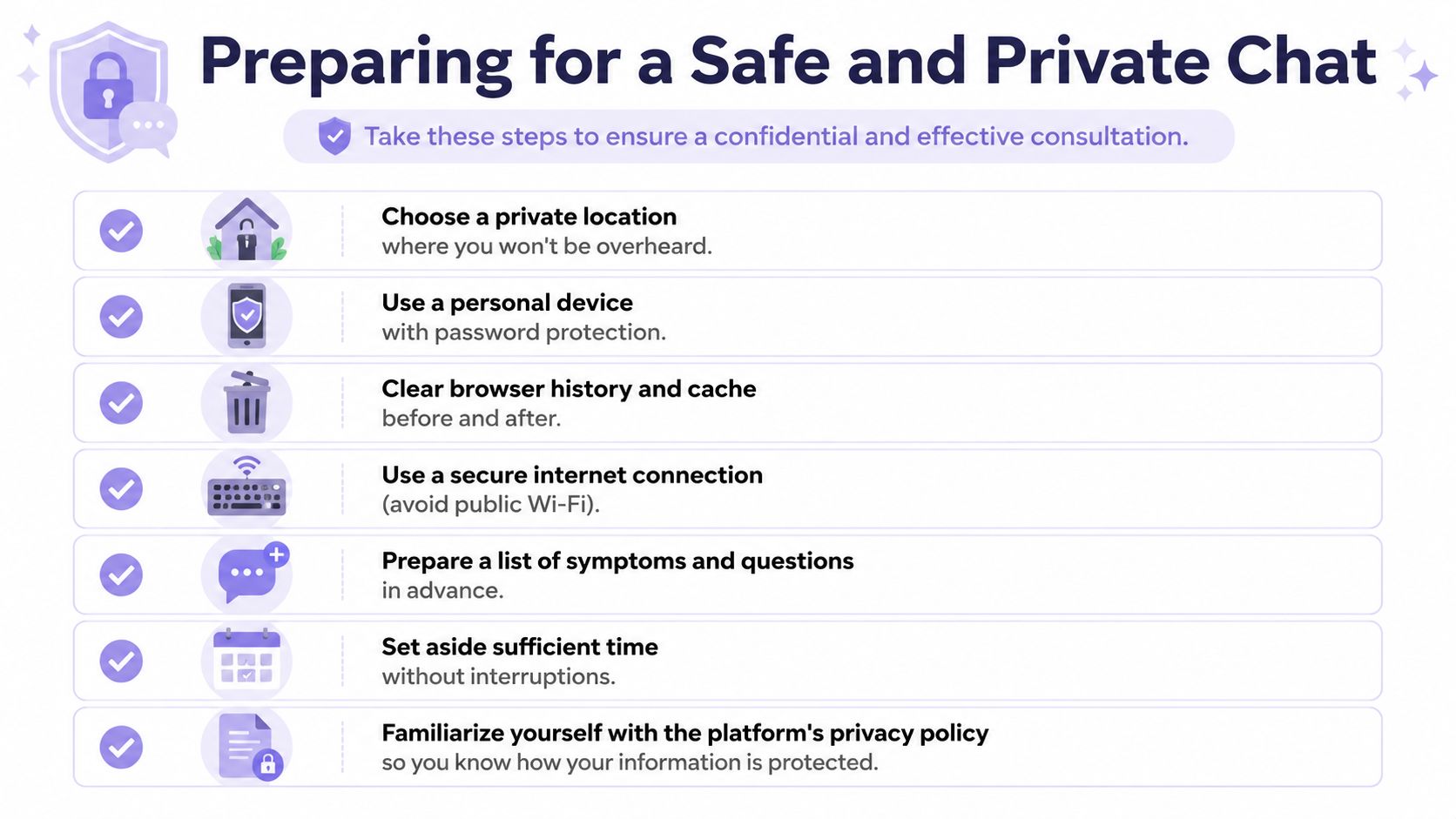
Choose a private place before you start. If you live with other people, use headphones where appropriate and make sure nobody can see your screen. A personal, password-protected phone or computer is preferable to a shared device.
If you're using a shared computer, consider whether browser history, saved passwords or notifications could expose the consultation. A secure internet connection is sensible, particularly when you're submitting medical details. Don't assume that deleting history is the only privacy measure. Read the provider's privacy notice and understand how it stores, uses and retains messages.
Information worth having ready
Write down the symptom timeline before opening the chat. Include when it started, whether it's changing and anything that makes it better or worse. Have your current contraception, medicines, allergies, relevant conditions and previous test results nearby.
Recent sexual contact may be clinically important, including approximate dates, condom use and whether a partner has reported an infection. You don't need to use perfect medical terminology. Plain descriptions are more useful than trying to diagnose yourself.
Practical preparation: The clearer your history, the less likely the clinician will need to delay an answer while asking basic follow-up questions.
Consent and communication
You'll normally need to agree to the service terms and confirm that the information you've provided is accurate. Read how the provider verifies identity, who reviews messages and when responses are available. Asynchronous care means you may not receive an immediate answer, so it isn't suitable for an emergency.
Before sharing photographs or sensitive details, check the platform's privacy arrangements. You can review information about how AgentStack handles data, but each healthcare provider remains responsible for explaining its own clinical record and data protection practices.
When Symptoms Need In-Person Care Instead
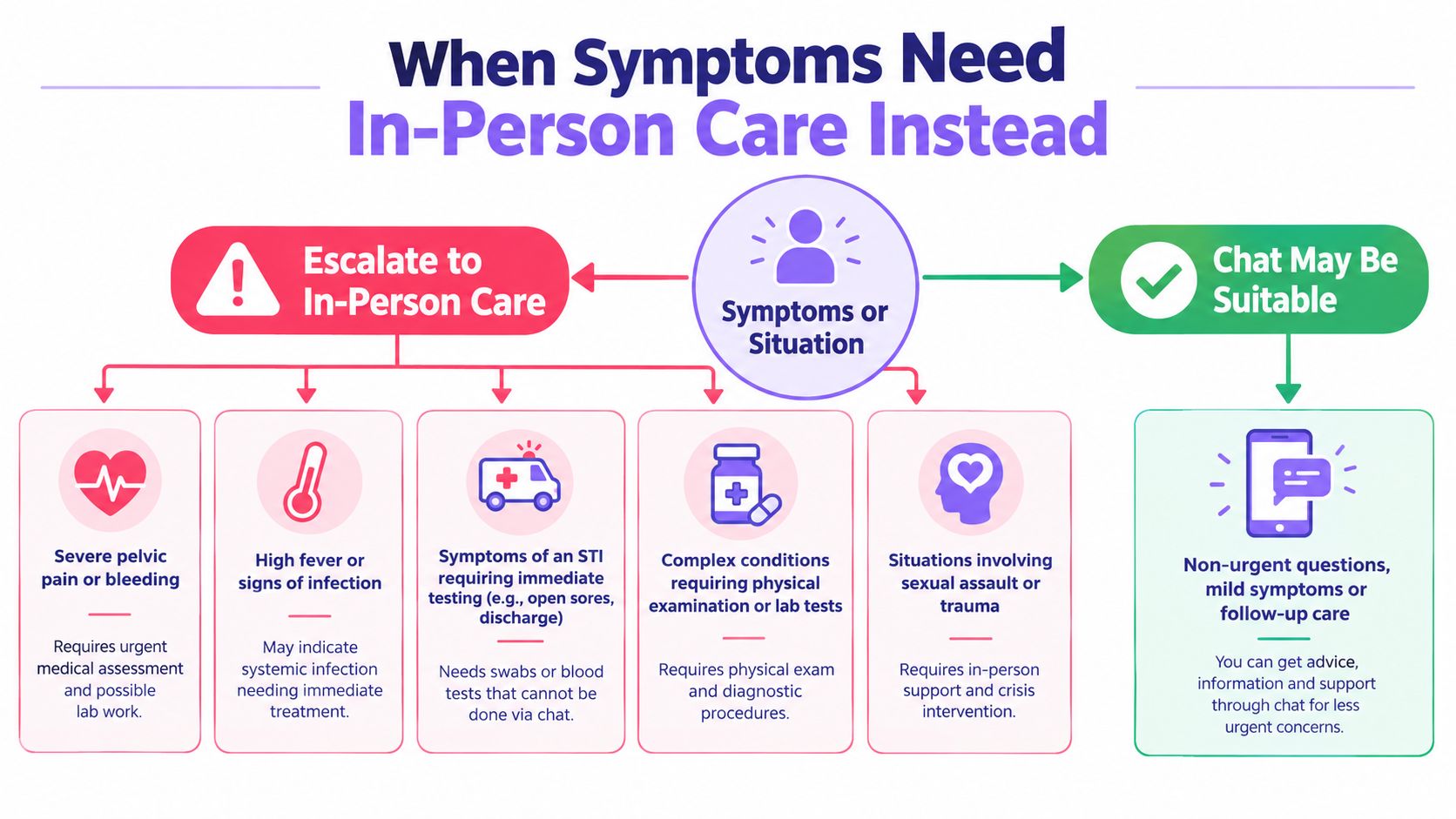
Online chat shouldn't be treated as a universal front door for every sexual health problem. A responsible clinician may redirect you because the safest next step involves examination, testing, treatment without delay or support that messaging can't provide.
Seek urgent assessment for severe pelvic pain, severe testicular pain, heavy or unusual bleeding, or fever with pelvic symptoms. Genital sores accompanied by systemic illness, rapidly worsening symptoms or suspected acute infection also need prompt clinical review. These presentations may require examination, swabs, blood tests or other investigations.
Post-exposure prophylaxis for HIV, known as PEP, is time-sensitive. If you think you may need it after a high-risk exposure, seek urgent specialist advice rather than waiting for a routine chat response. A service may direct you to an NHS sexual health clinic, urgent care or A&E, depending on the symptoms and urgency.
Why referral is a safety measure
Referral isn't a failure of online care. It's the point at which the clinician has identified that text alone can't answer the important clinical question. Physical examination, swabs, blood tests or imaging may be necessary, and no regulated provider should pretend otherwise.
Sexual assault or trauma also needs sensitive, appropriate support. You may need an in-person service that can assess immediate health needs and discuss specialist support. If you're unsure whether a lesion or symptom is suitable for chat, you can read XO's educational information on how to get tested for herpes, then seek personalised advice from a qualified clinician.
Call emergency services for an immediate danger or life-threatening situation. For other urgent concerns, contact an NHS sexual health clinic, urgent care or A&E rather than relying on an asynchronous message.
How to Choose a Trustworthy UK Provider
Start with regulation, not convenience. A private provider offering sexual health chat should make its General Pharmaceutical Council registration visible, including the pharmacy's registration number and registered premises. The provider should identify its superintendent pharmacist and explain who is responsible for the service.
Prescribers should be appropriately registered with the GMC or GPhC for the work they perform. You should also be able to verify a physical registered pharmacy address. These details let you check that the organisation is accountable within the UK healthcare system rather than presenting a polished website.
Questions to ask before submitting information
Look for a clear privacy notice covering encrypted messaging, retention of clinical records and how your data is shared. Check whether the service explains its response hours, age eligibility, accepted mobile numbers and arrangements outside working hours. NHS-linked chat services can have specific limits, including weekday response windows and restrictions on who can use them.
Medicine supply matters too. A reputable pharmacy should explain that medicines are sourced through lawful UK supply channels, that prescription-only treatment follows clinical assessment and that products are traceable. Ask how the pharmacy manages discreet packaging and any storage or delivery requirements that apply to a medicine.
| Trust signal | Warning sign |
|---|---|
| Visible GPhC registration number and registered address | Registration details are missing or difficult to verify |
| Named prescriber oversight | No clear information about who assesses consultations |
| Secure messaging and a transparent privacy policy | Chat records and data retention are unexplained |
| Prescription-only treatment supplied after assessment | Medication appears available without a consultation |
| Clear referral and urgent-care guidance | The service implies that every condition can be treated online |
| UK pharmacy fulfilment and traceable medicines | The fulfilment pharmacy is unidentified or outside the UK |
A provider describing itself as an online pharmacy, rather than a retailer, should still meet the same expectations for responsible prescribing and dispensing. XO's educational guide to an online pharmacy in the UK explains the practical checks patients can make. Don't rely on reviews alone. Verify credentials independently.
What to Expect from XO Medical
A consultation with XO Medical begins with an online questionnaire covering symptoms, medical history and current medication. The purpose is to give the clinician enough context to decide whether remote care is appropriate, not to guarantee access to a particular medicine.
A UK-registered pharmacist prescriber reviews the submission asynchronously. If an answer needs clarification, the prescriber can ask follow-up questions through secure messaging. The outcome may be a prescription, self-care guidance or a referral to a GP or local sexual health clinic.
Prescribing and follow-up
Any prescribed medication is subject to clinical suitability. A prescription-only treatment should only be issued when the prescriber has assessed the relevant information and considers it appropriate. Patients can ask questions about directions, possible side effects and what to do if symptoms don't improve.
Where medication is dispensed, XO Medical describes delivery using plain packaging and tracked dispatch. Timescales depend on the consultation outcome, prescription and delivery process, so check the current service information rather than assuming that every request will arrive on the same schedule.
Follow-up messages within the defined support window allow patients to report side effects or ask additional questions. That follow-up is useful, but it doesn't remove the need for in-person care if symptoms become severe or the clinician advises examination.
The service sits alongside NHS care rather than replacing it. NHS sexual health services, contraception support and HIV treatment are described as free with no prescription charge, while private online pharmacy care may involve its own fees. A clinician can help you decide which route fits the concern, urgency and testing requirements.
Key Takeaways and Safety Reminders
Sexual health online chat is most useful for lower-acuity concerns, including contraception reviews, STI test-kit requests and some recurrent thrush or UTI symptoms when a clinician considers remote management suitable. It can also support follow-up, explain results and direct you to the right local service.
It isn't the right route for acute pelvic or testicular pain, severe bleeding, fever with pelvic symptoms, suspected serious infection or any situation requiring examination, swabs, blood tests or imaging. Time-sensitive concerns, including possible HIV PEP after a high-risk exposure, need urgent specialist advice rather than a routine asynchronous message.
A safer way to assess providers
Before using a private service, verify the pharmacy's GPhC registration number, registered premises and superintendent pharmacist. Check that a UK-registered pharmacist prescriber reviews consultations, that messages are protected and that the provider explains its records, response times and referral arrangements.
You retain the right to decline treatment and to be referred onward. A legitimate clinician should explain uncertainty rather than pressure you into a prescribed medication. Keep your GP involved where possible, particularly if you have ongoing symptoms, regular medicines or a condition requiring continuity of care.
The figures from England's 2025 data show that internet-based sexual health contact is clinically significant, but they don't change the basic rule: the right service depends on the symptoms and the urgency. This content is for informational purposes only and does not constitute medical advice. Always consult a qualified healthcare professional before starting or changing any treatment.
If you're considering private sexual health online chat, XO Medical offers a secure questionnaire, asynchronous review by a UK-registered pharmacist prescriber, potential prescribing where clinically appropriate and referral when online care isn't suitable. Visit XO to review the available healthcare services and decide whether a qualified clinician-led consultation is appropriate for your needs.


0 comments