


A UK online doctor consultation is a formal medical assessment conducted via a secure digital platform, such as a website or app, rather than in a physical clinic. It provides a structured method for patients to obtain professional medical advice, a diagnosis for certain conditions, and a potential treatment plan from a UK-registered clinician. For many non-emergency health concerns, it serves as a safe and convenient alternative to a traditional GP appointment, though it is not a substitute for emergency services.
Understanding Online Consultations in UK Healthcare
Online consultations are an established and regulated component of the UK healthcare system. Reputable services operate under strict clinical and safety standards, providing a confidential and structured pathway for patients to access medical care and, if clinically appropriate, a prescription from a UK-registered pharmacy.
The process is designed for safety and efficiency. It typically starts with the patient completing a detailed online questionnaire about their symptoms, medical history, and overall health. A qualified UK clinician then reviews this information to make an informed clinical judgement. This model allows patients to initiate a consultation at their convenience, avoiding the need for telephone queues or in-person waiting times.
Key Aspects of the Service
This approach is particularly suitable for managing specific, non-emergency health conditions where patient safety is the primary consideration.
- Professional Clinical Oversight: Every consultation is assessed by a qualified UK-based prescriber, such as a GMC-registered doctor or a GPhC-registered prescribing pharmacist. Their professional responsibility is to determine if an online consultation and subsequent treatment is a safe and appropriate option for the individual patient.
- A Fully Regulated Process: Legitimate online clinical services are regulated by UK healthcare bodies, including the Care Quality Commission (CQC) for services with employed doctors, and the General Pharmaceutical Council (GPhC) for pharmacy operations. This ensures adherence to high standards of patient safety and care.
- Safe Prescription-Only Treatments: If a clinician determines that a prescription-only treatment is clinically suitable, they will issue a prescription. This is then dispensed by a licensed online pharmacy, ensuring that all medication is MHRA-approved and sourced from a regulated supply chain.
A UK online doctor consultation applies the same rigorous standards of clinical care and patient safety found in a physical clinic to a digital environment. A prescription is never guaranteed; it is the outcome of a thorough medical assessment by a qualified healthcare professional.
These services offer a practical solution for adults seeking timely medical support for certain health issues. They operate within the established UK healthcare framework, complementing the work of the NHS and prioritising patient wellbeing.
How the Online Consultation Process Works
The process for a UK online doctor consultation is designed to be straightforward, with patient safety as the central principle. It follows a clear, methodical system that guides the patient from an initial digital assessment to a final treatment decision made by a qualified UK prescriber.
Understanding the steps involved can help clarify the experience. The process enables a clinician to gather the essential information typically collected during a face-to-face appointment, but in a remote setting. Each stage is designed to ensure a responsible and safe medical judgement can be reached.
This flowchart illustrates the standard three-step process.
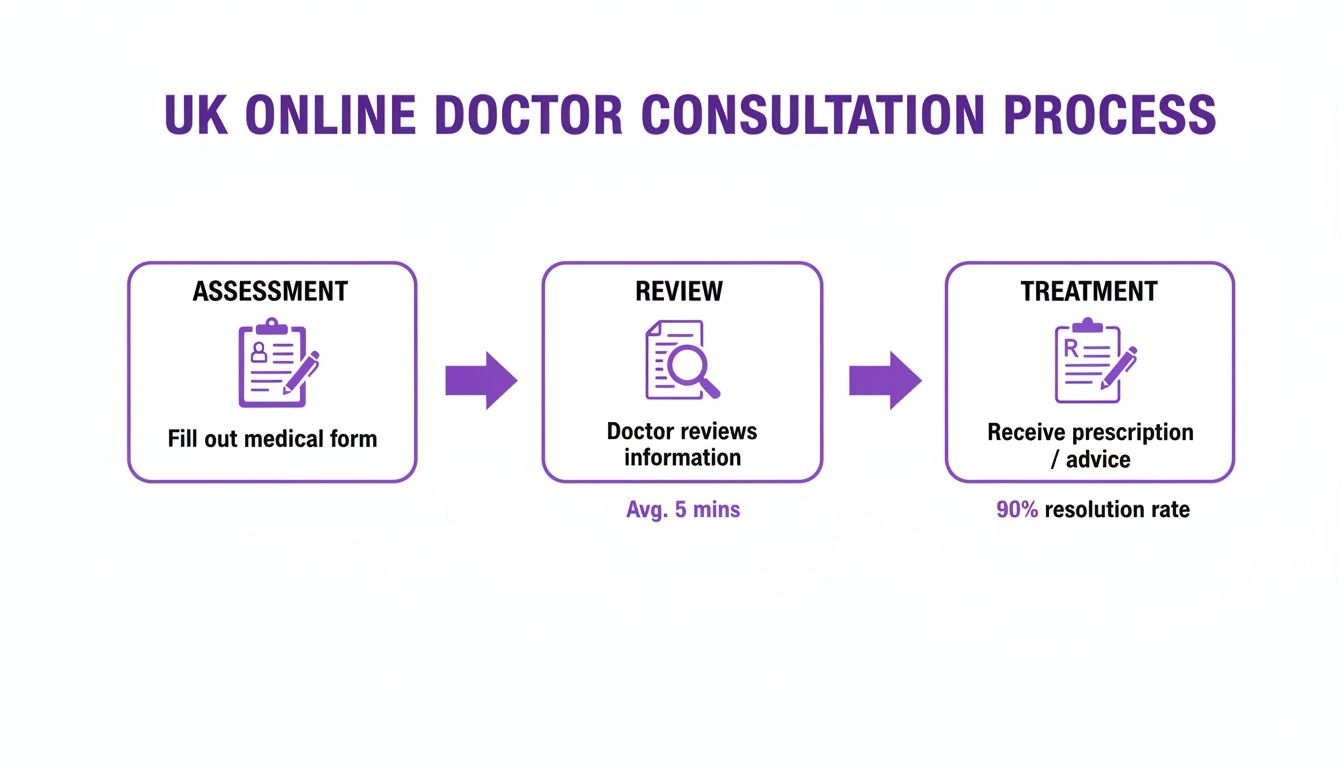
The system is structured around a secure and logical flow: the patient provides their health information, a healthcare professional reviews it, and a decision is made regarding the most appropriate treatment plan.
Step 1: The Online Assessment
The first stage involves completing a secure, confidential online questionnaire. This serves as a digital equivalent of the initial conversation with a GP, covering the patient's medical history and current health concern.
Patients will be asked to provide details on:
- Your symptoms: A clear and honest description of the health issue.
- Medical history: Including any pre-existing conditions or previous treatments.
- Current medications: A comprehensive list of all medicines being taken, including prescribed, over-the-counter, and complementary therapies.
Providing accurate and thorough information is essential. This forms the basis of the clinician's assessment, allowing them to determine if a prescription-only treatment is a safe and clinically effective option.
Step 2: Clinician Review and Assessment
Once submitted, the questionnaire is reviewed by a UK-registered clinician, such as a doctor or an independent pharmacist prescriber. They apply their clinical expertise and judgement to assess the information provided and determine if the requested treatment is medically appropriate and safe for the patient.
A clinician's primary responsibility is patient health and safety. A prescription is not guaranteed; it is the result of a careful clinical evaluation. If further clarification is needed, the clinician may contact the patient directly.
The integration of digital services into primary care is increasing across the UK. According to NHS England, millions of online consultation requests are submitted to GP practices each month, demonstrating a significant shift towards remote healthcare access and the use of electronic prescriptions.
Step 3: Treatment Decision and Prescription
Following the review, the clinician makes a clinical decision. There are three common outcomes:
- Treatment Approved: If the clinician determines the treatment is safe and suitable, they issue a prescription, which is then sent to a UK-registered pharmacy for dispensing.
- More Information Needed: The clinician may require additional details to make a safe decision and will contact the patient with follow-up questions.
- Treatment Declined: If the treatment is deemed unsafe or inappropriate for the patient's circumstances, the request will be declined. A clear explanation is provided, often with a recommendation to consult a GP for an in-person examination.
If treatment is approved, a regulated online pharmacy prepares the medication. All medicines supplied are MHRA-approved, meeting the UK's strict safety and quality standards. The prescribed medication is then dispatched in discreet packaging. You can learn more about how to get a UK online doctor prescription safely and what to check for in a provider.
Understanding the Safety and Regulation of UK Online Healthcare
Patient safety is the foremost priority in any medical service. It is reasonable to question whether a UK online doctor consultation adheres to the same high standards as a visit to a local GP. The UK has a robust regulatory framework to ensure all healthcare providers, both online and in-person, operate safely and ethically.
For those new to digital healthcare, understanding the regulatory landscape provides confidence. Key organisations are in place to protect patients by ensuring legitimate services operate under their strict supervision.

The Key Regulators Ensuring Patient Safety
In the UK, several independent bodies are responsible for overseeing the quality and safety of online health services. Registration with these bodies is a key indicator of a provider's legitimacy.
-
The Care Quality Commission (CQC): As the independent regulator of all health and social care in England, the CQC inspects services to ensure they are safe, effective, and responsive. Online doctor services that directly employ doctors must be registered with the CQC.
-
The General Pharmaceutical Council (GPhC): The GPhC is the regulator for pharmacists, pharmacy technicians, and pharmacy premises (including online pharmacies) in Great Britain. Services that dispense medication from their own online pharmacy must be registered with and regulated by the GPhC. This guarantees that all prescribed medication is managed correctly.
Verifying a provider's credentials is a straightforward and vital step. Reputable services will display their registration details, including official logos and registration numbers, on their website.
How Reputable Providers Prioritise Patient Safety
Beyond regulatory compliance, credible online health services integrate safety into every part of their process. These are not procedural formalities but practical measures designed to protect patient health and data.
Robust identity verification is a fundamental requirement to prevent fraud and ensure prescriptions are issued to the correct individual. This is a critical safeguard for safe online prescribing.
Data security is also paramount. Patient medical information is highly sensitive, and providers must comply with UK GDPR to protect it. This involves using secure, encrypted platforms for all communications, ensuring the same level of confidentiality as a local GP surgery.
A core principle of safe online healthcare is that a prescription is never automatic. It is always the result of a detailed clinical review by a UK-registered professional who has determined that a prescription-only treatment is clinically appropriate and safe for the patient.
The Importance of UK-Registered Clinicians
The quality of a UK online doctor consultation depends on the expertise of its medical team. Reputable services exclusively use clinicians registered with the relevant UK professional bodies:
- General Medical Council (GMC): For all medical doctors.
- General Pharmaceutical Council (GPhC): For pharmacist prescribers.
- Nursing and Midwifery Council (NMC): For specialist nurse prescribers.
These registrations ensure that clinicians meet the UK's high standards for training, competence, and professional conduct. This means the medical advice provided is based on current national guidelines, such as those from the National Institute for Health and Care Excellence (NICE). By understanding these markers of legitimacy, patients can differentiate a regulated provider from an unsafe website. You can find out more about the regulations governing a legitimate online pharmacy UK service.
What Conditions Can Be Treated Online?
A range of health conditions can be managed effectively through an online doctor consultation. These are typically non-emergency conditions for which a physical examination is not essential for an accurate diagnosis. Instead, a clinician can form a clear clinical picture through a detailed assessment of the patient's medical history, symptom description, and sometimes, supporting photographs.
This model is well-suited for straightforward health issues and the ongoing management of some long-term conditions. A secure, in-depth questionnaire provides the clinician with the necessary information to make a responsible clinical judgement about whether a prescription treatment is a safe and appropriate option.
Men's and Women's Health
Online services offer a confidential and discreet platform for addressing sensitive health topics, which may encourage individuals to seek advice they might otherwise postpone.
Examples include: For men:
- Erectile Dysfunction (ED): A diagnosis is typically based on reported symptoms and overall health. An online consultation allows a clinician to assess suitability for an MHRA-approved treatment while screening for underlying health issues that may require a follow-up with a regular GP.
- Hair Loss: Male pattern baldness can often be identified through a questionnaire and photographs, enabling a prescriber to determine if a prescription-only treatment is a safe and appropriate option.
For women:
- Contraception: Obtaining a new or repeat prescription for oral contraceptives can be managed effectively online. The assessment verifies the patient's health status to ensure their current contraception remains a safe and suitable choice.
- Menopause and HRT: An online consultation can be a valuable starting point for discussing symptoms of perimenopause or menopause. A clinician can review symptoms and medical history to assess if Hormone Replacement Therapy (HRT) is a suitable option.
Dermatology and Skin Conditions
Skin conditions are often well-suited for online consultations because diagnosis can frequently be made visually. Clear photographs, combined with a patient's description of their symptoms and medical history, can provide a clinician with sufficient information for an accurate assessment.
This enables patients to receive a prescription for an appropriate treatment without the delay of a face-to-face appointment.
Common examples include:
- Acne: By reviewing photographs, a clinician can assess the type and severity of acne and prescribe suitable topical or oral medication.
- Anti-Ageing Treatments: For concerns such as fine lines, a prescriber can assess a patient's skin and medical history to determine suitability for specific prescription-only treatments.
It is important to understand that completing an online consultation does not automatically result in a prescription. A clinician's primary duty is to patient safety and they will only prescribe a treatment if they are confident it is medically appropriate based on the information provided.
Weight Management and Lifestyle
Clinical support can be instrumental in achieving and maintaining weight loss. Online services can provide this structured support, which may include prescription medications as part of a comprehensive health plan.
Before any treatment is considered, a thorough assessment is conducted, covering BMI, full medical history, lifestyle factors, and previous weight loss attempts. This enables the prescriber to determine eligibility for an MHRA-approved weight management treatment. These medications are prescribed alongside a commitment to diet and exercise, and the online format is suitable for providing the ongoing support and progress monitoring essential for long-term success.
The Benefits and Limitations of Online Doctor Consultations
A UK online doctor consultation is a valuable resource for managing many health issues, but it is important to understand its appropriate applications and limitations. While the convenience is a significant advantage, this approach is not suitable for every medical situation. A clear understanding of its benefits and boundaries is key to using online healthcare safely and effectively.
This balanced perspective helps patients make informed decisions, embracing the efficiency of technology without compromising the quality of their medical care.

Key Benefits
The primary benefit for many patients is convenience. Online services eliminate common barriers to healthcare access, such as travel, waiting room times, and the need to take time off work. This is particularly helpful for individuals with mobility issues, those in rural locations, or anyone with a busy schedule.
Privacy is another significant advantage. An online assessment provides a discreet and confidential environment for discussing sensitive health issues, which can empower individuals to seek help for concerns they may have been hesitant to address in person.
The main benefits include:
- Speed and Efficiency: A consultation questionnaire can often be completed and reviewed by a clinician within hours, which is significantly faster than the typical waiting time for a routine GP appointment.
- Accessibility: Medical advice can be accessed from any location with an internet connection, removing geographical barriers.
- Discretion: The consultation and any prescribed medication from a UK-registered pharmacy are handled with complete confidentiality. Further information is available in our guide to online pharmacy next-day delivery.
The UK's telehealth sector is growing, partly in response to an ageing population and an increase in long-term health conditions. With 12.7 million people aged 65 or over in the UK, the demand for accessible, remote healthcare is increasing, indicating a fundamental shift in primary care delivery.
Understanding the Limitations
It is equally important to recognise when an online consultation is not appropriate. These services are designed for non-urgent conditions that a clinician can safely assess without a physical examination.
Online consultations are not a substitute for emergency care. For any medical emergency, such as severe chest pain, difficulty breathing, or serious injury, you must call 999 or go to A&E immediately.
Furthermore, some medical issues require a physical, hands-on assessment. A doctor may need to listen to a patient's chest, palpate their abdomen, or take blood pressure readings. For complex, undiagnosed, or severe conditions, an in-person appointment with a GP is the safest and most appropriate course of action.
Situations not suitable for online assessment include:
- Medical Emergencies: Any life-threatening condition requires immediate, in-person medical attention.
- Complex or Unexplained Symptoms: Vague or severe pain typically requires a physical examination to diagnose the cause.
- Conditions Requiring Physical Tests: If blood tests, scans, or other diagnostic procedures are needed, an in-person consultation is necessary.
A reputable UK online doctor consultation provider will be transparent about these limitations and will advise a patient to see their GP in person when it is clinically necessary. Patient safety must always be the priority.
How to Choose a Credible UK Online Doctor Service
With a growing number of online health services available, it is vital to know how to identify a trustworthy provider. A credible UK online doctor consultation service operates under strict regulations designed to ensure patient safety. Learning to recognise the signs of a legitimate provider is key to accessing care with confidence.
Digital healthcare is now an integral part of the NHS, with millions of online consultation requests submitted to GP practices each month. Since all GP practices in England are required to offer online consultation tools, patients are increasingly familiar with this method of accessing care. You can learn more about the increase in online GP consultations from NHS England.
Verify UK Regulation and Credentials
This is the most critical step. Any legitimate UK medical service must be regulated and will be transparent about its status.
Check the provider's website for:
- Regulatory Logos: Look for the official logos of the Care Quality Commission (CQC) and the General Pharmaceutical Council (GPhC). These are the independent regulators for healthcare in the UK.
- Verifiable Details: A trustworthy provider will list their registration numbers. Patients can use these numbers to verify the service's status on the official CQC or GPhC websites.
- UK-Based Clinicians: The service must use UK-registered doctors, pharmacists, or nurses. Their credentials should be verifiable with professional bodies like the General Medical Council (GMC) or GPhC.
Assess Transparency and Safety Protocols
A professional service is characterised by its transparency regarding pricing, its clinical team, and its data protection measures. A lack of clear information should be considered a warning sign.
Use this safety checklist:
- Clear Pricing: All costs for the consultation and any prescribed medication should be clearly stated upfront, with no hidden fees.
- Detailed Medical Team Information: Information about the clinicians, including their qualifications and registration status, should be easily accessible.
- Secure Platform: The website address should begin with "https://", indicating that the site is encrypted and personal data is protected in compliance with UK GDPR.
A key indicator of a safe service is that it will never guarantee a prescription. A thorough clinical assessment must always precede any decision to prescribe medication to ensure it is appropriate and safe for the patient.
Look for Red Flags and Warning Signs
Finally, be cautious of services that seem more focused on selling products than providing responsible medical care. Be wary of any provider that promises instant access to prescription-only treatment or appears to facilitate access to medication without a comprehensive consultation. This is not only poor practice but is also unsafe.
While patient reviews on independent platforms can provide insight, the most important verification is official regulatory approval. This is the definitive mark of a legitimate and safe provider.
Frequently Asked Questions About Online Consultations
It is normal to have questions before using an online doctor service for the first time. The following answers address some of the most common queries regarding the safety, legitimacy, and process of online healthcare.
Are Online Doctor Services Safe and Legal in the UK?
Yes, provided you choose a service that is properly regulated. A genuine UK online doctor consultation provider must be registered with the UK's healthcare regulators. Services employing their own doctors are regulated by the Care Quality Commission (CQC). If the service also operates its own online pharmacy to dispense medication, it must be registered with the General Pharmaceutical Council (GPhC).
These bodies enforce strict standards covering patient safety, data security, and the quality of clinical care. Before using a service, it is advisable to verify its registration details on the CQC or GPhC websites. This confirms that the provider employs UK-qualified clinicians and adheres to the same medical guidelines as an NHS practice.
Can I Get Any Prescription I Want?
No. A clinician's primary duty is patient safety. A prescription-only treatment can only be issued after a qualified UK prescriber has conducted a thorough review of your completed health questionnaire. They assess your symptoms, medical history, and any other medications you are taking to determine if the requested treatment is clinically appropriate and, most importantly, safe for you.
A clinician has the final say and will decline a treatment request if they judge it is not in the patient's best interests. The goal is to achieve a safe and effective health outcome, not simply to issue a prescription.
This professional oversight ensures that online prescribing is conducted responsibly. If a treatment is not suitable, the clinician will provide an explanation and may recommend an in-person consultation with your GP.
How Is My Personal and Medical Data Protected?
Reputable online health services are legally required to protect your sensitive information using robust security measures. They must comply fully with UK data protection laws, including the UK General Data Protection Regulation (GDPR).
In practice, this means your personal and medical information is handled with the same level of confidentiality as it would be at your local GP practice. Key security features to look for include:
- Data Encryption: All information you submit, from consultation answers to payment details, is scrambled to make it unreadable to unauthorised parties.
- Secure Servers: Patient records are stored on highly protected servers.
- Confidential Communication: All interactions with the medical team take place within a secure messaging system on the provider's platform.
A credible provider will have a clear and accessible privacy policy explaining exactly how they protect your data.
At XO Medical, we are committed to providing safe, regulated, and confidential healthcare. Our GPhC-registered pharmacy and our team of UK-registered clinicians are here to support you with expert advice and appropriate treatments. Learn more about XO Medical.


0 comments