


A UK online doctor prescription is a legally valid private prescription issued by a qualified, UK-based clinician following a remote consultation. This process provides a regulated and convenient way to be assessed for specific health conditions, with prescribed medication delivered discreetly from a registered online pharmacy.
Understanding the Online Prescription Process

While online healthcare may seem modern, it is a well-established and highly regulated component of the UK's medical framework. Legitimate online doctor services are held to the same stringent safety and clinical standards as traditional GP practices. They offer a structured, medically supervised pathway to treatment for a range of specific conditions.
This service is not intended as a substitute for in-person medical care for complex or urgent health issues. It serves as a safe and efficient alternative for more straightforward health concerns, utilising technology to improve access to healthcare for individuals with busy schedules or a preference for a private service.
The Core Patient Journey
Every reputable online service is built with patient safety as the primary consideration. While the user interface may vary between providers, the fundamental clinical steps remain consistent.
Here is a typical overview of the process:
- Secure Online Assessment: You will begin by completing a detailed clinical questionnaire. This form is designed to gather essential information about your symptoms, general health, and medical history, mirroring the data a clinician would require during a face-to-face appointment.
- Clinician Review and Assessment: Your completed questionnaire is then reviewed by a UK-registered clinician, such as a doctor or an independent pharmacist prescriber. They will use their clinical judgement to determine if a prescription-only treatment is appropriate and safe for you.
- Prescription Issuance: If the clinician deems the treatment suitable based on your assessment, they will issue a private prescription. This is then transmitted securely and electronically to a partner pharmacy.
- Dispensing and Discreet Delivery: A UK-registered pharmacy, regulated by the General Pharmaceutical Council (GPhC), dispenses your medication, which will be an MHRA-approved treatment. It is then dispatched in plain, unmarked packaging directly to your address, often with a next-day delivery option.
At every stage, the process is governed by strict clinical oversight and UK healthcare regulations. This ensures that the convenience of an online service does not compromise patient care or safety. A prescription is only issued when a clinician is confident it is the correct and safe choice based on the detailed information provided.
How UK Regulations Ensure Patient Safety Online
When obtaining a prescription from an online doctor in the UK, it is natural to consider the safety of the process. Every legitimate online doctor and pharmacy operates within a robust framework of independent regulation designed to protect patients.
These are not optional accreditations; they are legal requirements enforced by national bodies that hold digital health services to the same high standards as local GP surgeries and high-street pharmacies. The regulations cover everything from a clinician's qualifications to the authenticity of the medication you receive.
Key UK Healthcare Regulators
A multi-layered regulatory system ensures your care is safe and effective. Three primary organisations work in concert, each with a specific role.
-
The General Pharmaceutical Council (GPhC): The GPhC is the independent regulator for pharmacists, pharmacy technicians, and pharmacy premises (both online and physical) in Great Britain. Any service dispensing medicine must be a GPhC-registered pharmacy. This registration guarantees they meet strict standards for staff training, medicine handling, and secure storage.
-
The Medicines and Healthcare products Regulatory Agency (MHRA): The MHRA is responsible for the medicines themselves. It ensures that any drug or medical device sold in the UK is safe, effective, and of high quality. Any prescribed medication obtained from a UK service will be an MHRA-approved treatment, meaning it has undergone rigorous testing.
-
The Care Quality Commission (CQC): In England, the CQC regulates all health and social care services, including online doctor services. It conducts inspections to ensure providers are safe, effective, and well-led. CQC registration confirms that the clinical aspect of the service meets required quality and safety standards.
Obtaining a prescription-only treatment online is a controlled clinical process, governed by the same legal and ethical principles that apply in an NHS setting.
How This System Protects You
In practice, this regulatory framework creates a secure environment where patient safety is paramount at every step.
For instance, the GPhC ensures that a UK-registered pharmacy cannot dispense medication simply upon request. A valid prescription from a qualified UK prescriber is a legal prerequisite. This crucial backstop ensures that a clinician has professionally reviewed your health information before any treatment is approved.
The wider healthcare system has embraced this secure digital model. The NHS Electronic Prescription Service in England processed 996 million prescriptions in 2021/22, accounting for 95% of all prescriptions. This widespread adoption demonstrates the robustness and trustworthiness of the digital system.
You can learn more about the scale of electronic prescribing from recent data. This digital infrastructure, regulated by the GPhC and other bodies, is what ensures your prescription is handled safely from issuance to delivery.
How an Online Prescription Works in Practice
Obtaining a UK online doctor prescription involves a process built on the same clinical foundations as a traditional GP appointment. It is a formal medical consultation conducted remotely, not a simple retail transaction.
Let's examine the step-by-step journey to understand what to expect.
The Initial Online Assessment
The process begins with a detailed online assessment. This is not a simple form but a carefully designed clinical questionnaire, created by medical professionals to build a comprehensive picture of your health.
You will be asked to provide information on your symptoms, your complete medical history (including pre-existing conditions), and any other medications you are currently taking. Honesty and accuracy are essential, as this information forms the basis of the clinician’s decision-making process.
The Clinician Review
Once submitted, your assessment is reviewed personally by a qualified, UK-registered clinician—either a doctor or a specialist pharmacist prescriber. This is the most critical stage of the process.
Using their professional expertise, the prescriber carefully evaluates your responses to determine if the requested prescription-only treatment is clinically appropriate and safe for you. They will check your medical history and current medications for any contraindications that could make the treatment unsuitable.
If any information is unclear, the clinician will contact you directly via a secure messaging system to seek clarification. A prescription is only issued when the clinician is fully confident it is the medically correct course of action.
This infographic provides a high-level overview of how the key regulatory bodies collaborate to ensure system-wide safety.
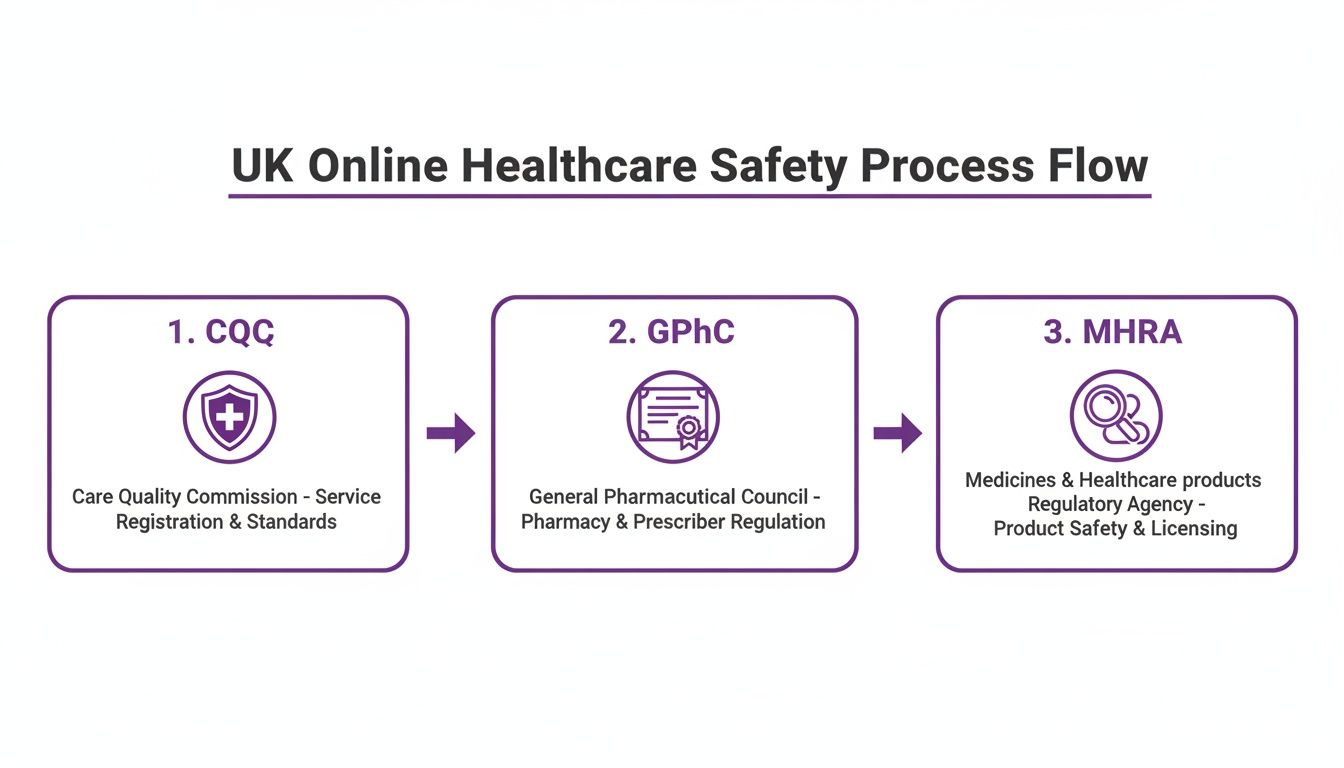
This robust oversight means patients are protected by the same high standards of care, whether they consult a doctor in-person or online.
Dispensing and Discreet Delivery
Once your private prescription is approved, it is sent electronically and securely to a UK-registered pharmacy. This is a legal requirement, and you can verify a pharmacy's credentials on the General Pharmaceutical Council (GPhC) register.
The pharmacy team then dispenses your medicine. Every treatment is MHRA-approved, which guarantees it meets the UK's stringent standards for safety and quality. The medication is then placed in plain, unbranded packaging to protect your privacy and dispatched. Most reputable services use tracked, next-day delivery to ensure your treatment arrives promptly and securely.
The move towards digital healthcare is now mainstream. The NHS App has over 33 million registered users in England, representing approximately 75% of the adult population. In the last year, repeat prescription requests via the app increased by over 45%. This demonstrates that, when implemented correctly, digital health services are trusted and valued for their convenience. As you can discover more about digital prescription trends from the World Health Organization, a well-regulated digital journey can meet patient needs safely and effectively.
What Conditions Can Be Treated Online?
Online consultations are highly convenient but are not suitable for all medical conditions. Legitimate UK online doctor services are specific about the conditions they treat, focusing only on those that can be assessed safely and accurately without a physical examination.
Patient safety remains the highest priority. The conditions best suited for online assessment are typically those with clear symptoms, an established medical history, or chronic issues requiring a repeat prescription. The privacy and discretion afforded by an online service can also make it easier for individuals to seek help for personal health matters.
Common Areas for Online Prescriptions
The health concerns that work well in a digital format are generally those where a structured questionnaire, sometimes supplemented with photographs, provides a clinician with sufficient information for a safe diagnosis and treatment plan.
It is crucial to remember that these services deal with prescription-only medicines. Every treatment requires a thorough clinical review by a UK-registered prescriber before a UK-registered pharmacy can dispense it.
Common treatment categories include:
-
Weight Management: This includes clinician-led programmes that may involve prescribing MHRA-approved treatments like GLP-1 medications. Online services can effectively monitor progress, provide support, and manage repeat prescriptions based on BMI and medical history.
-
Men's Health: Conditions such as erectile dysfunction and hair loss are frequently managed online. The diagnosis often relies on the patient's history, which can be gathered discreetly and efficiently through a secure questionnaire.
-
Skincare: Many skin conditions, such as acne or rosacea, can be diagnosed and managed remotely. Patients can upload clear photographs for a clinician to review alongside their questionnaire, leading to an accurate assessment and appropriate treatment.
The guiding principle is that a remote consultation must adhere to the same high clinical standard as a face-to-face appointment. If a clinician cannot confidently make a diagnosis or believes an in-person examination is necessary, they will not prescribe and will advise you to consult your GP.
Why This Model Works Safely
The effectiveness of managing these conditions online stems from the use of strict, evidence-based clinical protocols. For example, before prescribing medication for erectile dysfunction, a clinician must carefully assess a patient's cardiovascular health—a task for which a detailed questionnaire is well-suited.
Similarly, for hair loss treatments, the diagnosis is often straightforward based on the described pattern of loss. The assessment then focuses on ensuring there are no underlying health issues and that the proposed treatment is safe for the individual.
This focused approach allows online services to provide efficient, effective care for specific health needs, complementing the broader services offered by the NHS. By limiting their scope to areas where remote assessment is clinically appropriate, these platforms maintain high safety standards while improving access to essential treatments.
To explore some of the specific prescription-only treatments available following a consultation, you can find a detailed overview of various health categories.
Costs and Delivery Explained
When considering a prescription from an online doctor in the UK, understanding the cost structure is important. It operates differently from the NHS.
With a private online service, you are paying for the convenience, speed, and discretion of the medical advice and treatment. The price is not subsidised; it reflects the full cost of the clinician's time and the medication. This model allows these services to provide high-quality, regulated care as an alternative to the traditional NHS route.
Breaking Down the Total Cost
A reputable provider will always be transparent about the total cost before payment, with no hidden fees.
Typically, the price comprises three elements:
- The Private Prescription Fee: This covers the clinician's time to professionally review your clinical assessment, make a diagnosis, and issue a valid private prescription if appropriate.
- The Medication Cost: This is the price of the MHRA-approved medicine, dispensed from a UK-registered pharmacy. Unlike the flat NHS prescription charge in England, this is the full cost of the specific drug.
- Delivery Charges: This covers the cost of shipping your treatment to you, usually via a tracked and insured service.
The fee you pay funds the entire clinical service—the safety checks, secure technology, and the professional team ensuring every step meets the highest UK standards.
The Delivery Process Explained
Once your prescription is approved and dispensed by the pharmacy, the final step is secure, prompt, and private delivery.
A key feature is discreet packaging. Your parcel will arrive in a plain, unbranded box or envelope, with no external indication of its contents, protecting your privacy.
Furthermore, tracked shipping is standard practice. This allows you to monitor your parcel's journey from the online pharmacy to your door, providing an estimated delivery time. For many patients needing to start a prescription-only treatment promptly, the option of next-day delivery is a significant benefit. To learn more, see our guide on online pharmacy next-day delivery.
How to Choose a Safe Online Pharmacy

When seeking a UK online doctor prescription, ensuring the service is safe and legitimate is paramount. Convenience must be matched by the same safety standards expected from a local GP or pharmacy. A professional provider will be transparent about their identity and operational processes, making it easy to verify their credentials.
Distinguishing between a genuine medical service and an unregulated website is vital for your health. Unregulated sites may sell counterfeit medicines, bypass essential health checks, or lack qualified medical professionals.
Fortunately, UK regulations provide a clear framework for verification. By knowing what to look for, you can confidently select a trustworthy provider.
Verifying Regulatory Credentials
First, confirm that the service is properly regulated by UK healthcare authorities. This is non-negotiable.
-
GPhC Registration: Any online pharmacy operating legally in Great Britain must be registered with the General Pharmaceutical Council (GPhC). A reputable provider will display its GPhC registration number, often in the website footer. You should use this number to check the official GPhC pharmacy register.
-
MHRA Approval: The prescribed medication must be MHRA-approved. This guarantees the treatment is genuine, has passed strict safety tests, and is effective for its intended purpose. Legitimate services will only ever dispense medicines that meet these UK standards.
-
CQC Registration (for services in England): If the online service provides clinical consultations, it must be registered with the Care Quality Commission (CQC). The CQC is the independent regulator of health and social care in England, ensuring services are safe, effective, and well-managed.
If you cannot easily find and verify these registrations, it is a significant warning sign.
Essential Trust and Safety Signals
Beyond official registrations, other common-sense checks can help differentiate professional services from untrustworthy ones.
A trustworthy service will always provide a verifiable UK address and clear contact methods, such as a phone number or a secure messaging portal. Be cautious of any site that only offers a generic contact form. You should also be able to find information about the UK-registered doctors or pharmacists involved in your consultation.
Your medical data is highly sensitive, so ensure the provider has a clear privacy policy that complies with UK GDPR. Finally, consult independent patient reviews on platforms like Trustpilot to gain insight into the service's real-world performance. For more information, you can explore what sets a reliable UK online pharmacy apart.
Regulated Provider vs Unregulated Website: A Checklist
This comparison table highlights the key differences between a safe, regulated provider and a potentially risky, unregulated website.
| Feature | Regulated UK Provider | Unregulated Website |
|---|---|---|
| GPhC Logo & Number | Clearly displayed and verifiable on the GPhC register. | Missing, fake, or links to a non-functional page. |
| UK Clinicians | Information on GMC/GPhC registered clinicians is available. | No named clinicians, or details are vague and unverifiable. |
| Prescription Required | Always requires a prescription following a clinical assessment. | Sells prescription-only medicine without a prescription. |
| Physical Address | A verifiable UK-based address is provided. | No address, a P.O. Box, or an overseas location. |
| Contact Methods | Offers a UK phone number and secure patient support. | Only a basic contact form or email address is available. |
| Data Privacy | Has a clear, UK GDPR-compliant privacy policy. | Vague or non-existent privacy policy. |
| MHRA-Approved Meds | Exclusively dispenses official, MHRA-approved medication. | May sell counterfeit, expired, or unapproved drugs. |
Always perform these checks before using an online service to protect your health.
Medication adherence is a significant challenge in the UK. A 2026 survey found that 37% of UK adults with a prescription reported not taking their medicine as directed over the past year. This non-adherence is estimated to cost the NHS in England over £420 million annually in wasted medication. These figures underscore the importance of accessible and supportive digital healthcare services, such as online consultations and reliable prescription delivery. You can read more about the findings on UK medication adherence.
Frequently Asked Questions
It is natural to have questions when using online healthcare services for the first time. Below are clear answers to some of the most common queries about obtaining a prescription from an online doctor in the UK.
Are Online Prescriptions Legal in the UK?
Yes, they are completely legal and valid, provided they are issued correctly. A legitimate online prescription must be issued by a qualified UK prescriber—such as a GMC-registered doctor or a GPhC-registered pharmacist independent prescriber—following an appropriate online consultation.
The medication must then be dispensed by a UK-registered pharmacy that is regulated by the GPhC, adhering to the same standards as a high-street pharmacy.
Can I Obtain Any Medication Online?
No, and this is an essential safety measure. Reputable online services will only prescribe treatments for conditions that can be safely diagnosed and managed remotely.
This means that prescriptions for certain medications will not be issued online. This includes controlled drugs, high-risk medicines, and any treatment requiring a physical examination or close in-person monitoring. Patient safety is the guiding principle; a clinician will only prescribe when they are confident it is clinically appropriate and safe.
Should I Inform My NHS GP?
It is good medical practice to keep your NHS GP informed about any medications you are taking, including treatments obtained from a private online service.
This ensures your medical record remains comprehensive and up-to-date, which is vital for your long-term health. Reputable online providers will encourage this communication and, with your consent, can send details of your treatment directly to your GP.
How is My Identity Verified?
To prevent fraud and ensure treatment is provided to the correct individual, all legitimate UK services have robust identity verification procedures. This typically involves securely uploading a form of photographic ID.
Your medical history is collected through a detailed clinical questionnaire, providing our prescribers with the information needed to make a safe clinical decision, similar to the information gathered in a face-to-face appointment. The entire process is designed to be both thorough and secure.
At XO Medical, our process is designed to provide safe, regulated, and straightforward access to healthcare. From the online consultation with a UK-registered clinician to the discreet delivery of your MHRA-approved treatment from our UK-registered pharmacy, we are committed to the highest standards of care. Begin your secure consultation today.
This content is for informational purposes only and does not constitute medical advice. Always consult a qualified healthcare professional before starting or changing any treatment.


0 comments