


You've just been prescribed Betnovate Scalp Application, or you're holding a bottle you've obtained through a UK pharmacy, and the instructions seem simple: apply it to the scalp. The practical questions usually come afterwards. How do you reach the skin through your hair? How much is enough? Should you dry your hair first, and what happens if the problem returns?
Betnovate Scalp Application is a prescription-only topical corticosteroid. It can calm inflammation in certain scalp conditions when used for the course and frequency chosen by a qualified prescriber, but it isn't a general-purpose dandruff lotion, antifungal medicine or hair-growth treatment. The advice below is educational, not personalised medical advice. Use the product only under the supervision of a UK-registered clinician and follow the label supplied with your prescribed medication.
If you're researching scalp symptoms because you're unsure whether the issue is inflammation or hair loss, a clear explanation of the difference between telogen effluvium and androgenetic alopecia may help you prepare better questions for a clinician.
Table of Contents
- What This Guide Covers and Who It Is For
- Understanding Betnovate Scalp Application
- How to Apply Betnovate to Your Scalp Step by Step
- How Much to Use and How Often
- Common Mistakes and How to Avoid Them
- Side Effects, Withdrawal and When to Stop
- Frequently Asked Questions About Betnovate Scalp Application
What This Guide Covers and Who It Is For
This guide is for UK adults who've been prescribed Betnovate Scalp Application, are considering an online pharmacy consultation, or want to understand what the treatment does before speaking to a clinician. It explains what's in the bottle, why the formulation suits a hair-bearing scalp, and how to apply a thin layer to the affected skin rather than spreading it through the hair.
The application technique matters. A common mistake is squeezing the liquid over the hair and assuming it will reach the scalp. The intended target is the exposed, inflamed skin, so parting the hair and placing the nozzle close to the affected area are important practical steps. The guide also covers natural drying, the reason to avoid immediate hair-dryer use, and how to think about the amount supplied by a pharmacy.
You'll also find guidance on frequency, treatment duration, missed applications, other scalp products, and questions about coloured hair, pregnancy, breastfeeding and children. The product information recommends a treatment pattern that changes once improvement becomes noticeable, so running out without a review plan isn't ideal.
Clinical boundary: Online information can help you use a prescribed medicine correctly, but it can't confirm your diagnosis or decide whether a steroid is suitable for you.
A UK-registered pharmacy should dispense the quantity authorised by the prescriber and give directions consistent with the current product information. If you're using an online pharmacy, check that the service uses a proper clinical assessment and that its pharmacy is regulated by the GPhC. Your pharmacist or prescriber should also know about other treatments you use on the scalp.
Understanding Betnovate Scalp Application
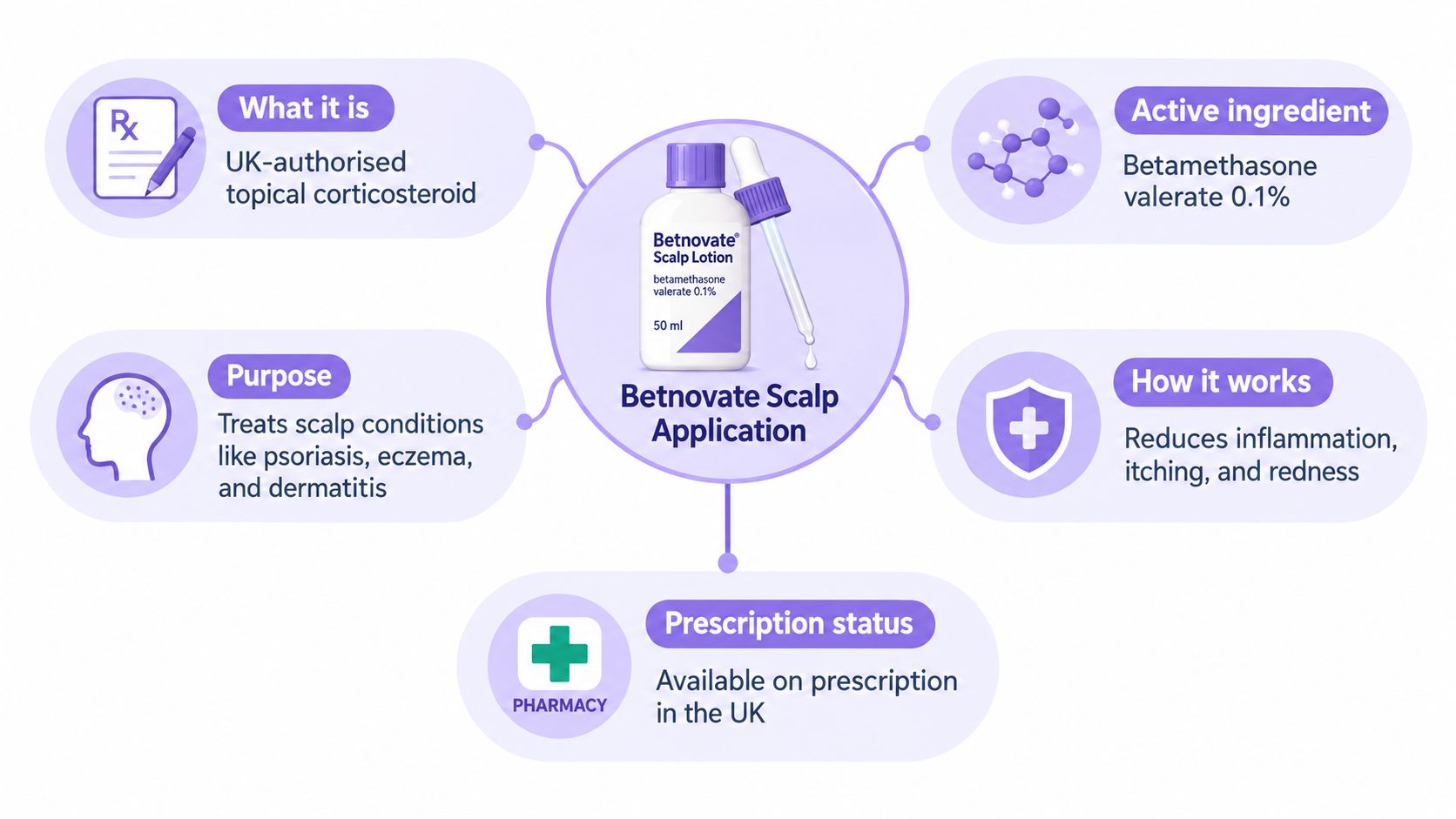
You open the bottle expecting a shampoo, then notice the watery liquid. Betnovate Scalp Application is a UK-authorised aqueous suspension containing betamethasone valerate, a potent corticosteroid for certain inflamed scalp conditions. The professional product information gives its strength as 0.122% w/w and places it under ATC code D07AC, the category for potent dermatological corticosteroids. (UK Summary of Product Characteristics)
The patient leaflet describes the contents differently, stating that each 10 ml contains 0.01 ml of betamethasone as valerate, or 0.1% w/w. These descriptions should not be converted into a different dose by the patient. The difference reflects how the suspension is standardised. Your prescriber's directions and the dispensing label govern the amount you use.
Its licensed role is to treat steroid-responsive scalp dermatoses, including psoriasis, seborrhoeic capitis and inflammation linked with severe dandruff. Betamethasone valerate reduces inflammatory activity in the skin, which can ease redness, irritation and itching when those symptoms come from a corticosteroid-responsive condition.
Betnovate Scalp Application is an anti-inflammatory treatment, not an antifungal, antibacterial or hair-growth medicine. If infection may be involved, or the diagnosis is uncertain, seek clinical advice before using it. A steroid can reduce visible inflammation while leaving another cause untreated.
Why the formulation matters
An aqueous suspension flows more easily than an ointment, making it practical for a hair-bearing scalp. It is still medicine for the affected skin, rather than a product to spread through the hair. Hair can act like a curtain, so the prescribed areas need to be exposed before application.
Flaking, irritation and hair shedding can occur alongside scalp inflammation, but they do not identify the cause by themselves. If thinning is your main concern, read about effective treatments for thinning hair and discuss the pattern with a qualified professional. For washing advice, see this guidance on shampoo for psoriasis.
How to Apply Betnovate to Your Scalp Step by Step
Start by washing your hands. If you've washed your hair, make sure the scalp is completely dry before applying the medicine. Wet hair can make it harder to see the affected skin and may cause the liquid to spread unpredictably.
Part the hair with your fingers or a comb so that you can see the inflamed area. You don't need to treat every strand. Betnovate Scalp Application is intended for the scalp, so focus on the patches identified by your prescriber rather than coating healthy skin or the length of the hair.
Place the bottle nozzle directly against, or very close to, the affected scalp. Squeeze out a small amount and distribute it as a thin, even layer. Aim for coverage of the affected skin, not a visibly wet or heavily coated area. The prescribed amount must not be exceeded.
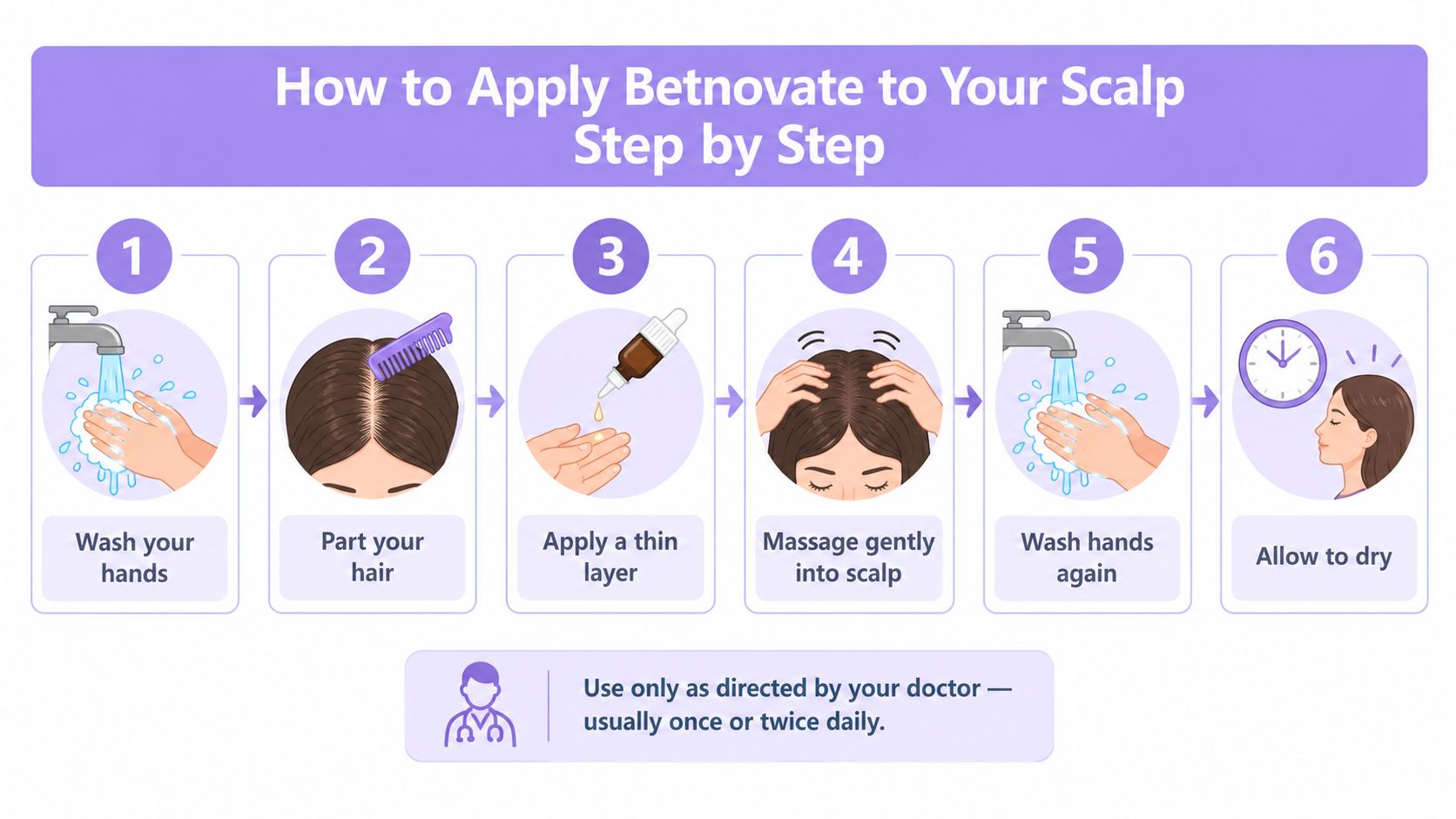
Rubbing the liquid in is optional. If you do so, use gentle fingertips rather than scratching with your nails. Once the affected areas have been covered, let the liquid dry naturally. Don't use a hair dryer immediately after application, particularly on a hot setting. NHS guidance advises allowing the product to dry naturally. (NHS guidance on using betamethasone for skin)
Wash your hands again after applying it, unless your hands are the area being treated. The UK professional directions recommend application in the morning and evening until noticeable improvement occurs, followed by a reduction to once daily or less often to maintain control. Your own label or prescriber's directions take priority.
For general context on applying treatments to the scalp, you can also read how to use minoxidil. Minoxidil is a different medicine with a different purpose, so don't substitute one product for the other.
How Much to Use and How Often
Start with the smallest amount that gives thin coverage of the affected scalp. The liquid should reach the skin, not saturate the hair. Applying more will not necessarily improve control and can increase corticosteroid exposure without a useful benefit. Follow the quantity on your prescription or the directions given by your pharmacist.
The UK professional directions recommend a small amount in the morning and evening until noticeable improvement occurs. Once symptoms are controlled, treatment may be reduced to once daily or less often to maintain control. Use the reduction set out by your prescriber, particularly if the condition keeps returning.
An NHS prescribing formulary gives a practical benchmark of approximately 15 to 30 g for an adult using a scalp corticosteroid once daily for two weeks. This is a planning guide, not a personal dose. Your requirement depends on the size of the affected area, hair density, application frequency and formulation. (NHS prescribing formulary guidance)
| Aspect | Guidance | Source |
|---|---|---|
| Initial frequency | Morning and evening until noticeable improvement | UK Summary of Product Characteristics, as linked earlier |
| Later frequency | Reduce to once daily or less often to maintain control, as directed | UK Summary of Product Characteristics, as linked earlier |
| Quantity benchmark | Approximately 15 to 30 g for an adult using one daily application for two weeks | NHS prescribing formulary guidance |
A bottle running out sooner than expected is a reason to contact the prescriber or pharmacy. Avoid stretching applications unpredictably or requesting repeated supplies without assessment. The review can check whether the diagnosis remains appropriate, whether the inflammation is controlled and whether your treatment frequency should change.
If a bottle lasts much longer than expected, arrange the planned review rather than continuing automatically. The bottle's duration is useful information about how much scalp you are treating and whether the current plan still fits.
Common Mistakes and How to Avoid Them
The most frequent practical error is treating the hair instead of the scalp. Liquid on the hair shaft doesn't address inflamed skin effectively, while spreading it across unaffected areas increases unnecessary exposure. Part the hair, work in small areas and apply only where the condition is present.
Heat is another avoidable problem. Applying the medicine and then using a hair dryer immediately can irritate the scalp and conflicts with NHS advice to let the product dry naturally. A tight hat, shower cap or other covering may also increase occlusion, so don't cover the treated scalp unless a clinician specifically tells you to.
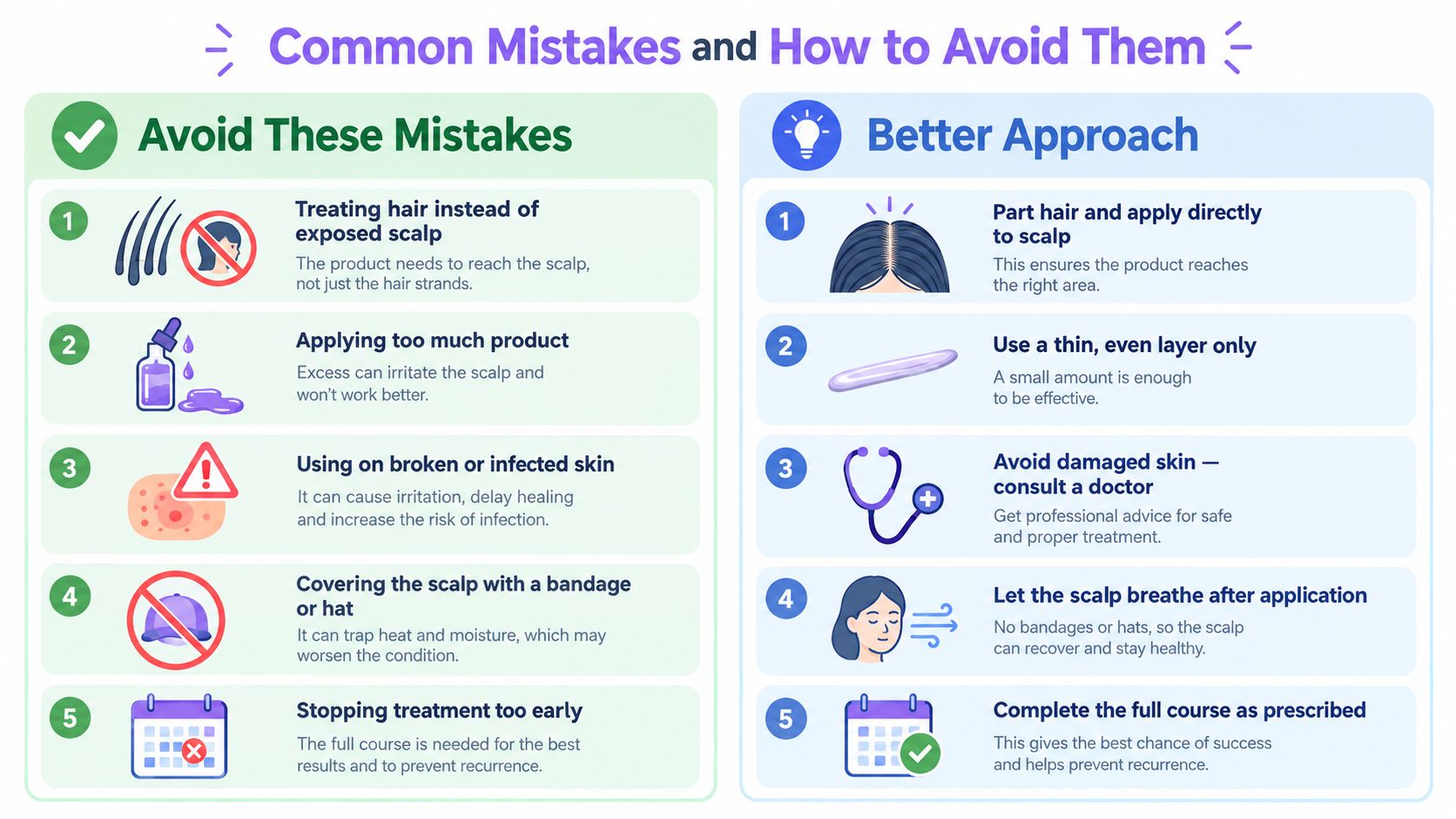
Keep this short checklist beside the bottle:
- Target the skin: Part the hair and apply directly to visible affected scalp.
- Keep the layer thin: Don't assume severe itching requires a larger quantity.
- Avoid damaged areas: Speak to a clinician before applying to broken or possibly infected skin.
- Let it dry naturally: Avoid immediate hair-dryer use and unnecessary covering.
- Review prolonged use: Don't continue daily for many weeks or months unless directed by a clinician.
The patient information specifically warns against continuous daily use for long periods unless a healthcare professional has advised it. If symptoms return after treatment, arrange a review rather than repeatedly restarting the same course on your own.
Side Effects, Withdrawal and When to Stop
A small amount of stinging or irritation can occur with topical medicines, but persistent or worsening discomfort needs attention. Betamethasone valerate can also cause local problems associated with corticosteroid use, including skin thinning, visible small blood vessels and changes in skin colour, particularly when used inappropriately or for prolonged periods.
The MHRA warns that topical corticosteroid withdrawal reactions can occur after prolonged, frequent or inappropriate use, especially with moderate- to high-potency products. Symptoms may appear days or weeks after stopping. They can include redness extending beyond the treated area, burning or stinging, intense itching, peeling, or oozing open sores. (MHRA safety guidance on topical steroid withdrawal)
When to seek advice: If symptoms worsen within two weeks of stopping, don't restart the corticosteroid without consulting a doctor unless you've previously been told to do so.
Contact a prescriber or pharmacist if the condition isn't improving as expected, if the scalp becomes increasingly painful, or if you notice signs that could indicate infection. Seek urgent medical attention for a serious allergic reaction, such as swelling of the face or difficulty breathing.
The safest general approach is to use the lowest effective potency for the shortest necessary time, with a gradual reduction in frequency or strength considered after prolonged treatment. That decision belongs with the clinician managing your condition. For broader information on protecting irritated skin, see skin barrier repair, but don't use general skincare advice as a substitute for assessment of a worsening scalp problem.
Frequently Asked Questions About Betnovate Scalp Application
Can I use it on coloured or chemically treated hair?
The medicine is applied to the scalp, not the hair, so parting the hair helps reduce contact with coloured or chemically treated lengths. The product information doesn't make it a hair-colour treatment, and individual products used during colouring may irritate the scalp. Ask a pharmacist or prescriber if your scalp has recently been coloured, bleached, relaxed or otherwise chemically treated.
Can I use coal tar or salicylic acid shampoo with it?
These products may be used in some scalp conditions, but compatibility depends on your diagnosis, skin condition and treatment schedule. Coal tar and salicylic acid products can irritate or dry the scalp, so don't add them to a prescribed regimen without checking with a UK-registered pharmacist or prescriber. Use any medicated shampoo exactly as directed and ensure the scalp is dry before applying Betnovate.
Is it suitable for children, pregnancy or breastfeeding?
Don't assume it's suitable without individual advice. A prescriber needs to consider age, the area being treated, duration, potency and the reason for use. During pregnancy or breastfeeding, tell the prescriber and pharmacist before starting or continuing treatment, and don't apply it to the breast where an infant could ingest it unless specifically advised.
What if I miss an application?
Apply it when you remember unless it's nearly time for the next application. Don't double the amount to compensate. If you're unsure, follow the dispensing label or ask your pharmacist, particularly if you've missed several applications or your symptoms are worsening.
If you need a prescription-only treatment, use a service that provides a genuine clinical assessment and supplies medication through a UK-registered pharmacy regulated by the GPhC. XO offers clinician-led online pharmacy services and educational support for prescription treatments, with XO available for information about its regulated healthcare options and consultation process. Bring your current product, symptoms and treatment history to the consultation so a clinician can decide what's appropriate.


0 comments