


You've lightened your hair, rinsed it off, dried the front pieces and noticed the same problem many people see in the mirror. The blonde isn't icy or beige. It's orange through the mid-lengths, warm at the ends, and nothing like the photo that made sense when the bleach first went on.
That's usually when a bottle labelled blue toner enters the story. Sometimes it helps. Often it's the wrong product, used on the wrong hair, for the wrong reason.
Blue hair toner can be useful, but only when you understand what it's built to do. In the UK, hair colouring remains highly mainstream. 85% of people dye their hair, 58% use DIY colouring at home, and 23% were considering at-home hair dye in the next 12 months, according to Garnier's UK report cited by CEW UK. That matters because toner sits inside a wider home-maintenance routine, not just salon correction.
Blue toner also isn't new. The UK hair colourants market was estimated at £306 million in 2019, with Mintel reporting a 1.6% decline that year and forecasting further downward pressure afterwards, while older blue rinses have been part of British hair culture since the 1930s, as noted by Cosmetics Business summarising Mintel. Modern blue toner is more advanced than a classic blue rinse, but the same basic principle still applies. It's a maintenance product, not a magic reset.
Table of Contents
- What Blue Hair Toner Actually Does
- The Colour Wheel Logic Behind Blue Toner
- Hair Levels and Tones That Respond to Blue
- How to Apply Blue Toner at Home or in Salon
- How Long Blue Toner Lasts and Why It Fades
- When Blue Toner Is the Wrong Choice
- Safety, Allergy Testing and Compatibility With Other Treatments
- Choosing Blue Toner With Confidence
What Blue Hair Toner Actually Does
Blue hair toner is a corrective colour product. Its job is to deposit blue pigment onto hair that has already been lightened and developed orange or copper warmth.
It doesn't bleach hair. It doesn't lift natural pigment. It doesn't turn a dark brunette into a cool blonde. It changes the tone you see, not the depth you started with.
The simple definition
Think of blue toner as a filter rather than a remover. If the hair has been lifted enough for orange warmth to show through, a blue-based formula can cool that warmth visually.
UK retail guidance is clear that blue toner is best suited to brunette hair with orange tones, and that semi-permanent toning results commonly last about 6 to 10 washes, while demi-permanent results commonly last about 12 to 28 washes, according to Sally Beauty UK guidance on choosing toner.
Practical rule: Blue toner is for orange brassiness. If the problem is dark hair, uneven lift, or strong yellow, you're solving the wrong issue with the wrong tool.
What people often expect by mistake
Most misuse starts with one of these assumptions:
- “It will lighten my hair.” It won't. Toner deposits pigment. It doesn't remove melanin.
- “It will make my hair blue.” Usually not. Corrective blue toner and fashion blue colour are not the same thing.
- “If purple shampoo didn't work, blue toner must be stronger.” Sometimes the issue isn't strength. It's choosing the wrong undertone.
If your concern is blonde maintenance rather than orange correction, it helps to understand the difference between blue and violet products. A straightforward guide to neutralizing brassiness with purple shampoo can help you spot when yellow, not orange, is the problem.
Where blue toner fits
Used properly, blue toner suits hair that has already been lifted and now looks too coppery. Used badly, it leaves the hair dull, smoky, or faintly green.
That's why the important questions aren't “Which blue toner should I buy?” but “What level is my hair?”, “Is the warmth orange?”, and “How porous are the ends?”
The Colour Wheel Logic Behind Blue Toner
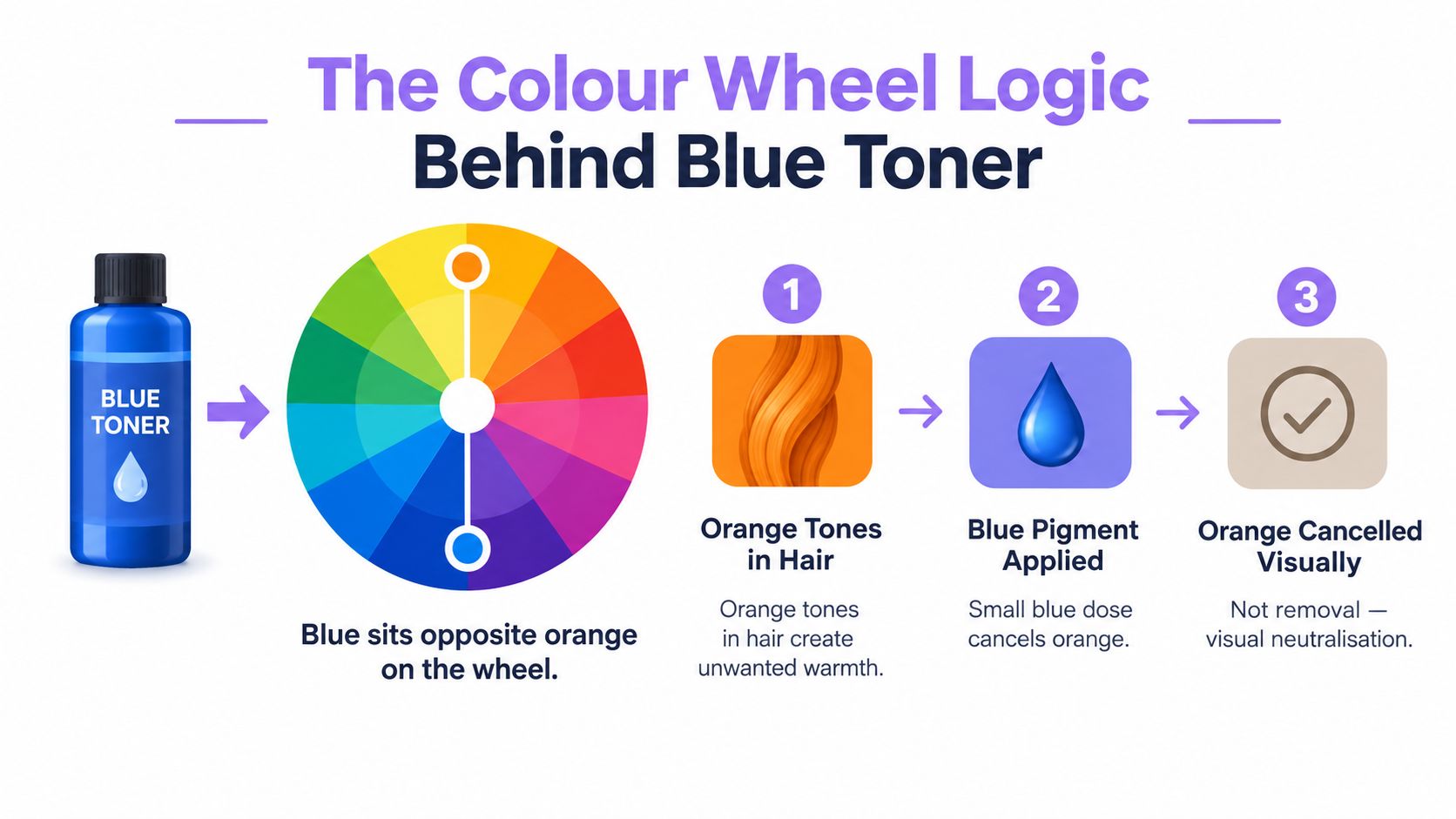
Blue toner works because blue sits opposite orange on the colour wheel. When you place a small amount of blue pigment over orange-looking hair, the eye reads less warmth.
That's visual neutralisation. It isn't pigment removal.
What the blue pigment is actually doing
If hair lifts from a warm brunette or dark blonde base, it often exposes coppery or orange undertones. A blue toner places cool pigment over that exposed warmth, so the final shade looks more balanced.
This only works when the underlying warmth is the right kind of warm. Blue doesn't cancel every version of brass.
A quick visual explanation can help if colour theory feels abstract.
Semi-permanent and demi-permanent formulas
The formula matters because not all toners behave the same way on the hair fibre.
- Semi-permanent toner sits more superficially and adds tone without developer.
- Demi-permanent toner uses a mild developer to help deposit colour more securely.
UK salon education sources stress that toner deposits pigment into the hair shaft without lifting natural colour and commonly recommend a mild developer, usually 10 volume, with processing kept under 30 minutes, according to Haircare Heaven's technical explanation of toner use.
Why over-toning looks muddy
A little blue can neutralise orange. Too much blue can make the hair look flat, smoky, or slightly green, especially on porous lengths.
Blue toner should make unwanted orange less visible. If you can clearly see blue, grey-green, or murky khaki, the formula has gone past neutralisation and into over-deposit.
That's the main difference between good toning and panic toning. Good toning aims for balance. Panic toning usually chases “cooler” until the hair stops looking natural.
Hair Levels and Tones That Respond to Blue
The best candidates for blue toner are usually hair levels where orange warmth is still visible after lightening. In practice, that often means darker blonde to light brown territory rather than very pale blonde.
Blue toner is technically suited to brunette and dark-blonde hair because blue pigments neutralise orange warmth. UK guidance also notes that it works best when the concern is orange or copper brassiness after lightening, not yellow brassiness or lack of lift, as explained by Sally Beauty UK.
The useful way to assess your hair
Look at the warmth in daylight, not under a bathroom bulb. Ask a narrow question: does the hair read orange/copper, or does it read yellow/gold?
That distinction matters more than the word “brassy”, because people use that one word for several different problems.
Blue vs purple toner
| Underlying Warmth | Best Toner Direction | Typical Hair Level |
|---|---|---|
| Orange or copper | Blue | Dark blonde to light brown, often after lifting brunette hair |
| Yellow | Purple or violet | Lighter blonde |
| Yellow-orange mix | Depends on what dominates | Mid to lighter lifted levels |
Where readers get caught out
Hair that started darker often throws more orange as it lifts, which is why blue-based correction is so common after bleaching brunette hair. By contrast, pale blonde hair usually shows yellow rather than orange, so blue is often too heavy-handed.
Very porous ends are another problem. They grab cool pigment quickly and can turn drab before the healthier parts of the hair have toned enough.
If you're assessing lighter lengths, highlights, or added hair pieces, this guide to blonde extension blending tips can be useful because extension colour matching often exposes whether the issue is orange depth, yellow brightness, or simple mismatch.
If the hair looks buttery or pale gold, blue toner usually isn't the answer. If it looks coppery or burnt orange, blue is more likely to make sense.
How to Apply Blue Toner at Home or in Salon
Application is where good colour theory often falls apart. The bottle may be correct, but the hair is too wet, too coated in conditioner, too porous at the ends, or processed for too long.
Clean, towel-dried hair gives the most predictable surface for deposit. Heavy silicone leave-ins and rich masks can block even uptake, so the toner clings in patches instead of laying down evenly.
Before you start
A few habits reduce avoidable mistakes:
- Strand test first. Use a small hidden section underneath. This shows how quickly your hair absorbs blue.
- Check the canvas. Toner works predictably on pre-lightened hair, not on untouched dark roots.
- Avoid overlap. Re-toning old porous ends while trying to fix fresher mid-lengths is a common cause of murky colour.
Semi vs demi in practical use
Semi-permanent formulas don't need developer and are usually more forgiving. Demi-permanent toners are stronger correction tools, but they need careful timing and product choice.
For demi use, UK educational guidance commonly points to 10 volume developer and processing kept under 30 minutes, especially because toner deposits rather than lifts, as described by Haircare Heaven.
At-home vs salon blue toner application
| Factor | At-Home Application | Salon Application |
|---|---|---|
| Colour assessment | Depends on your eye and lighting | Usually more accurate because the hair is assessed professionally |
| Formula choice | Limited by what you buy | Better matched to level, warmth, and porosity |
| Risk of over-toning | Higher, especially on porous ends | Lower if sectioned and timed carefully |
| Convenience | Immediate and private | Requires booking and travel |
| Correction of uneven hair | Harder to manage | Easier to customise by section |
Watch the hair while it develops. If the ends start looking smoky before the mids have cooled enough, rinse. That's your warning sign.
People often underestimate the value of process in hair work. The same is true in other appearance-led routines. A structured guide like how to use minoxidil safely and consistently isn't about toner, but it shows the same principle: products work better when timing, technique, and consistency are correct.
How Long Blue Toner Lasts and Why It Fades
Blue toner doesn't stay at the same intensity from day one until it disappears. It softens gradually, often unevenly, because the most porous parts of the hair release pigment differently from the healthiest parts.
The most reliable figures available here come from UK retail guidance. Semi-permanent formulas commonly last around 6 to 10 washes, and demi-permanent formulas commonly last around 12 to 28 washes, according to Sally Beauty UK.
Why the tone drops away
Blue toner fades because deposited pigment isn't permanent. Every wash, heat session, and environmental exposure nudges some of that surface or near-surface colour out of the hair.
The fading also shows up faster when the original correction was doing a lot of work. If the hair underneath is strongly orange, even a modest fade can make warmth visible again quite quickly.
What shortens wear time
Several day-to-day factors make blue toner disappear faster:
- Hot water washing opens the cuticle more and encourages colour loss.
- Harsh cleansing can strip deposited tone sooner.
- Swimming and sun exposure can leave cool shades looking less clean.
- Frequent heat styling tends to dry and roughen already lightened hair.
Porosity changes the pattern
High-porosity hair often takes toner quickly and loses it quickly. Low-porosity hair can resist initial uptake, but once tone settles evenly it may look more stable.
A useful way to think about maintenance is not “How long should toner last?” but “How fast does my hair reveal warmth again?” Product build-up can also distort tone, which is why broader hair-cleansing routines matter. Readers who are troubleshooting residue and dullness may also find apple cider vinegar shampoo and scalp build-up guidance relevant when trying to keep coloured hair looking cleaner between toning sessions.
When Blue Toner Is the Wrong Choice
Some of the worst blue toner results come from using it on hair that never needed blue in the first place.
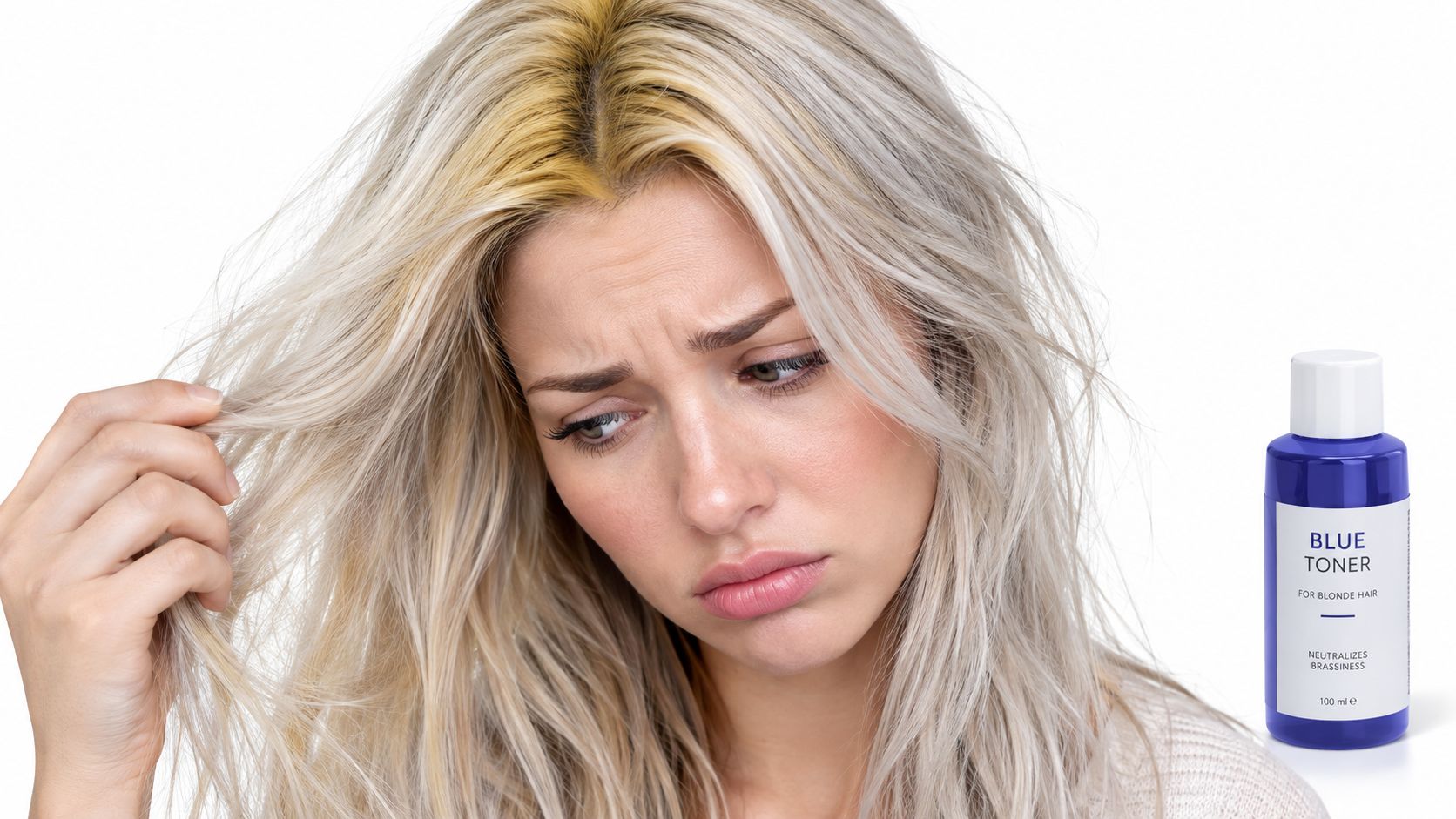
If the hair is very pale blonde and the visible warmth is yellow, blue is often too cool and too heavy. Instead of creating a clean blonde, it can make the hair look greyish, murky, or faintly green.
Three common misuse scenarios
The confusion usually falls into three camps.
-
Pale blonde hair treated with blue toner
Yellow needs violet or purple direction, not blue-heavy correction. -
Faded green or blue-green dye treated with more blue
Adding blue to an already murky green cast doesn't neutralise it. It can deepen the swampy tone. -
Trying to get fashion-blue hair from corrective blue toner
Corrective toner won't usually create a true denim, navy, or electric blue result.
Corrective blue is not fashion blue
This distinction matters more now because trend coverage and consumer searches often mix the two ideas together. UK trend coverage for 2026 highlights electric blue, vivid blues, and blue-toned reds as projected colour directions, while consumer confusion remains common around whether toner can create those looks. The same guidance also notes that faded blue or green is better neutralised with a red-based colour, not blue toner, according to Wella UK trend and colour guidance.
If you want your hair to look actually blue, ask for a direct dye or a dedicated fashion colour. If you want less orange in lifted brunette hair, that's where blue toner belongs.
Safety, Allergy Testing and Compatibility With Other Treatments
Blue hair toner is still a hair colour product. That means safety comes before tone.
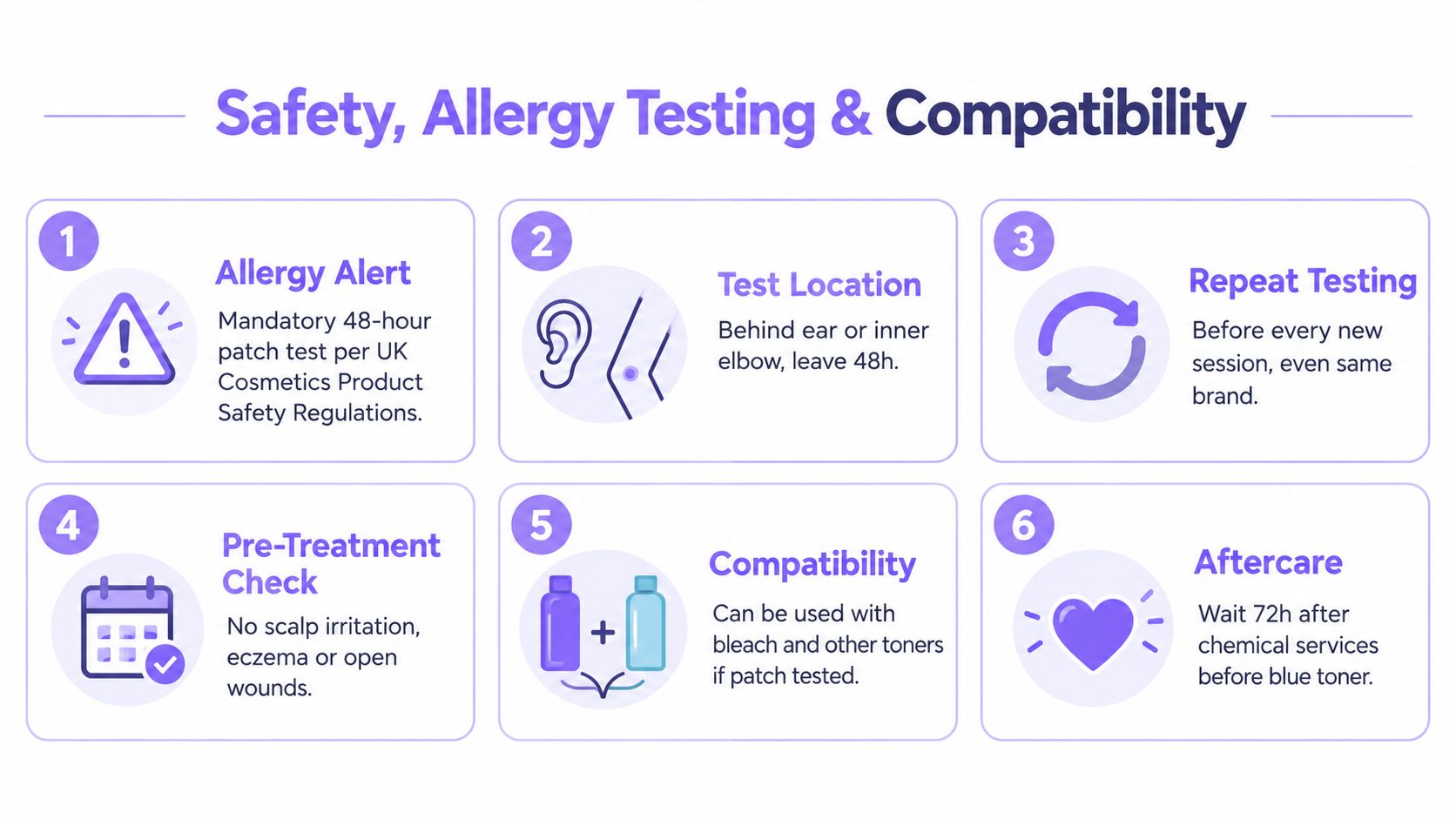
In UK practice, allergy alert testing is a routine part of using oxidative colour products. It isn't optional because you've used colour before, and it isn't optional because the brand calls itself “gentle”.
The UK allergy testing position
Industry guidance in the UK commonly requires an allergy alert test at least 48 hours before use, and the test should be repeated before each application because delayed reactions can develop over time. Some protocols also refer to testing around every six months for returning clients using the same product, according to the National Hair & Beauty Federation allergy alert testing factsheet.
The MHRA has also confirmed that Colourstart is a medicinal hair-dye screening test for people aged 16 and over, that the active patch contains 65 micrograms of PPD, and that if the patch test is positive, the hair colourant should not be used, according to MHRA guidance on Colourstart.
What patch testing does and doesn't do
Patch testing for consumer hair colour is not the same as specialist dermatology testing. UK professional and dermatology sources have said that Colourstart should not be treated as a universal substitute for formal allergy assessment, and that the Cosmetics Directive does not require manufacturers to provide self-tests or allergy alert tests, as set out in the British Society for Cutaneous Allergy response document.
If you notice itching, swelling, blistering, or breathing symptoms, don't reapply the product.
Compatibility with other hair services
Blue toner also needs a sensible compatibility check.
- Recently bleached hair may tone unevenly if the cuticle is very open.
- Previously coloured hair can hold patchy cool pigment.
- Henna or metallic salt history needs caution because outcomes are less predictable.
- Irritated scalp or broken skin means colouring should wait.
People who are already dealing with shedding, scalp irritation, or barrier problems should focus on scalp health first. General support on how to get thicker hair and improve scalp condition can be useful background before adding more chemical processing.
This content is for informational purposes only and does not constitute medical advice. Always consult a qualified healthcare professional before starting or changing any treatment.
Choosing Blue Toner With Confidence
Choosing blue toner properly is less about brand loyalty and more about honest assessment. If the hair is orange, lifted enough to show that orange clearly, and still in condition to receive pigment evenly, blue toner may be the right corrective step.
If any one of those conditions is missing, stop there and reassess.
A simple decision checklist
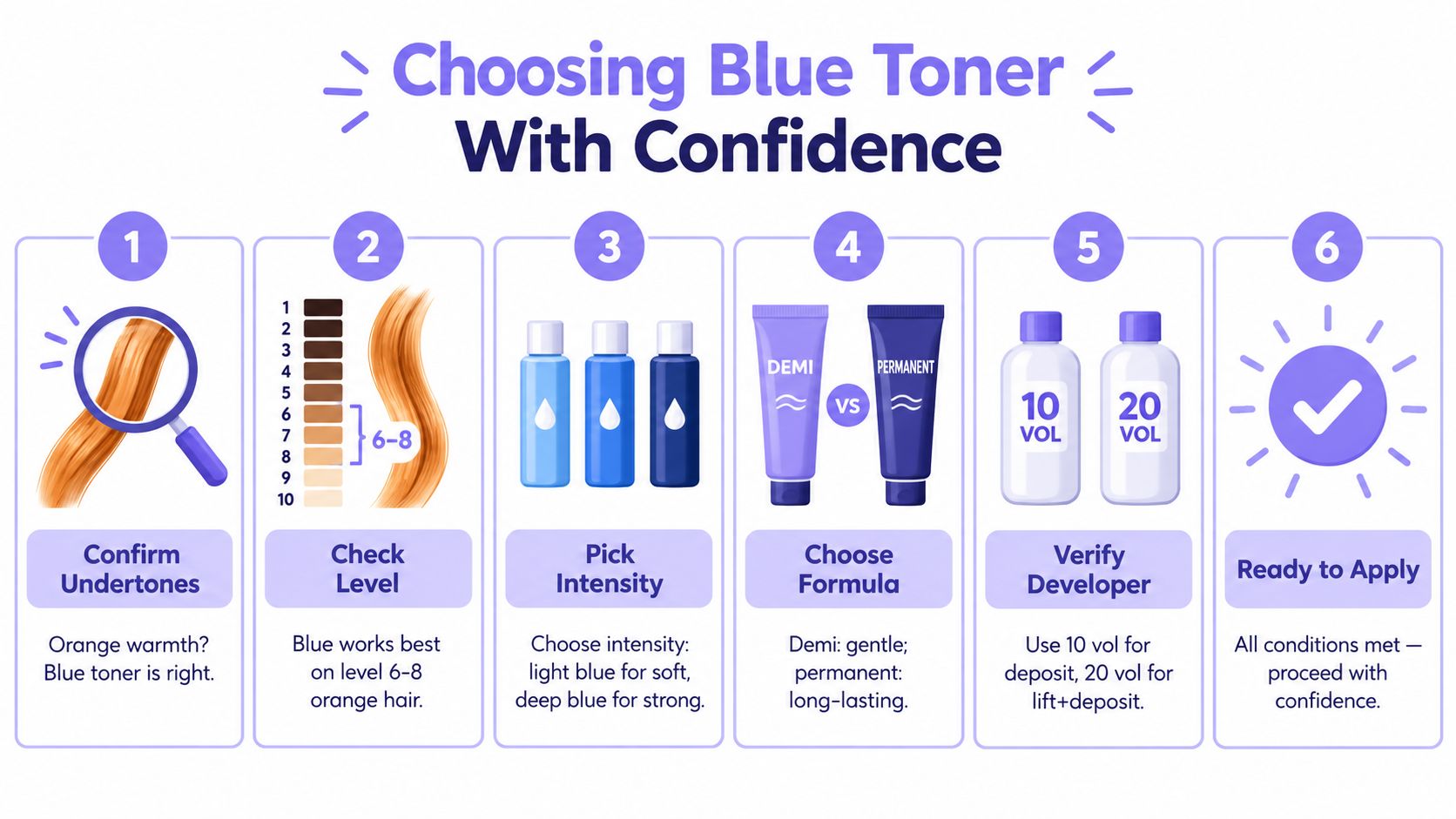
Use this checklist before you tone:
-
Confirm the undertone
In daylight, does the hair look orange or copper rather than pale yellow? -
Check the level
Blue correction makes most sense when the hair has lifted enough for orange warmth to sit visibly on the surface. -
Assess porosity
If the ends feel rough, over-processed, or absorb everything instantly, expect them to go cooler faster. -
Pick the formula type
Semi-permanent is gentler and more forgiving. Demi-permanent usually gives stronger correction and longer wear. -
Keep expectations realistic
Blue toner can cool warmth. It can't create lift, remove severe unevenness, or turn corrective colour into vivid fashion blue.
When professional help makes more sense
Salon input is usually worth it if the hair is previously box-dyed, patchily lifted, highly porous, or still visibly damaged after bleaching. Those are the situations where a technically correct formula can still produce an unattractive result because the canvas isn't stable.
The right toner on the wrong hair still gives the wrong outcome.
Review and governance notes
Reviewed by: Medical content team, editorial review standard aligned to UK regulated health publishing principles
Review date: 20 September 2026
Although this article covers hair colour rather than prescribed medication, the same principles of safe consumer guidance apply. Informational content should stay separate from personal medical advice. In UK healthcare, that means avoiding assumptions about suitability, supporting patch testing, and recognising when symptoms such as swelling or breathing difficulty need urgent professional input. It also means understanding the difference between beauty information and regulated care from an online pharmacy, a UK-registered pharmacy, or services involving prescribed medication and prescription-only treatment, particularly when those services are regulated by the GPhC. The same caution applies when choosing an in person aesthetics clinic offering botox, dermal fillers, skin boosters and polynucleotides (salmon DNA). Regulation, clinician oversight, and clear eligibility checks matter.
This content is for informational purposes only and does not constitute medical advice. Always consult a qualified healthcare professional before starting or changing any treatment.
XO brings together a UK-registered online pharmacy and a clinician-led clinic, so readers who care about safe, regulated advice can explore broader support for hair, skin, and wellbeing in one place. If you're looking for evidence-based health information, access to prescribed medication through proper assessment, or an in person aesthetics clinic offering botox, dermal fillers, skin boosters and polynucleotides (salmon DNA), visit XO.


0 comments