


You're home after a Botox appointment, looking in the mirror and wondering whether a small bump, tenderness or headache is expected. Most early reactions are local and settle, but aftercare is also a safety net: you need to know what to record, when to contact the clinic and which symptoms shouldn't wait.
Botox is a brand name commonly used for botulinum toxin treatment. This guide gives general UK aftercare information, not a personal assessment. Your treating clinician's written instructions take precedence, and you should know how to reach them if symptoms change.
Reviewed by: A named reviewing clinician and registration body haven't been provided for this article, so no reviewer attribution can be verified.
Review date: 2026
Table of Contents
- Botox Aftercare Timeline From Treatment to Four Weeks
- What to Do in the First 48 Hours and Daily Habits
- Normal Reactions and How Long They Usually Last
- Red Flags, Escalation and Choosing a Provider
- Follow-Up Visits and Symptom Tracking
-
Frequently Asked Questions About Botox Aftercare
- Does bruising mean the treatment is working?
- Should I massage the area to help it settle?
- Can I exercise or use a sauna the next day?
- Is a cold compress necessary?
- If I feel fine after a week, am I in the clear?
- Which pain relief is suitable?
- Can an online pharmacy supply Botox without a consultation?
- Is aftercare the same at every clinic?
Botox Aftercare Timeline From Treatment to Four Weeks
| Stage | Timing | What to do | What to expect |
|---|---|---|---|
| 0–4 hours | Immediately after injection | Stay upright and avoid lying flat for at least four hours. Use a gentle cold compress if swelling appears. | Minor redness, small bumps or tenderness at injection sites. |
| 4–24 hours | Day of treatment | Avoid alcohol, saunas, hot baths and strenuous exercise. Keep injection sites clean. | Mild tenderness; bruising may begin to show. |
| 24–72 hours | Days 1 to 3 | Don't rub, massage or press the treated areas. Avoid touching injection points. | Headache or swelling may peak; local effects are still settling. |
| Days 3–14 | Typical settling period | Follow clinic guidance, keep a symptom diary and contact the clinic about new symptoms. | Effects develop; the result is often assessed around two weeks. |
| Weeks 2–4 | Review window | Attend any offered follow-up and report persistent or new symptoms. | The result can be assessed. New weakness, speech, swallowing or breathing changes need urgent contact. |
These stages are general guidance. The written instructions from your treating clinician take precedence, because advice can vary with the treatment area, product and reason for treatment.
Botulinum toxin is a prescription-only medicine in the UK. It must be prescribed by an appropriate prescriber after clinical assessment, and aftercare information doesn't replace that assessment or a follow-up plan. An online pharmacy or UK-registered pharmacy can't supply it automatically. The same prescribing principle applies in an in-person aesthetics clinic, including one offering Botox, dermal fillers, skin boosters and polynucleotides. UK government safety information on botulinum toxin explains the need for appropriate prescribing and safety oversight.
Botulinum toxin's effects usually begin over several days, and the full result is commonly judged around two weeks. Don't use the first day to decide whether the treatment has worked.
Keep a record of the treatment date, product, treated areas, clinician's name and clinic contact route. Those details can help a clinician respond if you need advice later.
What to Do in the First 48 Hours and Daily Habits
The first evening after treatment, keep the written clinic instructions nearby. It is easy to forget details once you are home, so use clear time limits and record anything that changes. These steps are common aftercare guidance; some rationales are usual clinical explanations, not established effects for every patient.
- Stay upright for four hours. Avoid lying flat during this time. The usual rationale is to reduce the chance of pressure or movement affecting the treated area.
- Use a cold compress gently during the first few hours, if needed. Wrap it in clean cloth and rest it lightly on the skin. Do not press or put ice directly on your face.
- Avoid rubbing, massage or firm pressure for 24–72 hours. This includes pressing your face into a pillow or wearing a tight headband or helmet over treated areas.
- For 24 hours, avoid vigorous exercise, alcohol, saunas and hot baths, unless your clinic gives different instructions. Some hospital guidance sets a shorter minimum of three to four hours for heat and vigorous activity. Follow your treating clinician's specific directions if they differ. Hospital advice on botulinum toxin injections provides an example of written aftercare guidance.
- Keep injection sites clean. If your clinician recommends a topical product, apply it gently without rubbing.
- Note any symptom and when it starts. A brief record helps you describe whether it is settling, staying the same or changing if you contact the clinic.
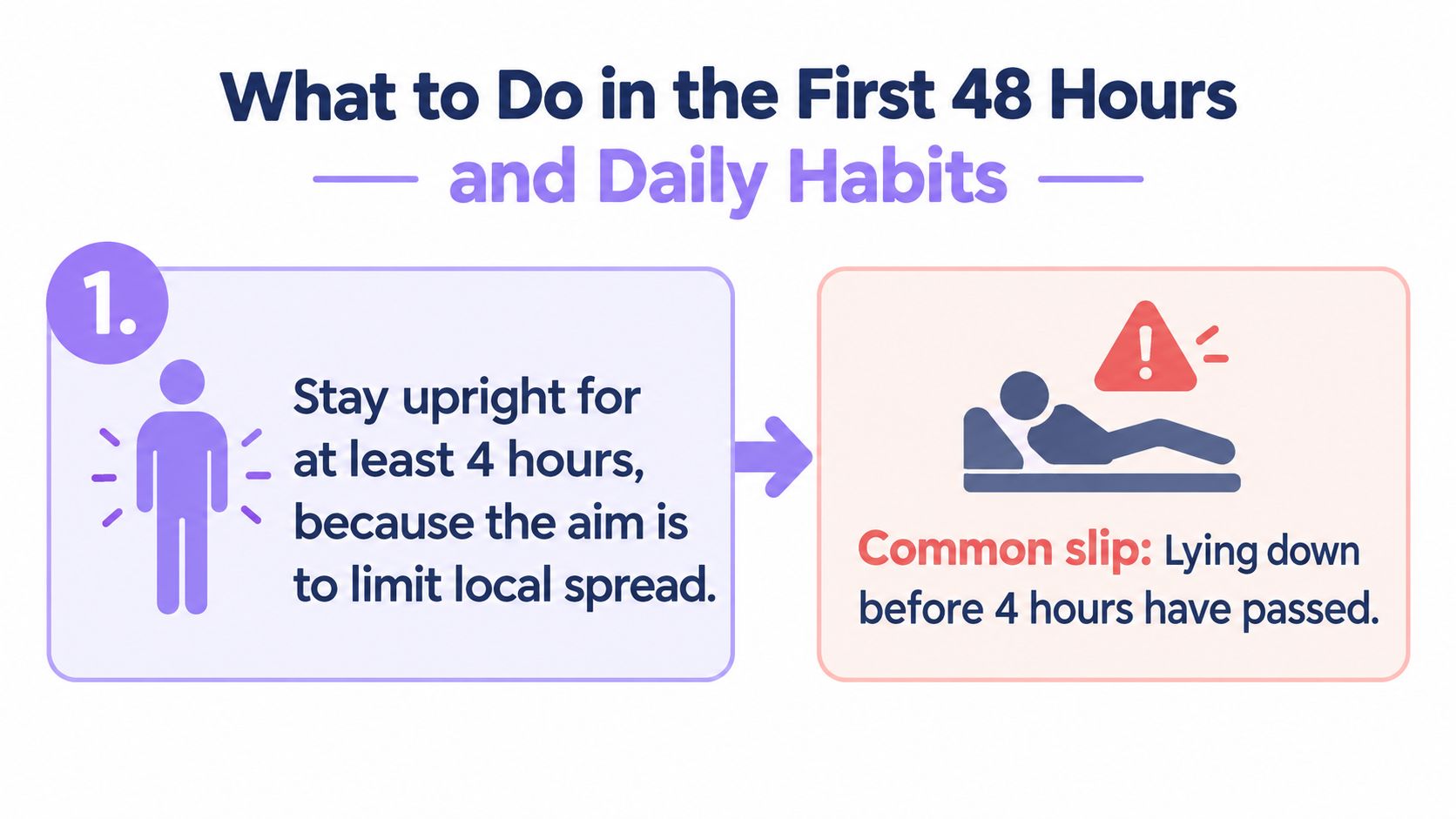
Everyday habits
| Habit | Practical approach | Evidence context |
|---|---|---|
| Sleep | Choose a comfortable position. If you sleep on your back with your head slightly raised, avoid putting pressure on treated areas. | Evidence for a specific sleeping position is limited. |
| Exercise | After the first 24 hours, return gradually. Avoid head-down positions on the first day. | This is common clinical practice; follow your clinic's advice. |
| Facial movement | Normal expressions are fine. There is no need to repeatedly test the treated muscles. | This is common practice, not a guarantee about results. |
| Skincare and makeup | Use gentle products and follow your clinic's timing advice before makeup or facial treatments. | Advice varies with the treatment and skin care plan. |
Restrictions do not all have the same level of evidence. Think of this period as a safety net: keep instructions accessible, note symptoms in plain language, and contact your clinic if you are unsure what to do. For a different injectable treatment, see dermal filler aftercare instructions. For general, non-clinical reading on maintaining results, Botox maintenance tips from Skin Perfection offers another perspective. Your treating clinician's advice is specific to your care.
Normal Reactions and How Long They Usually Last
The evening after treatment, a small raised bump or some tenderness around an injection site can be unsettling. Mild local reactions are common, and they often settle on their own. The timing and duration vary, so a symptom diary can help you distinguish a change from a reaction that is easing.
| Reaction | Typical timing | Usual duration |
|---|---|---|
| Bruising or swelling | Within the first 24–72 hours | Up to about two weeks |
| Headache | Within several days | Often a few days |
| Injection-site pain | First day or two | Usually short-lived |
| Redness or tenderness at injection sites | First hours to days | Several days |
| Small raised bumps at injection sites | Shortly after treatment | Hours to a few days |
| Mild local weakness in the treated area | Several days | Up to about two weeks |
If swelling or bruising appears, you can gently apply a clean, cold compress during the first few hours. Rest and avoid rubbing the area. Ask your clinician which pain relief is suitable for you.
A survey of adults in Great Britain and Northern Ireland reported bruising or swelling, headache and injection-site pain among post-treatment experiences. These are self-reported experiences, not a forecast of what will happen to you. The survey also found a gap in aftercare communication: only 28% recalled being told how to manage side effects, and 18% said they had not been informed about possible complications. The survey of post-treatment experiences and support
That gap makes it useful to write down what you notice, when it started, and whether it is improving or spreading. Think of the record as a simple timeline a clinician can read, rather than relying on memory later. Keep it with your aftercare instructions, and contact your clinic if you are unsure how to interpret a symptom.
For a general overview of anti-wrinkle injections, including what the treatment involves, see the linked guide. A local reaction that is settling is different from symptoms that worsen or affect other parts of your body.
Red Flags, Escalation and Choosing a Provider
You get home after treatment and, several days later, notice weakness that is spreading beyond the injected area. The timing does not rule out a treatment-related problem. Aftercare is also a safety net: clear instructions, a way to reach help and a record of changing symptoms can help a clinician decide what to do.
| Symptom | Why it matters | What to do |
|---|---|---|
| Redness, warmth, pain or swelling that increases after the first few days | May indicate infection | Contact the treating clinician the same day. |
| Drooping beyond the treated area or weakness that is spreading or worsening | May signal an effect beyond the injection site | Seek urgent advice through NHS 111. Call 999 for severe or rapidly worsening symptoms, or if you have trouble breathing or swallowing. If you cannot reach the clinic, contact NHS 111. |
| Double vision, blurred vision or other visual disturbance | May be a systemic effect | Seek urgent advice through NHS 111. If breathing or swallowing is also affected, call 999. |
| Slurred speech or difficulty speaking | Can be a feature of botulism | Seek urgent assessment through NHS 111. Call 999 if symptoms are severe or worsening. |
| Difficulty swallowing | Can be a feature of botulism | Seek urgent assessment through NHS 111. Call 999 if swallowing is severely affected or breathing is difficult. |
| Breathing difficulty, wheeze, facial or throat swelling, or collapse | Medical emergency | Call 999 immediately. |
The timing can be delayed. UK government safety guidance says symptoms of iatrogenic botulism typically arise 4–8 days after treatment, but may appear up to four weeks later. Risk factors include high doses, off-label or unapproved injection sites, and counterfeit or unauthorised products. Botulism after cosmetic treatment is rare, but can be life-threatening. Severe cases may need ventilation and intensive care. The UK safety guidance on delayed effects lists progressive or generalised weakness, marked fatigue, visual disturbance and difficulty speaking, swallowing or breathing as possible symptoms.
A symptom starting days later can still matter. If it is spreading, worsening or affecting speech, swallowing or breathing, seek urgent help rather than waiting for a routine clinic reply.
Before leaving the clinic, ask for the details in writing. People may not remember everything they were told, especially once they are home and worried about a new symptom. Keep:
- Written aftercare instructions, including what changes need review.
- The treating clinician's name and registration details.
- A clinic contact route and an out-of-hours route.
- A follow-up date or clear instructions for arranging a review.
- The action to take for urgent symptoms, including how to contact emergency services.
Check that the clinician is registered with the appropriate UK professional regulator, and that the clinic is registered with the relevant care regulator where registration is required. These regulators differ across England, Wales, Scotland and Northern Ireland. A UK pharmacy should be registered with the General Pharmaceutical Council (GPhC). XO Medical is a GPhC-registered online pharmacy, and prescribing still requires clinician assessment. For information about an in-person aesthetics service in Wakefield, see XO Clinic's Botox information. This information is educational and does not replace advice from your clinician.
Follow-Up Visits and Symptom Tracking
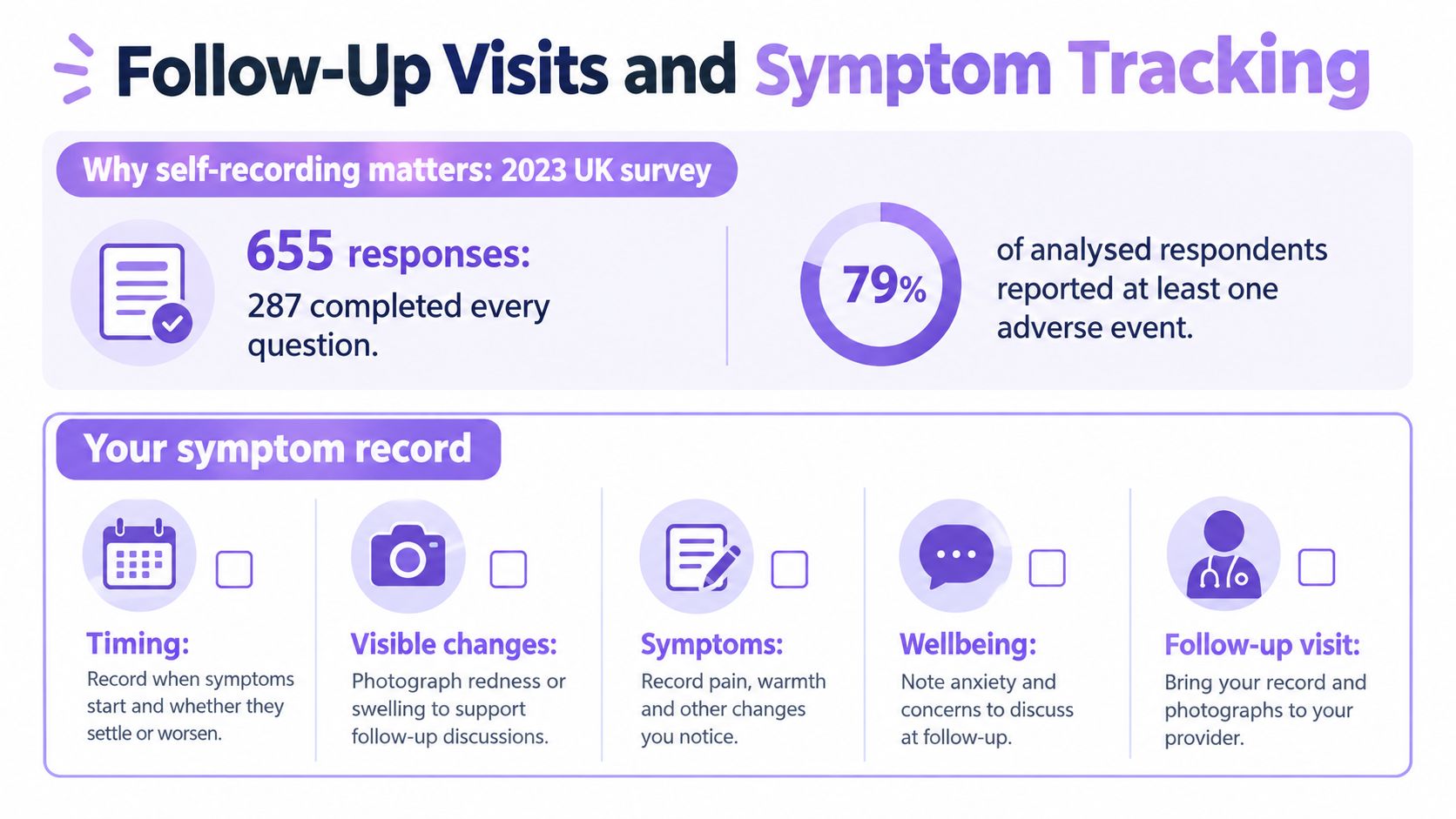
A follow-up is more useful when you can describe what changed and when. A voluntary UK survey published in 2023 received 655 responses. The analysis compared 511 usable responses with 188 MHRA adverse-event reports recorded between 1991 and 2020. The study reported that 79% of the 511 respondents in its analysis experienced at least one adverse event, and anxiety was the most frequently reported. These figures describe survey participants, not the complication rate for everyone receiving treatment. Because participation was voluntary, people with negative experiences may have been more likely to respond. The 2023 survey of patient experiences after cosmetic botulinum toxin
Keep a brief daily record, like a timeline a clinician can review. Include:
- Treatment details: date and time, treated areas, and clinician's name.
- Daily symptoms: note bruising, swelling, headache, or pain. A simple 0–10 scale can help describe severity.
- Changes over time: record when a symptom starts and whether it settles, stays the same, or worsens.
- Photographs: take weekly images in similar lighting if you need to track visible changes.
- Other medicines: list anything you took after treatment.
- Effect on daily life: note changes to sleep, work, or mood.
Record emotional distress too. Anxiety was the most frequently reported problem in the survey. If worry continues, contact the clinic or your GP rather than handling it alone.
A review, often around two weeks after treatment, gives you and your clinician a chance to discuss how the result has developed. Ask in advance how to get advice outside clinic hours. That way, if a change appears later, you have both a clear record and a route to help.
Frequently Asked Questions About Botox Aftercare
Does bruising mean the treatment is working?
No. Bruising is a local reaction to an injection and doesn't show whether the treatment has worked. The result is usually judged over about two weeks.
Should I massage the area to help it settle?
No. Avoid rubbing, massage or firm pressure for 24–72 hours. These restrictions are intended to limit local inflammation and unintended spread, although the evidence for several cosmetic restrictions is limited and your clinic's instructions take precedence.
Can I exercise or use a sauna the next day?
Avoid vigorous activity, saunas and hot baths for at least 24 hours, or for the period your clinic specifies. If you're unsure whether a particular activity is suitable, ask the treating clinician.
Is a cold compress necessary?
No, it isn't required for everyone. If swelling or bruising appears, you may use a clean cold compress gently during the first few hours.
If I feel fine after a week, am I in the clear?
Not necessarily. Rare systemic effects can appear up to four weeks after treatment, so keep the clinic's contact route available.
Which pain relief is suitable?
Ask your treating clinician. This article can't advise which medicine is appropriate for you.
Can an online pharmacy supply Botox without a consultation?
No. Botulinum toxin is prescription-only, and an appropriate prescriber must assess whether the medication is suitable before it can be prescribed and supplied.
Is aftercare the same at every clinic?
No. The injection site, dose, product and reason for treatment can change the advice. Follow your own clinician's written instructions and contact them about symptoms that concern you.
For information about clinician-led aesthetic treatment and aftercare, visit XO. XO brings together XO Clinic, an in-person aesthetics clinic in Wakefield, and XO Medical, a GPhC-registered online pharmacy where prescribing requires clinical assessment.


0 comments