


Botulinum toxin can reduce a gummy smile caused by overactive upper-lip elevator muscles by roughly 3.42 mm of gum exposure at two weeks, but the effect is temporary and typically fades by around 24 weeks, so repeat treatment is expected.
That number is a mean from grouped studies, not a promise for your face. Gum show is judged in millimetres, on how the lip moves, and on whether the cause is muscle, tooth, gum or jaw. Most marketing skips that step and jumps to a photograph.
This guide is general information for adults in the UK. It isn't a personal assessment, and it isn't a route to prescribed medication without a clinician. Botulinum toxin remains a prescription-only treatment.
Clinically reviewed for educational accuracy. Review date: 24 March 2026.
Table of Contents
- What Botox for a Gummy Smile Can and Cannot Do
- Understanding Gummy Smile and Its Four Causes
- How Botulinum Toxin Relaxes the Upper Lip
- Who Is a Suitable Candidate for Treatment
- Results Timeline and How Long Effects Last
- Risks, Side Effects and UK Safety Rules
- Comparing Botox with Surgery, Fillers and Orthodontics
- Aftercare, Follow-Up and Your Next Step
What Botox for a Gummy Smile Can and Cannot Do
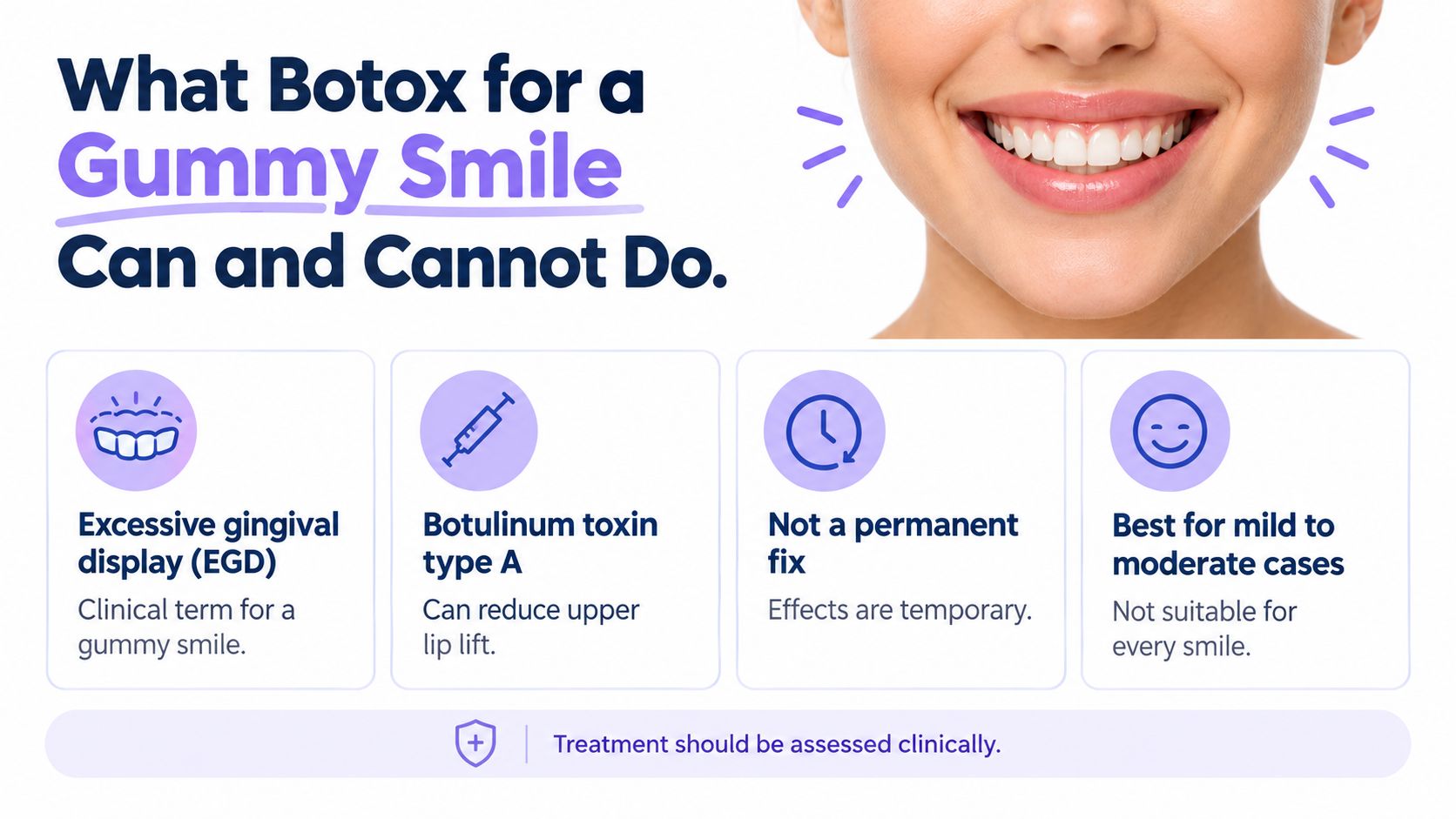
Clinicians describe a gummy smile as excessive gingival display (EGD). Botulinum toxin type A, the medicine in brands people call Botox, can relax the muscles that lift the upper lip. Less lift means less gum in the smile, but only when those muscles are the main reason the gum shows.
It can't move a tooth, trim excess gum, or shorten an upper jaw. If the principal cause is tooth position, extra gum tissue, altered passive eruption, or a very vertical upper jaw, toxin alone is the wrong tool. Those patterns need orthodontic, periodontal or jaw assessment. In more complex smiles, toxin is sometimes used as a short diagnostic test or as an adjunct, not as the whole plan.
Why you can't select yourself from a photo
In the UK, gummy-smile use sits outside the usual licensed cosmetic indications. MHRA advice on botulinum toxin products explains that products have authorised uses, while cosmetic use outside those indications may be off-label. The MHRA licenses some brands for temporary improvement of specific facial lines. It doesn't license botulinum toxin for general cosmetic procedures, so Botox for gummy smile may be prescribed outside the product licence.
A doctor, or another suitably qualified prescriber, has to examine you and issue a prescription. A UK-registered pharmacy then supplies that prescribed medication. An online pharmacy shouldn't provide it solely because you asked, or because you sent a photograph.
Practical rule: Millimetres of gum show, smile movement and the underlying anatomy come before any talk of units.
What you can reasonably hope for is a modest, reversible change, then review as movement returns. A single visit isn't a permanent correction, and this page can't tell you whether you're suitable.
Understanding Gummy Smile and Its Four Causes
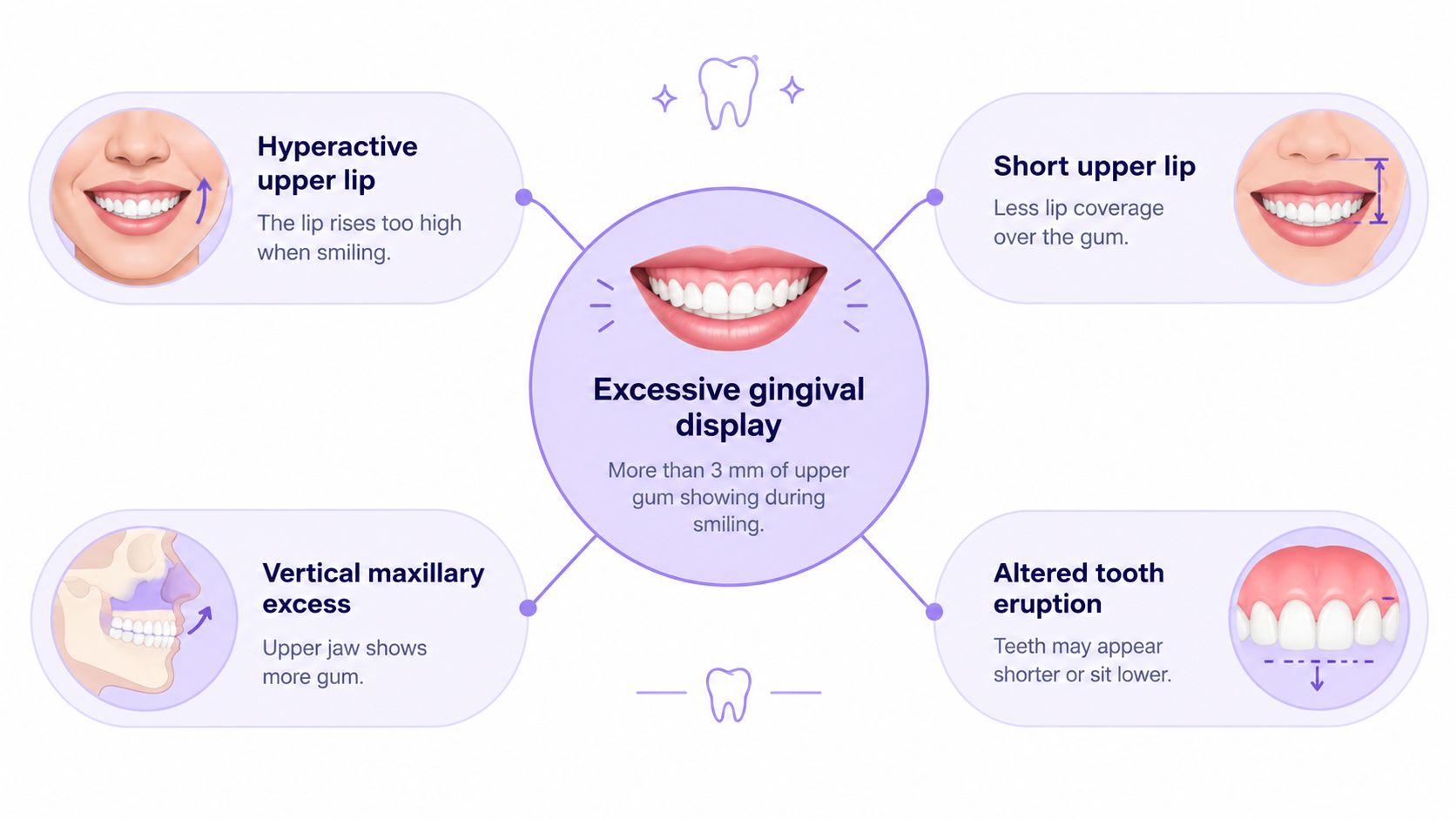
A smile showing more than 3 mm of upper gum is often described clinically as excessive gingival display. The measurement is a guide, not a universal standard for attractiveness. The gum's outline and the way the upper lip moves also affect how a smile looks.
A UCL preference study examined preferences for different smiles. Its findings are best used as context for discussion, not as a formula for deciding whether someone's smile needs treatment. A measurement alone cannot tell you which appearance a person will prefer, or what is causing the gum to show.
Four causes, only one of them muscular
The anatomy behind the display matters because botulinum toxin acts on muscle movement. It cannot change tooth position, remove excess gum tissue or alter the structure of the jaw.
- Hyperactive upper-lip elevators: Strong muscle activity lifts the lip high when smiling. Botulinum toxin may reduce this upward movement temporarily, if examination confirms that muscle activity is a significant cause.
- Tooth position: The position or angle of the teeth can affect how much gum shows. Orthodontic assessment may be appropriate; relaxing the lip will not move teeth.
- Excess gum or altered passive eruption: Gum covers more of the tooth surface than expected, making the teeth appear shorter. A periodontal assessment can clarify whether gum reshaping is suitable.
- Vertical maxillary excess: The upper jaw has a vertical skeletal pattern that contributes to the display. Assessment by a suitably trained team is needed to discuss whether orthognathic treatment is appropriate.
Two people may show a similar amount of gum for different anatomical reasons. One may have a mobile upper lip; another may have excess gum tissue or a jaw-related cause. A smile can also involve more than one factor, such as increased lip movement alongside extra gum coverage.
If only the muscle is treated, the other causes remain. A dentist, orthodontist or prescribing clinician should assess the smile and identify its likely drivers before discussing Botox for gummy smile. That assessment helps establish whether a temporary change in lip movement is likely to address the concern, while keeping expectations realistic.
How Botulinum Toxin Relaxes the Upper Lip
When you smile, a small group of muscles lifts the upper lip. If they contract strongly, the lip rises past the gum margin and the gingiva appears. Botulinum toxin type A blocks the nerve signal that tells those fibres to contract. The lip still moves. It just doesn't travel as far, so less gum shows.
The usual surface target is the Yonsei point, near the side of the nostril. At that landmark three elevators meet: levator labii superioris, levator labii superioris alaeque nasi, and zygomaticus minor. Relaxing that cluster reduces the upward pull. It isn't a numbing injection, and it isn't a filler that adds volume.

Why there is no fixed map of units
A British Dental Journal systematic review looked across nine prospective studies and found that injection sites, reconstitution and unit doses varied a great deal. That spread is a reason to refuse a one-size protocol. Face width, muscle strength, whether one side lifts more than the other, and how many millimetres you show all change the plan. Two people with the same gum measurement can still need different points and different doses.
The same literature treats this as an off-label oral and perioral use. Treatment should follow assessment by someone who can tell a muscular pattern from a dental or skeletal one. If you are comparing this with treatment for forehead lines, the mechanism is related but the target is not. Our notes on anti-wrinkle injections explain the broader cosmetic use, which is a different indication from the upper lip.
The short film below shows, in plain view, how lip elevation changes the amount of gum you see. It isn't a dosing tutorial, and it isn't a substitute for examination.
Higher doses aren't automatically better. Weakening the lip too far can flatten the smile or make the two sides look uneven. Individual anatomy, not a template, should set the dose.
Who Is a Suitable Candidate for Treatment
A proper consultation is a sequence, not a sales chat. The clinician measures gingival display in millimetres at a full smile, watches how the lip travels, and looks at tooth length, gum contour and jaw proportions. They take a medical history and a medicine list, because some conditions and some drugs change the risk. Photographs help the record. They don't replace that examination.
You're more likely to be suitable if you're an adult, the extra gum is driven by hyperfunctional lip elevators, and dental or skeletal causes have been considered and set aside. A 2022 British Dental Journal review of nine prospective studies found the strongest indication was gummy smiles of up to about 4 mm, with clinically useful benefit lasting at least 12 weeks when hyperfunctional muscles were the cause. The same review describes toxin as a safe, reversible option in that setting, and as a diagnostic or adjunctive step when the case is more complex.
You are less likely to be suitable, at least for toxin alone, if the gum show comes mainly from tooth position, excess gingival tissue, altered passive eruption, or vertical maxillary excess. Pregnancy, certain neurological conditions, and being unable to attend follow-up are reasons to pause. In England, cosmetic botulinum toxin injections are illegal for anyone under 18, including when a parent agrees.
Matching the Cause of a Gummy Smile to the Right Treatment Pathway
| Underlying cause | Typical clinical picture | Botulinum toxin appropriate | Alternative pathway |
|---|---|---|---|
| Hyperactive lip elevators | Lip rises high, teeth are a normal length | Often yes, as the main option | Review or repeat as movement returns |
| Tooth position | Teeth or bite drive the display | No, not alone | Orthodontics |
| Excess gum or altered passive eruption | Short-looking teeth under thick or low gum | No, not alone | Periodontal reshaping, sometimes later adjunct |
| Vertical maxillary excess | Upper jaw is excessively long | No, not alone | Orthognathic assessment |
If the cause isn't muscular, a neat injection photo won't fix the part you actually see.
Bring a list of medicines and any history of swallowing difficulty or neurological disease to that first visit. The prescriber should also explain off-label status before you consent. Leaving with a named cause matters more than leaving with a booking.
Results Timeline and How Long Effects Last
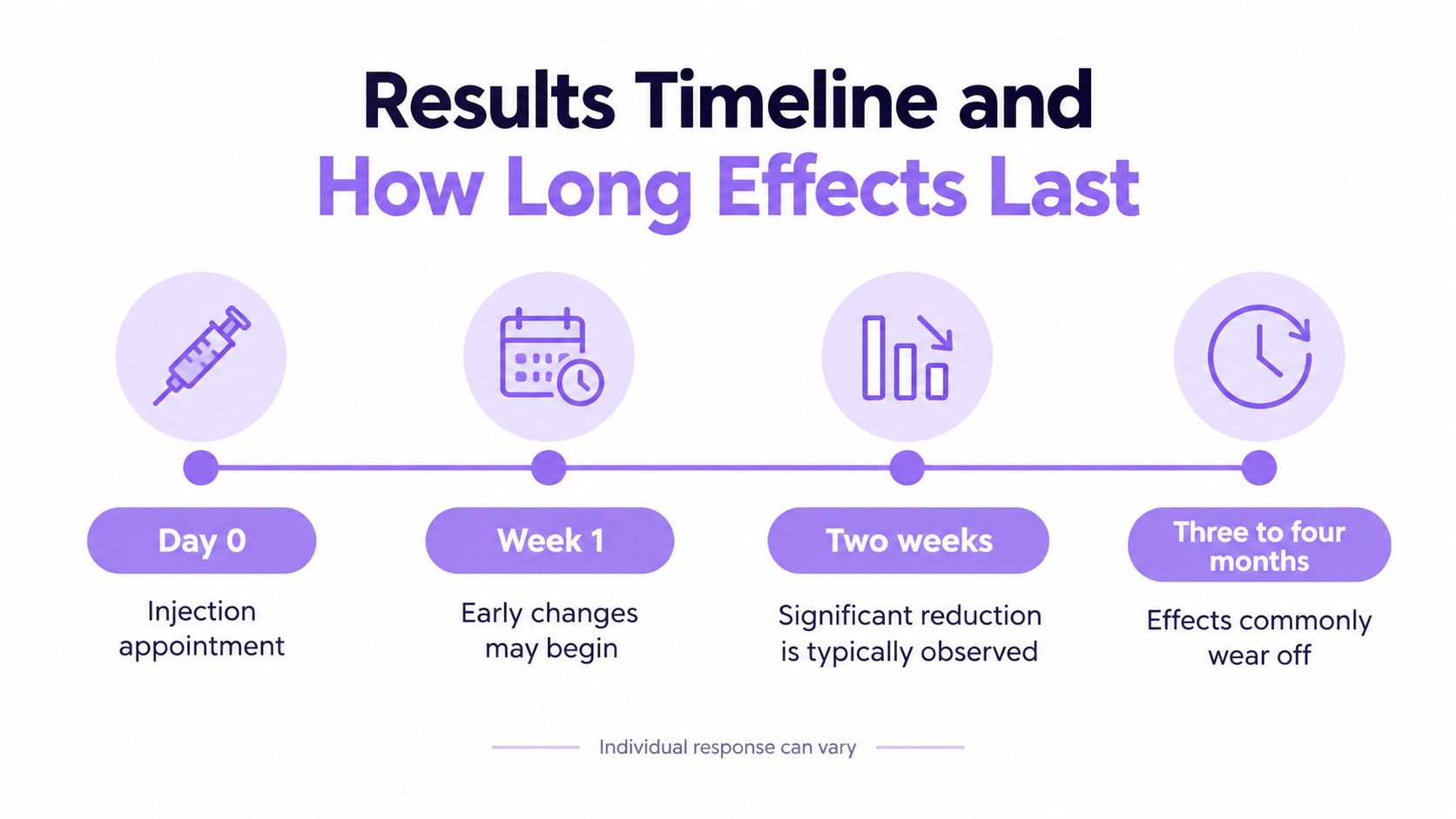
Significant reduction is typically seen from two weeks. After that early point the effect usually eases rather than holding still. Studies don't agree on the exact fade, because patients, techniques and measuring methods differ.
A controlled preliminary trial checked results at 2, 8, 12, 16, 21 and 25 weeks. One protocol used four injection points at 2 units per point. Another used two points at 2 units per point. Statistically significant reduction lasted to 25 weeks with the four-point protocol and to 16 weeks with the two-point protocol. UK enforcement guidance that summarises this evidence also records substantial between-study heterogeneity, so those week counts aren't a dosing recipe. The trial itself had many people lost to follow-up and should be read as preliminary.
Why your result may not match the average
The meta-analysis behind the two-week figure had an I² of 97%. That means almost all the variation between studies was real difference, not chance. Anatomy, injection technique, dose, muscle pattern and the day someone is measured all move the result. A strong early change doesn't prove you'll still see it at four months.
What maintenance actually means
Plan for gradual return of lift, not a cliff-edge at a fixed date. Many people need review as the smile starts to climb again, and repeat treatment is expected if they want to keep the change. Chasing the first-week look with an early top-up isn't automatically wise. Too much weakness is harder to live with than a little returning gum.
Keep a simple note of when you first noticed the change and when the lip felt fully mobile again. That personal interval is more useful at the next visit than any average on a chart.
Risks, Side Effects and UK Safety Rules
It is easy to file this with a brow shape or a lip tint. That assumption doesn't hold. You're weakening muscles you use to speak, drink and control a straw, and you're doing it with a medicine prescribed outside its usual licence.
A British Dental Journal review of gummy-smile toxin treatment describes the use as off-label, with evidence that is still comparatively limited. Results in the short term were generally favourable, and reported duration is commonly about 12 to 24 weeks, so repeat treatment is part of the plan. The same review found that 2 to 3 units were often enough, while higher dosing could increase side effects. The "right" dose is individual. More units aren't a better smile.
What too much weakness looks like
If the elevators are over-weakened, the problems are local and obvious in daily life.
- Uneven smile: One side lifts more, so the lip line tilts.
- Reduced movement: The lip feels heavy, or it doesn't curl as it used to.
- Drinking or speech: A straw, a cup, or certain sounds become awkward.
- A flatter smile: The shape you wanted isn't the shape you get, even if less gum shows.
These effects are expected to ease as the toxin wears off. They still need a documented plan, not a promise to "wait and see" with no review.
Rare spread beyond the lip
Effects can rarely travel past the injection site. MHRA warnings after rare botulism cases list generalised muscle weakness, difficulty swallowing, slurred speech and breathing difficulty. Those symptoms can start within days or as late as four weeks. Risk may be higher with some neurological disorders, a history of dysphagia or aspiration, high doses, or injection at an unapproved site. NHS guidance lists facial weakness and swallowing or breathing difficulty among possible complications. Serious events aren't the expectation. They are why this isn't a routine beauty appointment.
Who is responsible
Botulinum toxin is prescription-only. The prescriber assesses, documents consent, and explains off-label status. The person who injects must be appropriately trained and accountable. In England, cosmetic injections are illegal under 18 even with parental permission. If you are choosing between a remote supply and a visit, an in-person Botox clinic in Wakefield still needs the same prescriber oversight as any other setting. Ask who the prescriber is, what off-label means for you, and who you call if the smile is uneven.
Comparing Botox with Surgery, Fillers and Orthodontics
There isn't a single best fix. The right pathway is the one that matches the cause you have, and that you can maintain safely.
Botulinum toxin suits a hyperactive lip, especially milder display. It is reversible, which is useful if you want to see a lower lip line before considering anything surgical. You should expect repeat care across the year, not a one-time correction. Cost is recurring because the effect fades.
Surgical lip repositioning is discussed when the lip is very mobile or soft tissue needs a longer-lasting change. It can hold after healing in a way toxin can't, but it brings operative risk, stitches and a recovery window. It still doesn't correct a jaw that is too vertical, or teeth that are in the wrong place.
Dermal fillers don't relax the elevator muscles. They can support or reshape the lip so the gum is less obvious in some patterns. They have their own complications, including vascular injury, and hyaluronic acid products can often be dissolved. That reversibility isn't the same as a toxin wearing off on a schedule. A fuller comparison sits in our guide to dermal fillers versus Botox.
Orthodontics is the direct route when tooth position or eruption drives the display. Treatment takes months, and retainers keep the result. It won't stop a purely muscular lip from rising, so a combined plan is sometimes honest.
How to choose in the UK
Decide on cause first, then on reversibility, then on who is accountable.
- Name the cause: If nobody has said muscle, tooth, gum or jaw, you aren't ready to pick a treatment.
- Match durability to the anatomy: Temporary toxin for a muscular trial. Surgery or orthodontics when the structure is the problem.
- Identify the prescriber: For toxin, you should be able to name the prescriber and the follow-up route.
- Check regulation: A pharmacy should be regulated by the GPhC. A clinic should be clear about who injects and how complications are handled.
An in person aesthetics clinic offering botox, dermal fillers, skin boosters and polynucleotides (salmon DNA) can assess you face to face. A UK-registered pharmacy is the route for prescribed medication after a proper consultation, not a shortcut around one. Neither setting should imply you can have treatment automatically.
Aftercare, Follow-Up and Your Next Step
For the first 48 hours, follow the aftercare sheet you were given. Don't book the injection and then invent your own rules from social media. Contact the treating clinician if the smile is clearly uneven, the lip feels too weak for normal drinking, or you're unsure whether a change is expected.
Urgent care is different. Seek emergency help for difficulty swallowing, slurred speech, breathing difficulty or generalised muscle weakness. Those can appear days later, and occasionally up to four weeks.
Review is usually planned as movement returns, not only if something goes wrong. A written plan for an uneven result matters more than any before-and-after photograph. Before you commit, confirm three things: who the prescriber is, whether the pharmacy or clinic's regulatory status checks out, and how monitoring and aftercare are arranged.
The useful next step is a consultation with a suitably qualified clinician who will diagnose the cause before any treatment is agreed. This content is for informational purposes only and does not constitute medical advice. Always consult a qualified healthcare professional before starting or changing any treatment.
XO brings UK clinical assessment to both settings covered here. XO Medical is a GPhC-registered online pharmacy for prescribed medication after a proper consultation, and XO Clinic in Wakefield offers in-person medical aesthetics, including assessment for treatments such as botulinum toxin where a muscular gummy smile is the right indication. If you want that cause checked before any decision, visit XO.


0 comments