


Yes, you can take Mounjaro on a plane. In the UK, essential liquid medicines can pass through security even when the container is over 100ml, provided you carry them separately and can show supporting medical documentation.
You're probably asking this while checking your passport, rearranging your hand luggage and wondering whether airport security will confiscate your injection. Mounjaro, also known as tirzepatide, is a prescription-only treatment, so travelling with it involves more than just placing a pen in your washbag.
The practical answer is reassuring, but two issues need careful planning: protecting the medicine during transport and ensuring you have enough supply to maintain your prescribed schedule abroad. Airport screening is usually manageable when the medication is clearly labelled and supported by evidence. Supply problems, delayed journeys and uncertainty about your next dose can create greater difficulty if you leave preparation until the day before departure.
Reviewed by: UK-registered clinician
Review date: 3 October 2026
This content is for informational purposes only and does not constitute medical advice. Always consult a qualified healthcare professional before starting or changing any treatment.
Table of Contents
- Introduction to Travel Planning with Mounjaro
- Storage and Temperature Requirements for In-Flight Safety
- Navigating UK Airport Security and Documentation
- Managing Continuity of Supply and Dose Timing Abroad
- Handling Side Effects and Dosing Schedules During Travel
- Summary of Best Practices for Flying with Mounjaro
Introduction to Travel Planning with Mounjaro
Mounjaro is a weekly injectable medicine prescribed after a clinical assessment. If you're travelling for a short break, moving between airports or spending an extended period abroad, you'll need to consider the medicine's storage instructions, your injection schedule and the rules of the airports you'll use.
The most reliable arrangement is to keep Mounjaro in your hand luggage, in its original packaging, with your prescription details available. Checked baggage can be delayed, lost or exposed to conditions you can't monitor. Keeping the pen with you also means you can respond more easily to flight delays or a change in your itinerary.
You don't need to hide the medicine or place it inside an ordinary toiletries bag. Prescription injectable medicines are treated as medical liquids in UK aviation guidance. They can be subject to additional screening, so putting the pen somewhere accessible is more practical than packing it beneath clothing, electronics or other liquids.
A calm plan before leaving home
Before departure, check the instructions supplied with your exact Mounjaro presentation. Confirm whether the pen is unused or has already been used, whether it has remained refrigerated and what your prescriber has advised about the next injection.
Keep the following together:
- The labelled medicine: Carry the Mounjaro pen in its original packaging where possible.
- Supporting evidence: Take a copy of your prescription or a letter from your prescribing clinician.
- Your travel plan: Note your usual injection day and how you'll contact your prescriber or pharmacy if your plans change.
- Cooling equipment: Use suitable cooling support if your storage instructions require it, while preventing direct contact with frozen packs.
For a plain-language overview of Mounjaro treatment and prescribing considerations, you can read XO's educational guide to Mounjaro. An online pharmacy or private prescriber should assess your medical history rather than issue a prescription automatically, particularly if you're requesting medication close to departure.
This video may also help you visualise the practical steps involved in preparing your medication for travel.
Storage and Temperature Requirements for In-Flight Safety
Temperature control is the main medication-handling issue during a flight. UK guidance from Lilly states that unused Mounjaro KwikPens should be stored at 2°C to 8°C during transport, must not be frozen and, after first use, may be kept at room temperature up to 30°C. These instructions apply to the UK KwikPen guidance, so you should still check the packaging and patient information supplied with your own prescription.
The safest approach for an unused pen is to preserve the cold chain from your home refrigerator to suitable refrigeration at your destination. That means using an insulated medical travel case when appropriate, keeping the pen in its carton and avoiding direct contact with ice or frozen gel.
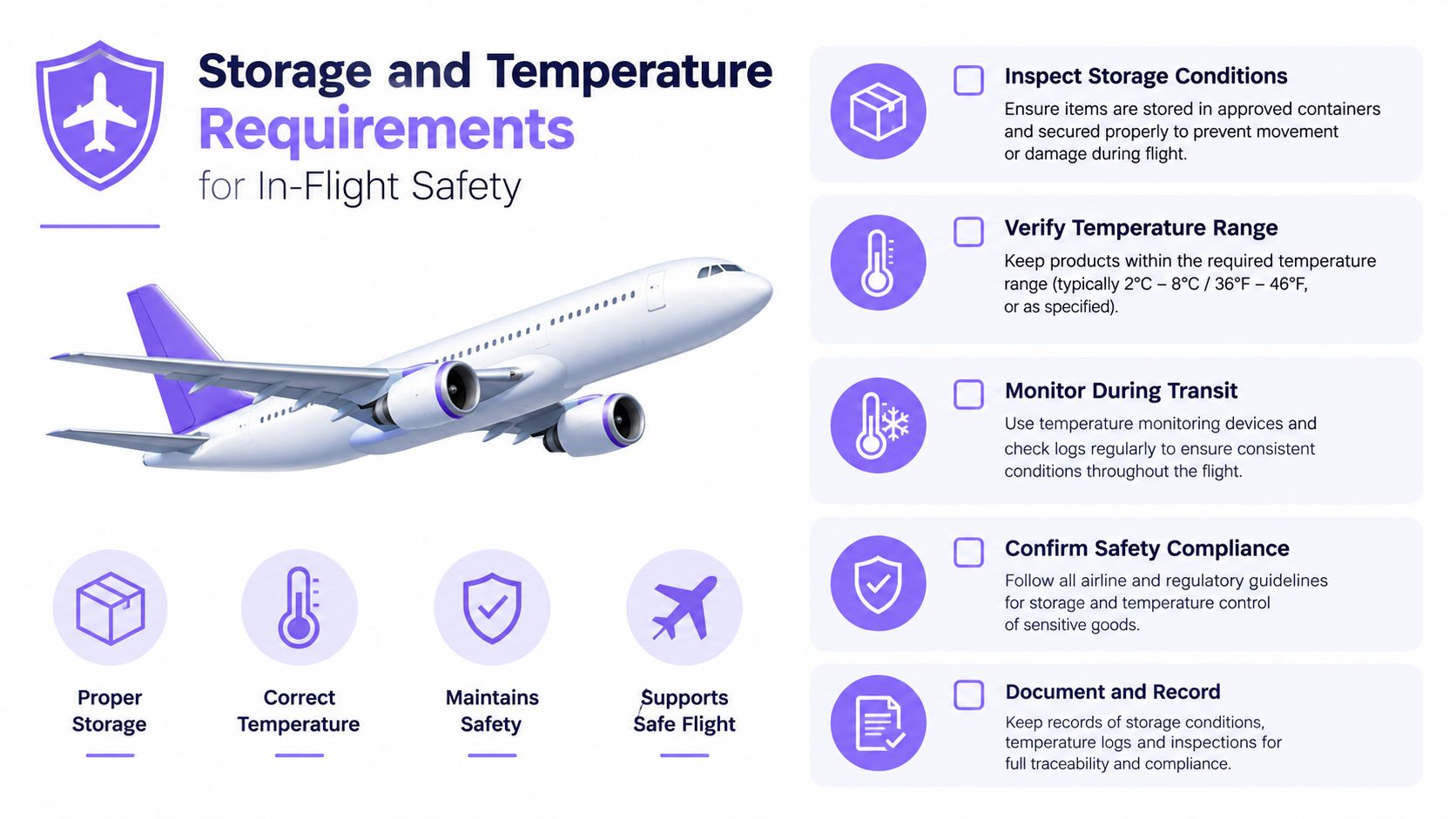
Packing the pen without freezing it
A cooling case can help maintain a stable environment, but it doesn't make unsafe packing safe. Place a barrier between the pen and any frozen component, and don't leave the medicine in direct sunlight, beside a heater or in a hot vehicle during transfers.
The UK Civil Aviation Authority says that where medical documentation states a medicine must be kept cool, an ice pack or cooling gel pack may be carried in cabin baggage. This supports using a suitable cooling method, but airport staff may still need to inspect the pack and its contents.
Practical rule: Cooling Mounjaro is important, but freezing it is also unsafe. The pen should never rest directly against a frozen pack.
An insulated case is particularly useful when you face a long airport day, connections, delays or warm ground transport. It's less useful if the pack is so cold that it freezes the pen, or if the case is left open repeatedly. Follow the storage instructions for your exact device rather than assuming every tirzepatide product has identical handling requirements.
For broader background on temperature-sensitive peptide handling, these reconstituted peptide shelf-life tips may be useful as general educational reading. They don't replace the manufacturer's instructions for prescribed Mounjaro.
You can also review XO's guide to using the Mounjaro pen before departure. If the pen has been exposed to freezing, excessive heat or an uncertain temperature history, don't rely on appearance alone. Ask a pharmacist, prescriber or dispensing pharmacy whether it remains suitable for use.
Navigating UK Airport Security and Documentation
UK airport security normally limits liquid containers in hand luggage to 100ml or less, placed in a transparent resealable bag no larger than 1 litre. Prescription medication is an exception when you have appropriate medical confirmation, so Mounjaro can be carried as an essential medical liquid even if the container exceeds the usual liquid limit. The Civil Aviation Authority's guidance on travelling with medicines explains this exception.
You should present Mounjaro separately when asked. Keep the pen, original carton and documentation together in an accessible part of your hand luggage rather than burying them in a packed suitcase.
What evidence should you carry?
A prescription record or a letter from your clinician can help demonstrate that the medicine has been prescribed for your personal use. Original packaging with your name and dispensing details is also useful because it gives security staff and customs officials a clear explanation of what the medication is.
Take:
- The prescription information: A printed or electronic copy can support the medicine's legitimacy.
- A clinician's letter: This is especially sensible for international travel, connections through another country or when you're carrying cooling equipment.
- The original carton: It helps identify the medicine and protects it from light.
- Contact details: Keep the dispensing pharmacy and prescribing service details available in case the medicine is questioned or damaged.
The UK Government guidance on essential medicines and medical equipment confirms that liquid medicines over 100ml are permitted when they're essential, although you may need to show documentary proof. The CAA's air travel health guidance also states that prescription injectable medicines can be carried separately and may undergo additional screening.
What happens at the checkpoint?
Tell the security officer that you're carrying prescribed liquid medication. Place it where it can be removed easily, follow the request for separate screening and allow extra time for an inspection.
Security staff may ask to see the prescription or clinician's letter. That doesn't mean there's a problem. Additional screening is a normal part of handling medical liquids over the standard limit.
Rules can differ at your destination, even when UK departure procedures are straightforward. Check the requirements of the airline, destination country and any country where you'll pass through customs. A UK-registered pharmacy can explain what documentation it can provide, but it can't guarantee how another country's border officials will interpret its rules.
Managing Continuity of Supply and Dose Timing Abroad
Many travel pages focus on whether Mounjaro can pass through airport security. In practice, continuity of supply may be the more important risk. If you leave with too little medication and expect to obtain more abroad, you may encounter different prescribing requirements, unavailable stock, unfamiliar product presentations or a pharmacy that can't dispense a UK prescription.
UK diabetes organisations reported that wider GLP-1 supply shortages had been resolved at the end of January 2025, but later highlighted localised access problems involving Mounjaro. The Diabetes UK response to serious supply issues shows why patients should treat supply planning as part of travel preparation rather than an afterthought.
Build a realistic supply plan
Ask your prescriber or dispensing pharmacy about your expected supply before booking or leaving. Don't stockpile beyond what has been clinically prescribed, but don't assume a destination pharmacy will provide an emergency replacement without assessment.
A sensible plan includes:
- Checking your current supply: Confirm how many doses you hold and whether they remain within their storage requirements.
- Allowing for disruption: Consider delays, cancelled flights, lost luggage and changes to your return date.
- Confirming the next dose: Write down your prescribed injection day and ask your prescriber what to do if travel interrupts it.
- Carrying evidence: Keep prescription details with the medicine so a clinician or pharmacist can understand what you're taking.
- Avoiding destination assumptions: International access isn't equivalent to UK access, even when the medicine is known locally.
A UK online pharmacy may be able to discuss delivery timing and prescription management before departure, but it should still operate through clinical assessment and appropriate prescribing governance. For example, information about online pharmacy next-day delivery can help you understand the logistics of receiving prescribed treatment before travel. Delivery timing isn't a substitute for checking clinical suitability or confirming that the medicine can legally be taken into your destination country.
If supply is uncertain, contact your prescriber early. Don't change your dose, take an unplanned replacement medicine or borrow someone else's pen to solve a travel problem.
Handling Side Effects and Dosing Schedules During Travel
Travel can make a regular injection routine feel disorganised. A departure may fall on your usual injection day, while jet lag, unfamiliar meals and long transfers can make nausea or digestive symptoms harder to manage.
Before you leave, decide whether you'll keep the same injection day or ask your prescriber whether a change is clinically appropriate. Don't improvise the interval between doses. The correct approach depends on your prescription, treatment history and the instructions for your particular medicine.
Make the day predictable
Put the injection reminder in your phone using the local time you expect to follow. Keep the pen and documentation in the same accessible place, and avoid putting medication into checked luggage or a hotel room safe that you may forget to open.
If the dose falls during a flight, you may prefer to administer it before departure or after arrival, but that decision should follow the advice given by your prescriber. A change in time zone doesn't automatically make a dose safe to move by an arbitrary amount.
Plan for gastrointestinal symptoms
Mounjaro can affect appetite and digestion. During travel, choose manageable meals, drink regularly and avoid making several unfamiliar dietary changes at once. If symptoms are troublesome, ask a healthcare professional for advice rather than stopping treatment or taking additional medicines without checking their suitability.
Seek urgent medical help if you develop severe or persistent symptoms, signs of dehydration, severe abdominal pain or another symptom that concerns you. Identify how to access medical care at your destination before leaving, particularly if you're travelling somewhere where language or healthcare access may make urgent communication difficult.
Cabin pressure isn't a reason to alter Mounjaro storage or dosing. The practical concerns are temperature, access, timing and your general wellbeing. Keeping a simple written plan can reduce the chance that jet lag or a delayed connection causes an avoidable missed dose.
Summary of Best Practices for Flying with Mounjaro
The best travel arrangement keeps the medicine under your control from departure to arrival. Hand luggage is preferable to checked baggage because you can monitor the pen, present it during screening and protect it from baggage delays or handling conditions that you can't assess.
| Action Item | Requirement |
|---|---|
| Pack the medicine | Keep Mounjaro in hand luggage and, where possible, its original packaging |
| Protect the temperature | Follow the storage instructions for your exact pen and prevent both overheating and freezing |
| Prepare for security | Present the medicine separately and explain that it's prescribed liquid medication |
| Carry evidence | Have prescription details or a clinician's letter available |
| Protect dose continuity | Confirm your supply, injection day and plan for delays before departure |
| Check destination rules | Review airline and destination-country requirements for prescribed injectable medicines |
| Respond to uncertainty | Ask a pharmacist or prescriber before using medicine exposed to unsuitable temperatures |
The comparison is straightforward:
| Packing option | Practical benefit | Main risk |
|---|---|---|
| Hand luggage | Keeps the pen accessible and allows you to present it for medical-liquid screening | You must organise the medication and cooling equipment for inspection |
| Checked baggage | Removes the medicine from your cabin belongings | The bag can be delayed, lost or exposed to conditions you can't monitor |
Mounjaro isn't an over-the-counter product. A UK-registered pharmacy or clinician should assess whether treatment is suitable, provide appropriate prescribing oversight and advise on what to do if a dose is disrupted. This is different from obtaining medication automatically through an online form.
If your travel involves complex timing, limited refrigeration or an extended stay, discuss the plan before departure. A private prescribing service may be able to review your treatment and supply arrangements, but it should still work within UK clinical and pharmacy regulations.
XO Medical is a UK-registered online pharmacy with UK-registered clinicians and a service regulated by the GPhC, while XO Clinic is an in-person aesthetics clinic offering Botox, dermal fillers, skin boosters and polynucleotides (salmon DNA). Visit XO to review its healthcare services and arrange an appropriate clinical consultation before travelling.


0 comments