


You've had lip or cheek filler at a UK high-street clinic, and on the second morning the area looks more swollen, bruised or uneven than it did yesterday. That can be part of ordinary healing, but some changes need prompt clinical attention. Knowing the difference helps you respond calmly and quickly.
Dermal fillers are a medical procedure, not just a beauty treatment. This guide explains dermal fillers side effects in plain English, including expected recovery, delayed problems and the rare emergency of vascular occlusion. It's general information, not personal medical advice. Always consult a qualified healthcare professional before starting or changing any treatment.
Table of Contents
- Why Dermal Filler Side Effects Matter in the UK
- How Dermal Fillers Work and Why It Shapes the Risk Profile
- Common Side Effects and What Normal Recovery Looks Like
- Serious Complications and How to Recognise Them Early
- Delayed and Long-Term Side Effects to Watch For
- Reducing Risk, Contraindications, and What to Ask Your Clinician
- Practical Questions UK Patients Ask After Treatment
Why Dermal Filler Side Effects Matter in the UK
Dermal fillers used in the UK include hyaluronic acid gels and other injectable materials. Under the UK Medical Devices Regulations 2002, fillers are regulated as medical devices, while post-market safety signals are monitored through systems including MHRA reporting. The reporting pathway is separate from the regulatory arrangements people may associate with botulinum toxin or cosmetic skincare products.
UK surveillance shows why balanced information matters. The MHRA received 305 spontaneous adverse incident reports in 2019, 217 in 2020 and 195 in 2021, a decline over that period rather than a steady increase, according to its UK dermal filler incident breakdown. These figures describe reports received, not the true incidence among all filler users. The MHRA states that the total number of reactions and the total number of people treated aren't known.
The same 2021 breakdown recorded infection in 7 reports, inflammation in 15, pain in 13, and deformity or disfigurement in 7. Adverse or allergic reaction and embolism were each recorded as fewer than 5 reports, while 90 reports recorded “none” in the listed clinical-effects category. Those figures are historical surveillance markers, not a prediction of what will happen to an individual patient.
Regulation doesn't remove the need for judgement
There's no statutory cooling-off period for every non-surgical aesthetic treatment in the UK. Patients therefore need to assess the clinician, the premises, the product and the follow-up arrangements before treatment, rather than relying on a mandatory waiting period.
Voluntary registers such as the Joint Council for Cosmetic Practitioners and Save Face may help patients investigate practitioner credentials, although registration alone doesn't replace a proper consultation or independent judgement.
Practical rule: A normal bruise should gradually settle. A sudden change in colour, escalating pain or visual disturbance needs urgent assessment.
The useful question isn't whether fillers are entirely safe or dangerous. It's which effects are expected, which need a review, and which require immediate escalation. The following sections work through those distinctions, then cover delayed complications, risk reduction and practical aftercare questions.
How Dermal Fillers Work and Why It Shapes the Risk Profile
A filler's behaviour depends on its material, structure, placement and the anatomy around it. Hyaluronic acid, or HA, is a gel that can attract water and add volume. Clinicians can also use hyaluronidase to break down HA when correction or emergency treatment is needed, although this must be assessed and administered by an appropriately trained professional.
Other families behave differently. Calcium hydroxylapatite and poly-L-lactic acid are used as longer-lasting or collagen-stimulating materials and aren't reversed with hyaluronidase. Permanent materials such as PMMA or silicone have much longer consequences if a nodule, migration or foreign-body reaction develops, which is one reason they're uncommon in contemporary UK practice.
Product design and injection technique both matter
Manufacturers alter HA gels through processes such as cross-linking. A firmer gel with a higher G-prime may provide structural support in areas such as the cheek or jawline, while a softer product may integrate more subtly in superficial tissue. Particle size, concentration and the amount injected influence whether a product feels palpable, attracts swelling or remains visible beneath thin skin.
Placement changes the risk profile too. The glabella, nose and nasolabial fold contain important vessels and connections with the arterial supply around the eye. The cheek body and jawline can be lower-risk treatment areas when a suitably trained clinician chooses an appropriate plane, but no facial area is risk-free.
A needle gives precise access, while a cannula may alter the way the clinician navigates tissue. Neither instrument guarantees safety. The relevant factors include the practitioner's anatomical knowledge, injection pressure, depth, product choice and ability to recognise a complication immediately.
| Filler family | Typical duration | Reversible? | Key side-effect considerations |
|---|---|---|---|
| Hyaluronic acid | Temporary | Often reversible with hyaluronidase | Swelling, bruising, lumps, migration, inflammatory reactions and vascular occlusion |
| Calcium hydroxylapatite | Longer-lasting or semi-permanent | Not dissolved by hyaluronidase | Firmness, nodules and inflammatory reactions can be more difficult to correct |
| Poly-L-lactic acid | Develops through collagen stimulation | Not dissolved by hyaluronidase | Delayed nodules and uneven collagen response require careful management |
| PMMA or silicone | Permanent | Not enzymatically reversible | Granuloma, migration and long-term correction difficulties |
For a plain-language comparison of the two different treatment mechanisms, see this educational guide to dermal fillers versus Botox. The key point is simple: reversibility is a safety feature, but it doesn't make an injection risk-free.
Common Side Effects and What Normal Recovery Looks Like
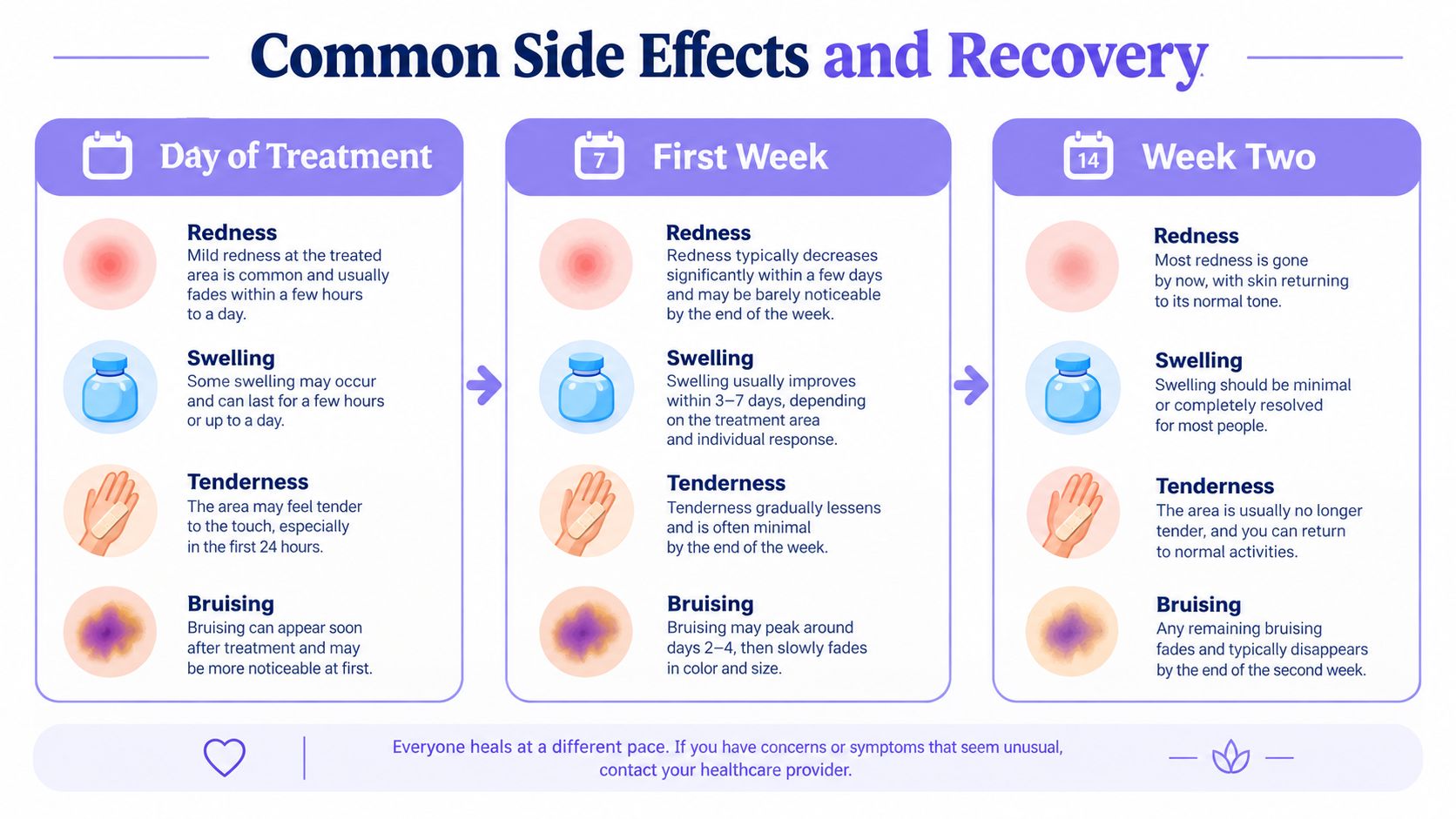
Most early reactions result from the needle, tissue handling and the gel's interaction with surrounding tissue. Redness at injection points, pinpoint bleeding, tenderness, itching, swelling and bruising are common. The treated area may also feel firm or look mildly asymmetrical while oedema is developing.
On the day of treatment, redness and tenderness are usually most noticeable. Swelling often becomes more apparent during the first couple of days. Lips commonly swell more than patients expect, while cheeks and the chin may show bruising that takes longer to fade. Under-eye filler can remain puffy for longer because the skin is thin and lymphatic drainage is delicate.
Mild lumps or unevenness during the first 48 to 72 hours often reflect oedema rather than misplaced product. Don't massage a lump unless the treating clinician has specifically advised it. Early swelling makes it too soon to judge the final result.
A sensible first-day routine
Keep cleansing gentle and avoid pressing or repeatedly checking the area. Many UK clinicians advise avoiding makeup for 12 hours, strenuous exercise and alcohol for 24 hours, alongside sleeping with your head propped up and using a cold compress for short periods.
These steps aren't a substitute for clinical advice, and your injector's instructions take priority. You can also review practical dermal filler aftercare instructions before your appointment so you know what support should be available afterwards.
Contact the treating clinic if swelling continues to worsen after it had started settling, pain becomes more intense rather than easing, redness spreads or the area becomes increasingly warm. A rash, persistent itching, marked tenderness or a new symptom outside the injection area also deserves assessment.
Normal recovery should trend towards improvement. It doesn't need to look perfect immediately, but it shouldn't steadily deteriorate.
Serious Complications and How to Recognise Them Early
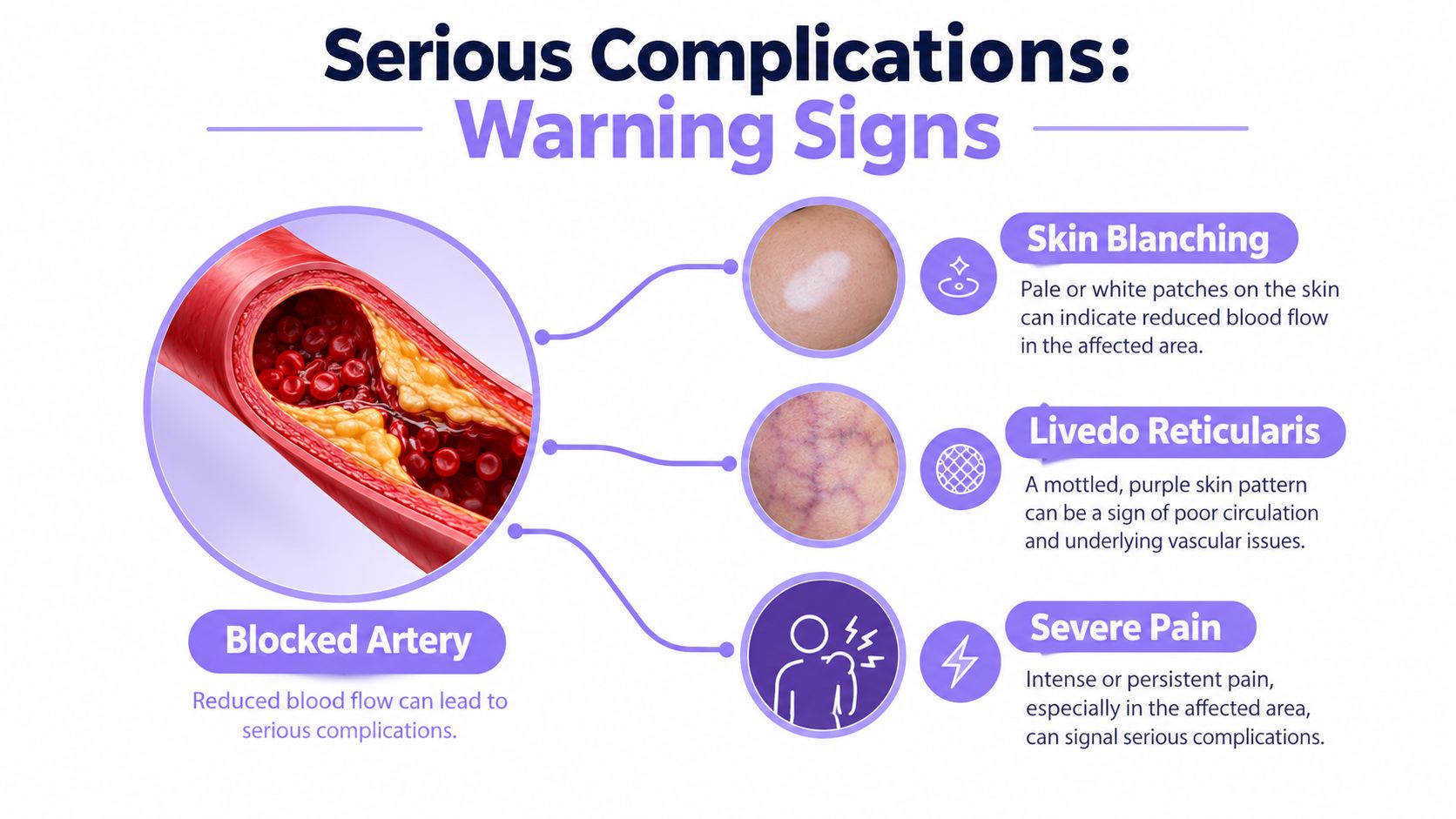
The most serious filler complication is vascular occlusion, where filler enters or compresses a blood vessel and reduces blood flow to the tissue beyond it. Ischaemia can progress to tissue necrosis, scarring and tissue loss. In arterial territories connected with the eye, it can rarely cause blindness.
A British Dental Journal review reported an estimated incidence of vascular occlusion after soft-tissue augmentation of about 1 in 100,000, as described in this peer-reviewed UK clinical article. That estimate isn't a guarantee of safety, and it shouldn't be compared directly with MHRA report totals because those totals aren't incidence rates.
The warning signs are anatomical, not cosmetic
A simple bruise usually stays close to needle entry points and changes gradually. Vascular compromise may produce a pale or white patch, a streak following a vessel, or dusky mottling known as a livedo pattern. The skin can feel unusually cool, and pain may be severe, escalating or out of proportion to the treatment.
The glabella, nose, nasolabial fold and forehead deserve particular caution because vessels in these regions connect with the circulation supplying the eye. Any blurred vision, double vision, a dark spot, partial sight loss or sudden change in vision after filler is an emergency.
What to do if you're concerned
Contact the injector immediately if you notice disproportionate pain, blanching, spreading mottled colour or any visual symptom. Don't wait for a routine follow-up or assume it's a bruise. If the clinician can't be reached promptly, seek emergency medical help and explain what filler was used, where it was injected and when.
For HA filler, a trained clinician may use hyaluronidase as part of urgent management. The treating team needs to decide whether it's appropriate and how it should be administered. Non-HA products don't have the same enzymatic rescue option.
The MHRA recorded 1,323 UK spontaneous adverse incident reports for dermal fillers up to 27 July 2023, including HA and non-HA products, in its FOI response on reported dermal filler incidents. The report includes events such as blurred vision, hypersensitivity, inflammation, infection, swelling and unspecified vascular problems. It reinforces the need for vigilance, but it doesn't show how often complications occur among all patients.
Delayed and Long-Term Side Effects to Watch For
A smooth first week doesn't rule out every later problem. UK government reviews identify infection, lumpiness, granuloma formation, ulceration, prolonged swelling, vascular occlusion, tissue necrosis and rare blindness among recognised filler complications. The UK review of cosmetic interventions also helps explain why delayed symptoms deserve proper reassessment rather than automatic reassurance.
A delayed nodule may feel firm, tender or irregular. Possible explanations include an inflammatory response, infection or a foreign-body granuloma. A biofilm, where bacteria persist around implanted material, can be difficult to distinguish from inflammation without clinical assessment. Don't assume every late lump is filler migration, and don't assume every red lump is a simple infection.
HA may produce delayed swelling or irregularity that a clinician can sometimes treat with hyaluronidase, anti-inflammatory treatment or antibiotics, depending on the cause. Biostimulators and permanent materials require a different approach. Ultrasound-guided assessment can help identify where material sits and distinguish a nodule from surrounding tissue, but the clinician must decide whether imaging is appropriate.
| Filler family | Typical onset | Common presentation |
|---|---|---|
| Hyaluronic acid | Early or delayed | Swelling, lumps, migration, bluish Tyndall effect, inflammatory nodules or infection |
| Calcium hydroxylapatite | Delayed or persistent | Firmness, palpable nodules or inflammatory reactions |
| Poly-L-lactic acid | Delayed | Uneven nodules or excessive local collagen response |
| PMMA or silicone | Delayed or long-term | Granuloma, migration, persistent inflammation and difficult correction |
Illness, dental treatment or vaccination may coincide with renewed swelling around previously treated areas. That timing doesn't prove the trigger, but it's clinically relevant history. Tell the assessing professional that filler is present, where it was placed and which product was used if you know.
For another patient-focused discussion of questions to raise before treatment, the Ringway Dental filler safety guide offers useful context. New swelling, nodules, surface irregularity or tenderness appearing weeks or months later should prompt a review, not indefinite waiting.
Reducing Risk, Contraindications, and What to Ask Your Clinician
A safe consultation starts before the syringe is opened. The clinician should ask about medical conditions, medicines, allergies, previous fillers, reactions, dental work and any active skin problem. You should disclose treatments received abroad or products whose names you don't know, because existing material can change both anatomy and management options.
Treatment is usually deferred when there's an active infection, cold sore or significant inflammation near the intended site. Pregnancy is generally treated as a reason to postpone an elective injectable because adequate safety evidence isn't available. Immunosuppression, bleeding problems, anticoagulant treatment and previous adverse reactions require individual assessment rather than an automatic decision.
Check the clinical safeguards
Ask to see the product packaging and batch details. The clinician should explain whether the device carries the relevant UK conformity marking, such as CE or UKCA where applicable, and record the product in your notes. A proper consultation should include alternatives, limitations, likely reactions, serious risks, expected aftercare and what happens if the result is uneven or a complication develops.
Use this checklist before consenting:
- Injector qualifications: Ask about relevant healthcare registration, aesthetic training and experience with the precise area you want treated.
- Emergency readiness: Ask whether the clinic has an emergency kit and a written escalation pathway.
- Hyaluronidase access: If HA is being used, ask whether appropriately trained staff can access and use hyaluronidase urgently.
- Product traceability: Confirm the product name, batch information and treatment area are documented.
- Follow-up arrangements: Find out who answers urgent calls outside the appointment and where you should go if the clinic is closed.
- Consent records: Make sure you have time to read the consent form and ask questions before treatment begins.
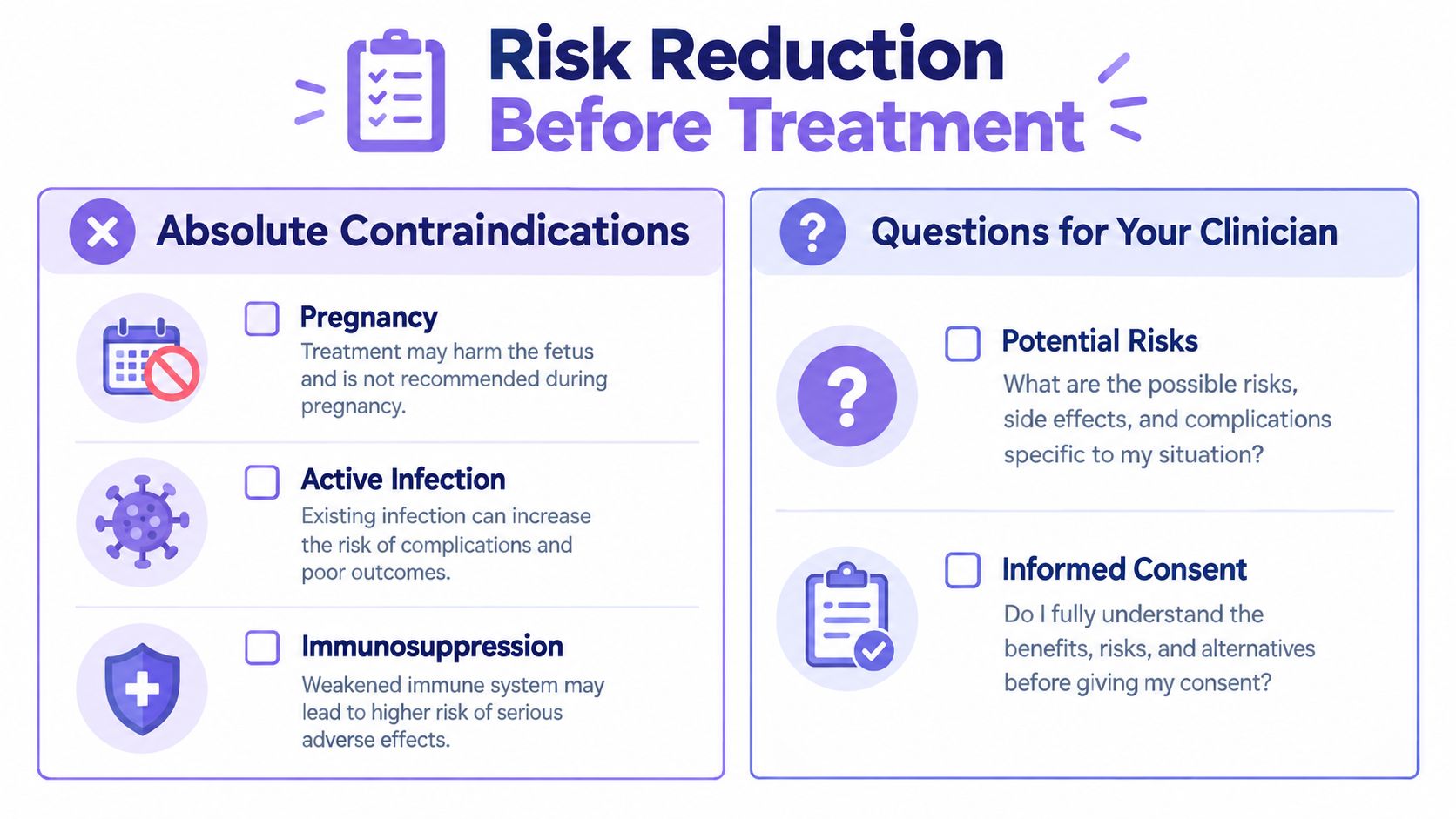
A consultation shouldn't feel like a sales interaction. You should be able to pause, decline treatment or return another day without pressure.
You can read about clinical considerations for lip filler treatment in Wakefield, but online information can't determine your eligibility. A clinician must assess you in person or through an appropriate regulated pathway before recommending treatment.
Practical Questions UK Patients Ask After Treatment
What should I do during the first 48 hours?
Use a cold compress briefly rather than applying constant pressure. Keep your head slightly propped up when resting, cleanse gently and avoid touching the treated area unnecessarily. Follow the clinic's instructions about makeup, alcohol and exercise, with many clinicians advising no makeup for 12 hours and no strenuous exercise or alcohol for 24 hours.
Don't restart retinoids, exfoliating acids or other potentially irritating skincare products until the injection sites have closed and the treating clinician says it's suitable. The right timing depends on the area, product and condition of your skin, so avoid treating a generic timetable as personal advice.
When should I call urgently?
Mild swelling, bruising, tenderness and small areas of firmness can be monitored when they're following an improving pattern. Call the treating clinic promptly if pain escalates, swelling becomes increasingly one-sided, redness spreads, the skin changes to white, dusky or mottled colour, or you develop visual symptoms.
A pharmacist can support general medicines advice within the aesthetics pathway, but can't replace the clinician who injected the filler or assess a vascular emergency remotely. Keep the treating clinician's emergency contact accessible, and seek urgent medical help if that person can't respond quickly.
Can I travel, have dental work or receive vaccinations?
Discuss travel before treatment, particularly if you'll be away from the clinic during the period when early complications could appear. Tell your dentist about existing filler before dental work, and ask the treating clinician whether planned dental treatment should be rearranged. Vaccinations and intercurrent illness may coincide with delayed swelling in previously treated areas, so report new symptoms rather than assuming they're harmless.
Future top-ups should wait until the result and any swelling have been properly assessed. More product isn't automatically the answer to early asymmetry, and repeated treatment can make later evaluation harder.
XO offers UK-based clinician-led support through XO Medical, a UK-registered pharmacy regulated by the GPhC, and in-person aesthetic care through XO Clinic, including Botox, dermal fillers, skin boosters and polynucleotides, sometimes described as salmon DNA. Visit XO to find regulated healthcare information, clinical assessment options and appropriate follow-up support.


0 comments