


You're standing by a bathroom mirror, or catching your reflection in a car window, and the corners of your hairline look slightly higher than you remember. Perhaps the change is subtle: a deeper M shape, a little more scalp visible when your hair is wet, or finer hairs around the temples. An early receding hairline can be difficult to judge from a single glance, particularly in your late teens or twenties.
The useful first step is observation rather than alarm. Hairlines can mature naturally, but progressive recession may be the frontal sign of androgenetic alopecia, commonly called male-pattern hair loss. This guide explains what the pattern means, how UK clinicians assess it, which treatments are prescription-only, and how NHS and regulated online pharmacy pathways differ. It's general information, not a diagnosis.
Table of Contents
- Noticing the First Signs of an Early Receding Hairline
- What an Early Receding Hairline Actually Is
- How Common It Is in the UK and Why Age Matters
- Distinguishing Pattern Hair Loss from Other Causes
- How Clinicians Diagnose an Early Receding Hairline
- Evidence-Based Treatments Available in the UK
- UK Regulation, Prescriptions and Online Pharmacy Access
- Realistic Timelines and When to Seek Help
Noticing the First Signs of an Early Receding Hairline
A man in his twenties may notice the change while checking his hair before work. The hairline that looked rounded in older photographs now seems more angular, and the temples appear to sit further back. Looking at one photograph rarely answers the question, because hairstyle, lighting, hair length and wetness can all change how the hairline appears.
The more useful approach is to look for progression and density. Early signs can include:
- A widening M or V shape: The corners recede while the central forelock remains lower.
- A higher forelock: The middle section may appear less prominent in relation to the temples.
- More visible scalp when wet: This can reflect reduced density, although wet hair naturally clumps together.
- Finer hairs at the front: Miniaturised hairs may be shorter, lighter and less substantial than surrounding strands.
- A gradual change in photographs: Images taken under similar conditions can reveal movement that a mirror doesn't.
Shedding on a pillow or in the shower doesn't automatically prove that the hairline is receding. Hair naturally cycles through growth and shedding, and short hairs can be difficult to identify without examining the scalp. Conversely, a hairline can change with relatively little obvious shedding because the main process is gradual follicle miniaturisation.
Practical rule: Compare photographs taken from the same angles and in similar lighting. Don't rely on a single close-up under a bright bathroom light.
A slightly higher, more defined adult hairline can be a normal maturation process. The concern rises when the temples continue moving backwards, the hairs become progressively finer, or thinning appears behind the frontal edge. The NHS men's health guidance describes male-pattern baldness as becoming more common with age and notes that some forms of hair loss are permanent. That makes early assessment worthwhile, but it doesn't mean every uneven hairline needs medication.
What an Early Receding Hairline Actually Is
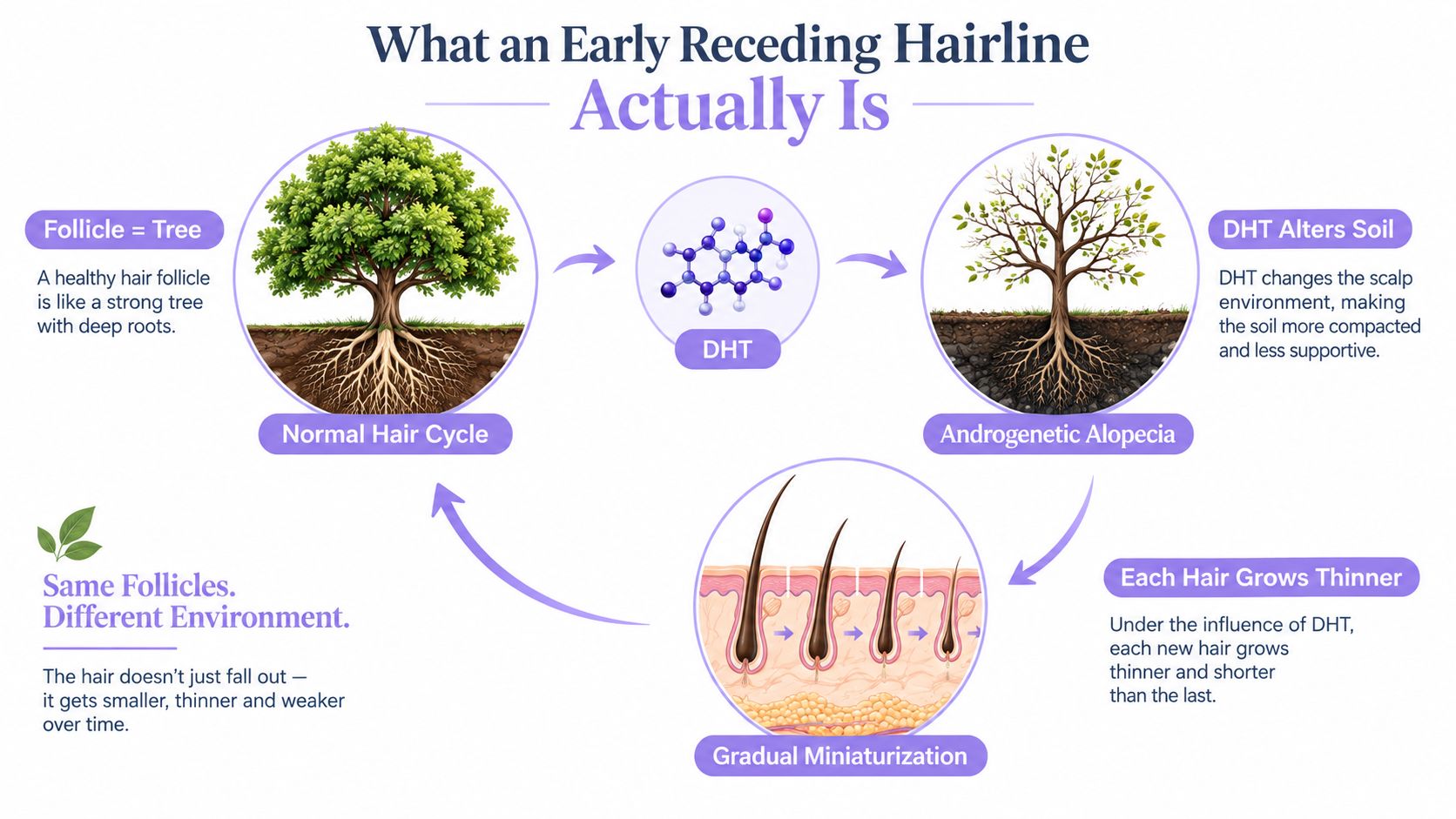
The most common explanation for a typical frontal-temporal pattern is androgenetic alopecia, a non-scarring form of hair loss caused by genetic and hormonal factors. The British Association of Dermatologists' patient information explains that dihydrotestosterone, or DHT, progressively miniaturises susceptible follicles.
A useful analogy is a tree growing in soil. The follicle is the tree, and the scalp provides its growing environment. In a genetically sensitive follicle, DHT gradually alters that environment. Each new hair grows thinner, shorter and lighter, rather than disappearing overnight. Over successive growth cycles, the follicle may produce hair that's no longer visible.
This process is called miniaturisation. It doesn't mean that every follicle is affected equally. The temples and frontal scalp are often more sensitive, which is why an early receding hairline commonly appears as a widening M shape. The crown may become involved later, although patterns vary between individuals.
Mature hairline or progressive recession
A maturing hairline is a modest shift from the lower, rounder hairline many people have during adolescence. It may create a more adult shape during the late teens or early twenties. The research material commonly used in UK hair-loss education describes this as a shift of around 1 to 1.5 cm, but that figure should be treated as a rough guide, not a diagnostic boundary.
The important difference is what happens next. A mature hairline may settle, while androgenetic alopecia tends to show continuing recession or thinning. Family history can support the diagnosis, but it isn't essential, and hair loss can occur even when relatives have retained their hair.
You may also encounter the Norwood or Hamilton-Norwood scale. These systems describe the shape and extent of male-pattern hair loss, helping clinicians communicate consistently. They're useful classification tools, not a substitute for examining the scalp or considering other causes.
How Common It Is in the UK and Why Age Matters
An early receding hairline can feel personal, but male-pattern hair loss is widespread in Britain. UK men's health materials linked to the NHS state that around 6.5 million men in the UK are affected by male-pattern baldness and that the condition becomes more common with age. Historical and demographic summaries used in UK hair-loss reporting also note that around 50% of men over 50 experience pattern hair loss. These figures place temple recession within a broad age-linked condition rather than a niche cosmetic problem.
Other UK summaries report that noticeable thinning can begin as early as age 17, with about 25% of men under 30 already showing visible thinning, although these estimates come from reporting summaries rather than a single universal measurement method. A separate UK facts summary gives a male hair-loss rate of 40.09% and reports that approximately 40% of men show hair loss by age 35, around 66% experience some thinning by ages 35 to 40, and some reports place the figure at roughly 85% by age 50. The figures vary between sources because definitions, age groups and assessment methods differ.
The UK hair-loss facts and statistics summary is useful context, but prevalence figures shouldn't be used to diagnose one person. They tell you that the experience is common, not whether a specific change is normal maturation, androgenetic alopecia or another condition.
Prevalence of male pattern hair loss by age
| Age range | Approximate prevalence of visible pattern hair loss |
|---|---|
| Under 30 | About 25% of men under 30 show visible thinning in some UK clinic summaries |
| By age 35 | Around 40% of men show hair loss in some UK reports |
| Ages 35 to 40 | Roughly 66% experience some degree of thinning in some UK summaries |
| Over 50 | Around 50% of men experience pattern hair loss in historical and demographic summaries |
Early onset matters because it gives a longer period in which progression may occur. It doesn't guarantee severe loss, and it doesn't mean treatment is mandatory. It does mean that a clinician can assess the pattern while follicles may still be producing fine hairs, rather than waiting until the area appears completely smooth.
Distinguishing Pattern Hair Loss from Other Causes
The location and behaviour of the loss often provide the first diagnostic clues. Male-pattern hair loss usually develops gradually at the temples and sometimes the crown, while other conditions may cause widespread shedding, sharply defined patches or inflammation.
| Condition | Where loss starts | Pattern of loss | Key clues |
|---|---|---|---|
| Androgenetic alopecia | Temples, frontal scalp or crown | Gradual recession and miniaturisation | Family pattern, finer hairs, relatively preserved skin |
| Telogen effluvium | Across the scalp | Diffuse shedding | Often follows illness, significant stress or another trigger |
| Alopecia areata | Any scalp area | Smooth, well-defined patches or diffuse loss | Patchiness, sudden change, possible loss elsewhere |
| Traction alopecia | Hairline and tension points | Localised thinning along pulled areas | Tight hairstyles, extensions or repeated tension |
| Scarring alopecia | Variable | Permanent loss with possible inflammation | Redness, scaling, pain or altered follicle openings |
Telogen effluvium often produces noticeable shedding after a trigger, with the hairline itself remaining relatively intact. Alopecia areata can create smooth patches without the typical temple progression. Traction alopecia follows mechanical tension from tight styling, while scarring conditions may cause redness, scaling, tenderness or a shiny area where follicle openings are no longer visible.
A clinician may assess the distribution, the thickness of individual hairs, scalp changes and the history of recent illness, medication or styling. A hair-pull test may sometimes add information, but it isn't an answer by itself.
For broader, non-diagnostic reading about products and approaches, you can browse hair loss remedies. Keep in mind that supplements and cosmetic products don't replace diagnosis, particularly when loss is rapid, patchy or inflamed. XO's educational resource on what causes male pattern baldness also provides further context on the condition.
How Clinicians Diagnose an Early Receding Hairline
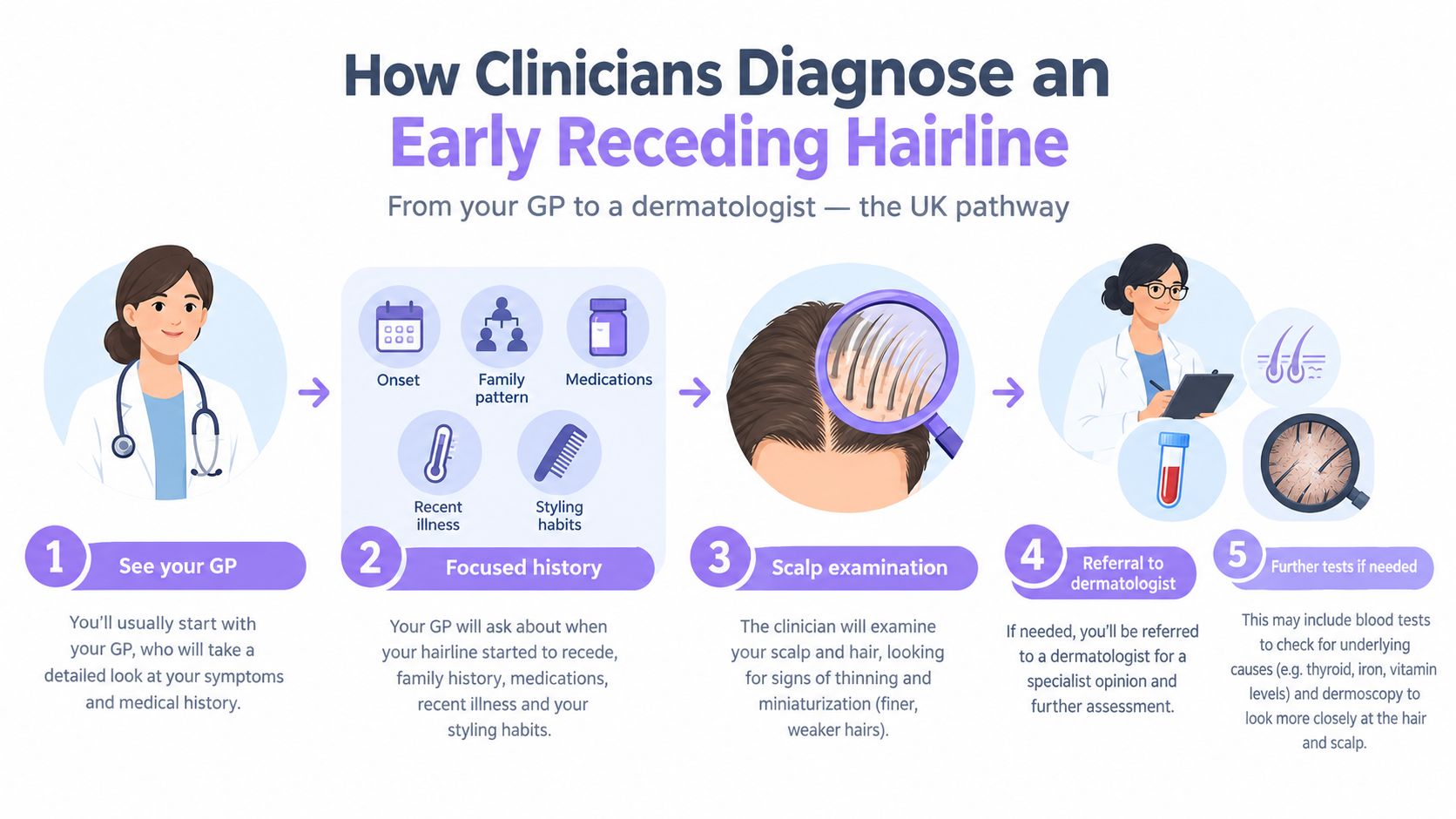
A UK assessment usually begins with a focused history rather than an immediate prescription. A GP may ask when the change started, whether it's progressing, which relatives have experienced hair loss, and whether you've recently been unwell. They may also review medicines, nutrition, weight change and hairstyling practices.
The scalp examination is performed under suitable light. The clinician looks at the temples, frontal hairline, crown and the density behind the edge. They may compare thicker terminal hairs with finer miniaturised hairs and look for scaling, redness, broken hairs or signs of scarring.
When further investigation helps
The Norwood or Hamilton-Norwood scale may be used to describe the visible pattern. Specialist clinics may also use trichoscopy, a form of magnified scalp examination that can show variation in hair shaft diameter, miniaturisation and features suggesting inflammation or scarring.
Blood tests aren't automatically needed for a classic, gradual pattern. A clinician may consider tests such as ferritin, thyroid function, vitamin D or zinc when the history suggests a reversible contributor. Test selection should follow the symptoms and examination, not a standard package applied to everyone.
Referral to a dermatologist is particularly appropriate when the loss is rapid or patchy, the scalp looks inflamed, scarring is suspected, the diagnosis is uncertain, or an initial treatment plan hasn't produced the expected result after an appropriate review period. Women with a receding frontal hairline also need careful assessment, because this pattern is less typical and may have a different cause.
A diagnosis should explain both the pattern of loss and the condition of the scalp. A prescription issued without that clinical context may miss a treatable alternative.
Evidence-Based Treatments Available in the UK
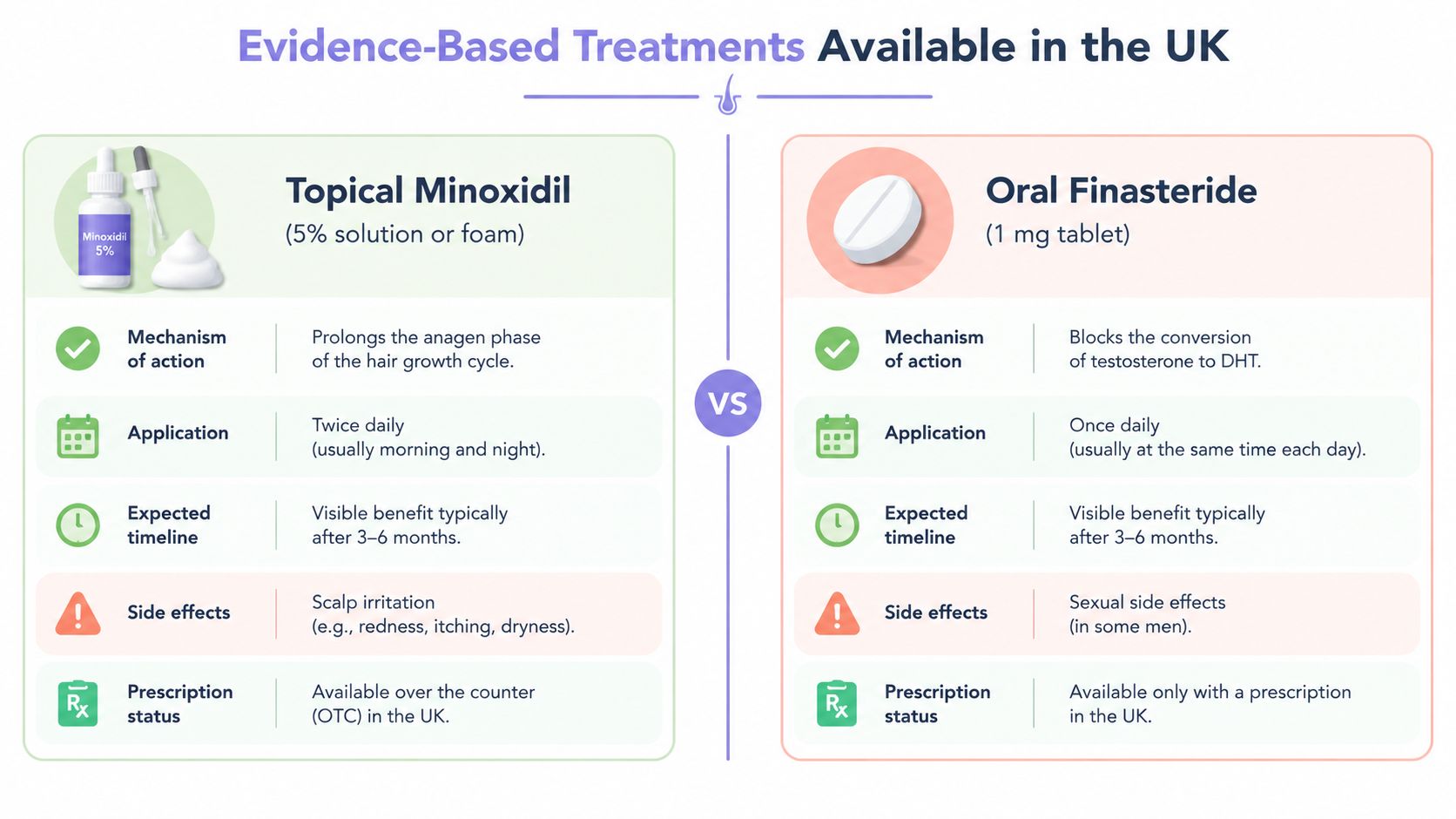
For confirmed male-pattern hair loss, minoxidil and finasteride are the principal UK treatment options. They work differently. Minoxidil acts at the follicle and can support the active growth phase, while finasteride reduces the conversion of testosterone to DHT, addressing a key hormonal pathway in susceptible follicles.
Topical minoxidil is commonly supplied as a 5% solution or foam and is generally applied twice daily according to the prescribed product instructions. Visible benefit may take several months, and ongoing use is needed to maintain any benefit. Scalp irritation can occur, and early shedding may be reported as hairs in the cycle change. A prescriber should confirm whether it's suitable, especially if the pattern is atypical.
The MHRA assessment report for finasteride confirms that finasteride 1 mg is approved in the UK for male-pattern hair loss and is available by prescription only. It isn't recommended for women or children. Finasteride may help stabilise loss and support regrowth, but response varies. Patients should discuss possible sexual and mood-related adverse effects with a prescriber before treatment and report concerning symptoms.
Options requiring specialist judgement
Low-dose oral minoxidil may be considered by specialists in selected circumstances, but hair-loss use requires medical oversight. Dutasteride is another DHT-modifying medicine that may be used off-label, so the prescriber must explain its status and suitability. Low-level laser devices and platelet-rich plasma have mixed evidence, and neither should be presented as a guaranteed replacement for established medical treatment.
Hair transplantation is a surgical option for selected patients. It doesn't stop the underlying tendency to lose native hair, so stabilising progression and planning the donor area are important parts of assessment.
If you're researching non-prescription approaches, it may help to compare DHT blockers for men, while remembering that supplements aren't equivalent to a licensed prescription medicine and may interact with other treatments.
This video provides another general explanation of the treatment topic:
For a broader overview of the options and their limitations, see XO's guide to the best treatments for thinning hair.
UK Regulation, Prescriptions and Online Pharmacy Access
Access is an important part of hair-loss care in the UK. The NHS explains that male-pattern baldness commonly presents with a receding frontal hairline and thinning on top, but NHS commissioning policies state that surgical and non-surgical treatments for male-pattern baldness aren't routinely funded. In practice, many people therefore explore private GP, dermatology or pharmacy services.
Finasteride is a prescription-only medicine. The UK Parliament written answer on finasteride confirms that finasteride-containing medicines must be prescribed by a doctor or another authorised health professional before a pharmacy can dispense them. Topical minoxidil products have different legal classifications depending on the formulation and strength, so patients should check the specific product and follow a clinician's advice rather than assuming that every version is prescription-only or freely suitable.

What a regulated online pharmacy does
A legitimate online pharmacy doesn't provide automatic access to prescribed medication. It collects relevant health information, verifies the consultation details, and sends the case to an appropriately qualified prescriber for clinical review. The General Pharmaceutical Council guidance requires online pharmacy services to verify information supplied in the initial questionnaire and supports two-way communication between the patient and prescriber.
Before using a service, check that:
- The pharmacy is regulated: Confirm its registration with the GPhC and identify the responsible pharmacy details.
- A clinician reviews the consultation: The service should explain who prescribes and how you can communicate with them.
- The product is authorised and sourced appropriately: Look for clear information about the medicine and its supply chain.
- Follow-up is available: You should know how to report side effects, ask questions and request a review.
- The service protects your information: Read its privacy and clinical governance information.
XO's educational overview of the UK online pharmacy pathway explains the distinction between a consultation-led service and unregulated sellers. Don't buy medicines from websites that conceal the prescriber, avoid health questions or offer unusually simple access to unverified products.
Realistic Timelines and When to Seek Help
Hair grows in cycles, so treatment can't be judged after a few applications or tablets. With topical minoxidil, visible changes commonly take several months, and maintaining any benefit requires continued use. Finasteride also needs sustained treatment and clinical review, with stabilisation or regrowth assessed over a longer period rather than from day-to-day shedding.
Some people notice increased shedding during the early phase of treatment, but a sudden or severe change shouldn't be dismissed automatically as a normal response. Contact a qualified healthcare professional if you develop troublesome symptoms, mood changes, sexual side effects, scalp inflammation or any reaction that concerns you.
Seek clinician-led assessment when:
- Loss is rapid: A quick change doesn't fit the usual gradual pattern.
- Loss is patchy: Smooth, sharply defined areas may indicate alopecia areata or another condition.
- The scalp is inflamed: Redness, scaling, pain or scarring needs examination.
- Hair loss follows a new medicine: A prescriber can review possible causes and alternatives.
- The pattern is unusual: Frontal loss in women or diffuse shedding needs an assessment.
Early evaluation can preserve treatment choices because miniaturised follicles may still produce fine hairs, while long-standing smooth areas are more difficult to restore. Avoid unregulated products, unapproved generics and devices promoted with guaranteed results. A UK-registered pharmacy or clinician can help you weigh likely benefits, risks, cost and the need for ongoing treatment.
This content is for informational purposes only and does not constitute medical advice. Always consult a qualified healthcare professional before starting or changing any treatment.
XO Medical provides consultation-led hair-loss care through a UK-registered pharmacy and telehealth service, while XO Clinic offers in-person aesthetics services, including botox, dermal fillers, skin boosters and polynucleotides (salmon DNA). To learn more about the available clinical pathways and arrange an appropriate consultation, visit XO.


0 comments