


Seeing dramatic GLP-1 weight loss before and after photographs online can make treatment appear straightforward. One image shows a person before treatment, another shows a much smaller body, and the difficult months between those photographs are missing. There's usually no explanation of the starting BMI, the prescribed dose, side effects, clinical supervision, lifestyle support, or what happened after treatment stopped.
A safer way to assess these medicines is to look at aggregated UK clinical data, not isolated social media results. Semaglutide, sold for obesity as Wegovy, and tirzepatide, sold as Mounjaro, are prescription-only treatments used within defined medical pathways. They can support meaningful weight loss, but they aren't cosmetic quick fixes. Outcomes depend on eligibility, dose progression, tolerability, food and activity changes, engagement with follow-up, and the maintenance plan created with a prescriber.
Table of Contents
- Understanding Realistic GLP-1 Weight Loss Before and After Expectations
- How GLP-1 Medications Work and Typical Treatment Timelines
- Interpreting Clinical Data and Real-World UK Outcomes
- The Reality of Weight Maintenance After Stopping Treatment
- UK Eligibility Criteria and Regulatory Safety Standards
- Taking the Next Step with Regulated Clinical Support
Understanding Realistic GLP-1 Weight Loss Before and After Expectations
Why online photographs can mislead
A before-and-after photograph shows an outcome, not the treatment process. It can't tell you whether the person used semaglutide, tirzepatide, another intervention, or a combination of approaches. It also doesn't show whether weight loss continued steadily, whether treatment was stopped, or whether some weight returned afterwards.
Clinical results are presented differently. Researchers measure changes across groups of patients, usually as a percentage of starting body weight, and follow people over a defined period. That approach gives a more useful benchmark than selecting the most dramatic personal story online.
For example, the NICE evidence and recommendation for semaglutide described about 12% greater average body-weight loss than placebo over 68 weeks in the STEP 1 trial. That doesn't mean every patient will lose the same amount, nor does it mean the result happens immediately. It reflects an average in a particular clinical trial, with a structured treatment approach and defined eligibility.
A realistic before-and-after comparison includes the treatment timeline, clinical context and maintenance plan, not just the final photograph.
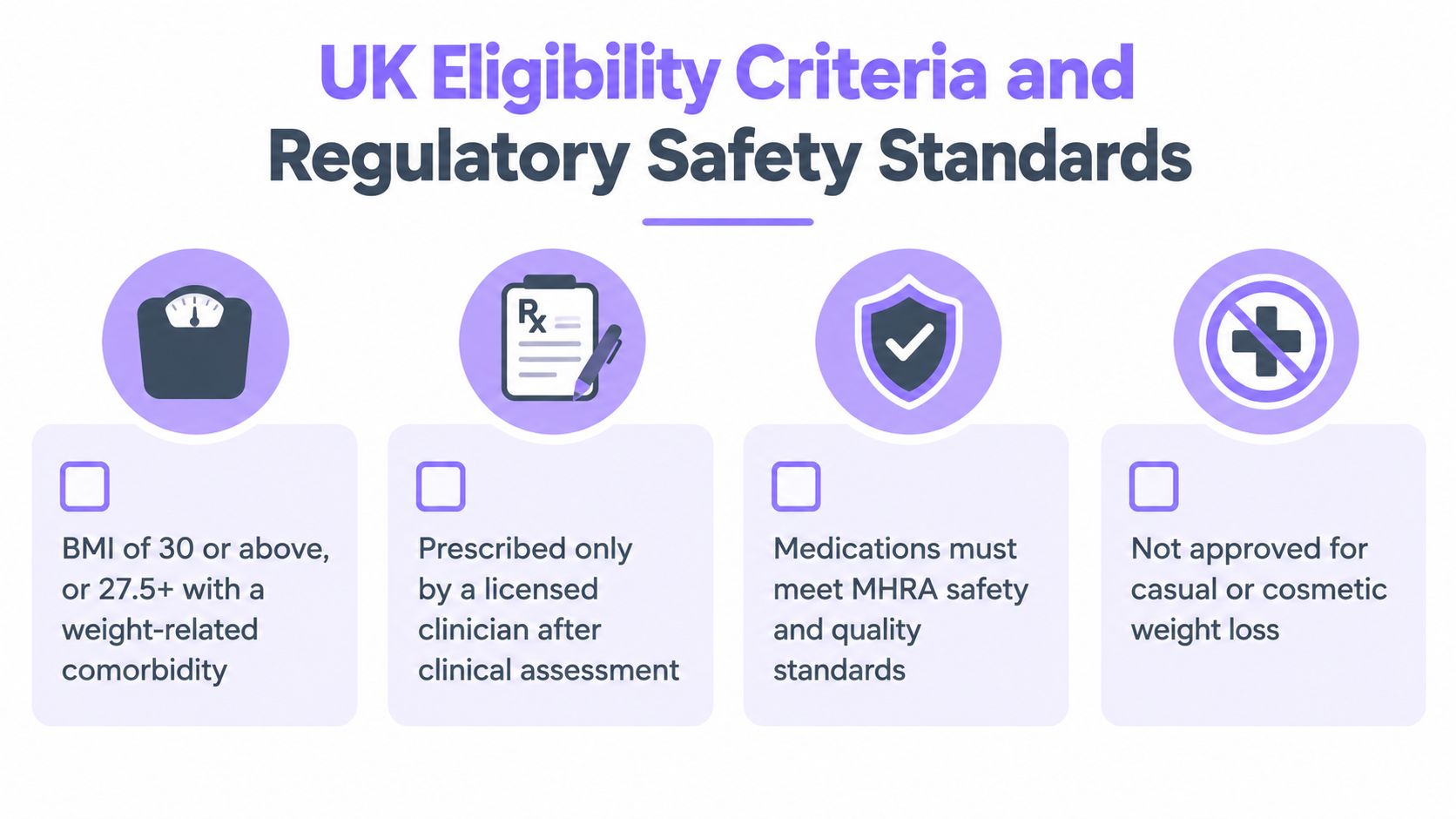
Semaglutide is a GLP-1 receptor agonist. In the UK, it's used for obesity under the brand Wegovy. Tirzepatide acts on GLP-1 and another hormone pathway, and is available as Mounjaro for eligible patients. Both require assessment by an authorised prescriber. The UK Government explains that GLP-1 medicines are licensed for specific medical disorders and aren't intended for cosmetic weight loss. Some are prescription-only medicines supplied through the NHS under defined conditions or through regulated private care, as described in its guidance on GLP-1 medicines for weight loss and diabetes.
What a clinically meaningful result involves
The number on the scales matters, but it isn't the only measure. A prescriber may also consider appetite control, waist measurements, mobility, blood pressure, blood glucose, sleep, eating patterns, treatment tolerability and whether the patient can sustain new habits.
NICE says semaglutide should be used alongside a reduced-calorie diet and increased physical activity, within specialist weight-management services. Its public information also says treatment may be stopped if a patient loses less than 5% of initial weight after 6 months, a threshold that is linked to treatment review rather than a promise of a particular result.
A patient seeking private healthcare should therefore ask practical questions before treatment begins:
- Who assesses me? The provider should use a qualified prescriber who reviews medical history, current medicines and relevant risks.
- How is progress monitored? A safe service should provide follow-up, assess side effects and review whether treatment remains appropriate.
- What happens if I plateau or stop? A proper plan should include maintenance support rather than treating the final prescription as the end of care.
The most reliable interpretation of GLP-1 weight loss before and after results is cautious. Some people achieve substantial loss, some lose less, and some stop because of side effects or lack of benefit. Your result can't be predicted from another person's photograph.
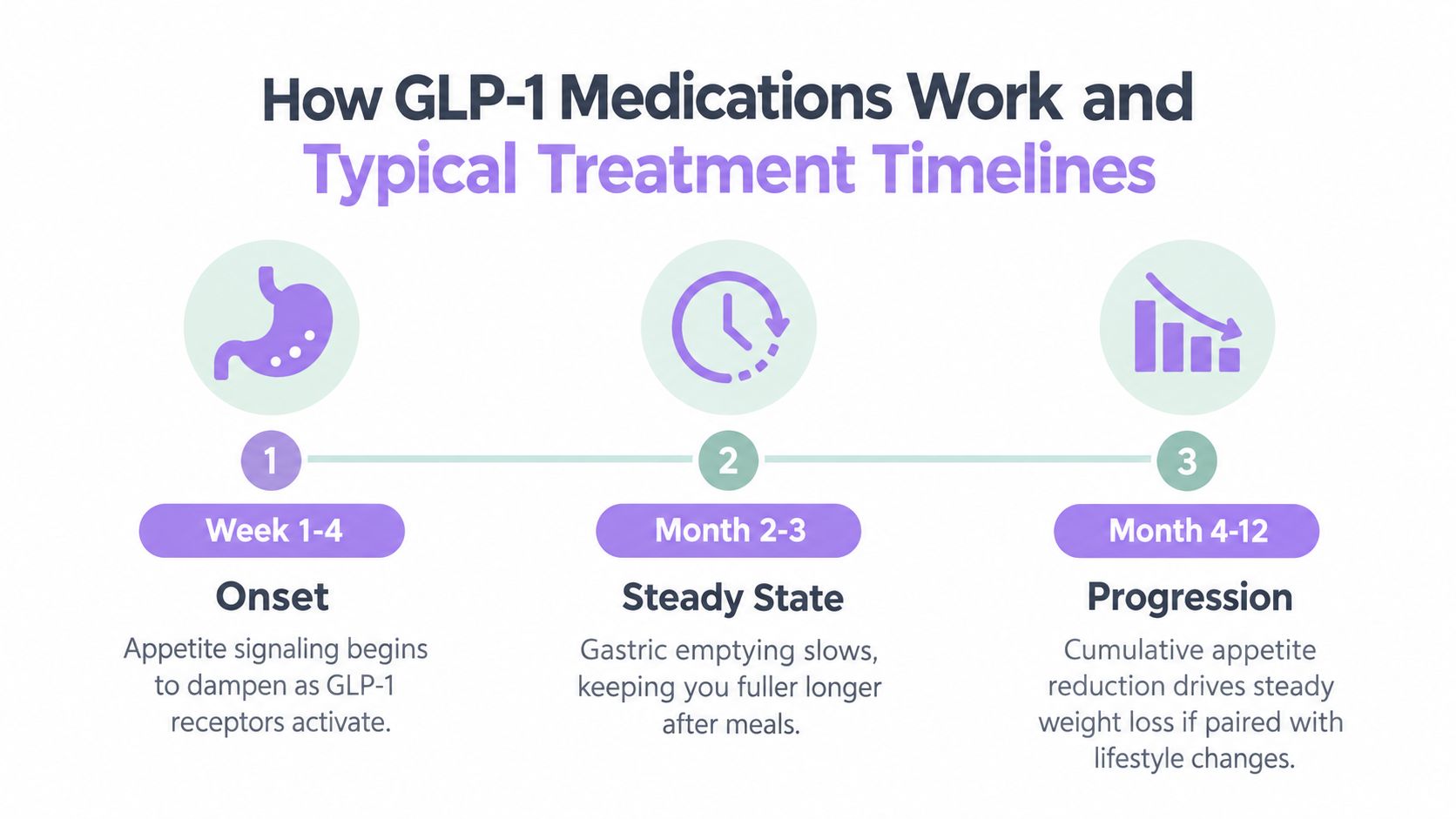
How GLP-1 Medications Work and Typical Treatment Timelines
GLP-1 medicines imitate the action of a naturally occurring gut hormone involved in appetite and digestion. Semaglutide helps reduce appetite and makes people feel fuller for longer, and the NHS advises that it should be used with exercise and diet changes for effective obesity management, as explained in its semaglutide medicine information.
The practical effect is usually a reduction in hunger and food intake, rather than a direct process that removes fat without effort. These medicines can also slow the movement of food through the stomach. That may help fullness last longer, but it can contribute to gastrointestinal side effects, particularly as the dose changes.
For a plain-language explanation of semaglutide's role, see what semaglutide is used for. It's still important to distinguish educational information from an individual treatment recommendation.
The early treatment phase
During the first weeks, the main clinical task is usually safe dose escalation. The prescriber starts at a dose intended to help the body adjust, then increases it according to the product instructions and the patient's response. A person may notice appetite changes before seeing a large change in weight, while another may experience nausea or other symptoms that require clinical review.
The first month isn't a reliable point at which to judge the whole treatment. Eating less because of reduced appetite can take time to become consistent, and the early dose may not be the final therapeutic dose. Patients shouldn't increase, repeat or alter doses outside the instructions given by their prescriber.
Months two and three
As treatment progresses, the patient and clinician can assess whether appetite suppression is useful, whether meals remain nutritionally adequate and whether side effects are settling. The number on the scales may move unevenly. Day-to-day changes can reflect fluid, bowel movements and normal variation, so a clinician will usually look at the trend rather than one reading.
This is also when structured support becomes important. A reduced-calorie eating pattern should still provide adequate nutrition, and physical activity should be adapted to the person's health and ability. The aim isn't to eat as little as possible. It's to establish a pattern that can continue if the dose changes or treatment later ends.
Later months and visible change
By later months, cumulative changes in appetite, food intake and activity may produce a clearer before-and-after difference. Yet treatment response remains individual. Some patients plateau, and a plateau doesn't automatically mean the medicine has failed. It may prompt a review of dose, adherence, eating pattern, activity, side effects, eligibility or the wider care plan.
NICE states that semaglutide produces greater weight loss when combined with supervised weight-management support than support alone, and that it outperforms liraglutide in weight reduction. In UK practice, semaglutide is recommended only with diet and activity support, and treatment within specialist services is limited to a maximum of two years, according to NICE's recommendations.
The timeline is therefore progressive rather than instant. A responsible prescriber tracks more than photographs, including symptoms, dose changes, nutrition, activity and the patient's ability to continue safely.
Interpreting Clinical Data and Real-World UK Outcomes
A patient may compare one social media photograph with another and expect the same result from treatment. Clinical data offers a more reliable view. It replaces selected before-and-after images with averages from groups, while showing how care works outside a tightly controlled trial.
Clinical trials test a medicine under defined conditions, with planned follow-up and carefully selected participants. An NHS service evaluation asks a different question: what happens in routine care, where missed appointments, side effects, changing motivation and access problems can affect progress?
UK real-world evidence from 1,666 NHS patients with severe obesity found mean weight loss of 4.39% at 3 months and 8.53% at 6 months while using semaglutide. The group's baseline mean BMI was 46.91 kg/m². These averages come from the UK NHS semaglutide real-world evidence evaluation, so they describe a defined population rather than a guaranteed personal trajectory.
The evaluation also reported different results according to digital engagement. App-engaged patients reached 9% weight loss at 3 months and 11.53% at 5 months. Non-engaged patients reached 5.9% and 8% at those same time points.
What the comparison tells us
| Timeframe | Digitally Engaged Cohort | Non-Engaged Cohort |
|---|---|---|
| 3 months | 9% loss | 5.9% loss |
| 5 months | 11.53% loss | 8% loss |
These are aligned time points, which makes the comparison easier to interpret. It still does not prove that using an app alone caused the difference. Digital engagement may sit alongside other factors, such as follow-up attendance, motivation or contact with the care team. The findings do show why engagement with monitoring and clinical support matters when assessing GLP-1 weight loss before and after outcomes.
The 8.53% figure at 6 months belongs to the full cohort and has no digitally engaged equivalent in the cited evaluation. It should not be read as a direct six-month comparison between the two engagement groups.
Why starting point matters
Percentage weight loss is calculated from the starting weight. Two people can lose the same percentage but a different number of kilograms. Age, medical conditions, other medicines, eating patterns, activity, dose tolerance and adherence can also influence results.
Online reviews are personal accounts, not forecasts. This patient-focused explanation of Mounjaro weight loss reviews can help readers identify useful questions, but it cannot replace clinical assessment.
The practical conclusion is that medication is one component of care. A regulated online pharmacy or telehealth service should pair prescribing with follow-up, practical lifestyle support and progress records, giving the prescriber evidence to assess safety and response.
The Reality of Weight Maintenance After Stopping Treatment
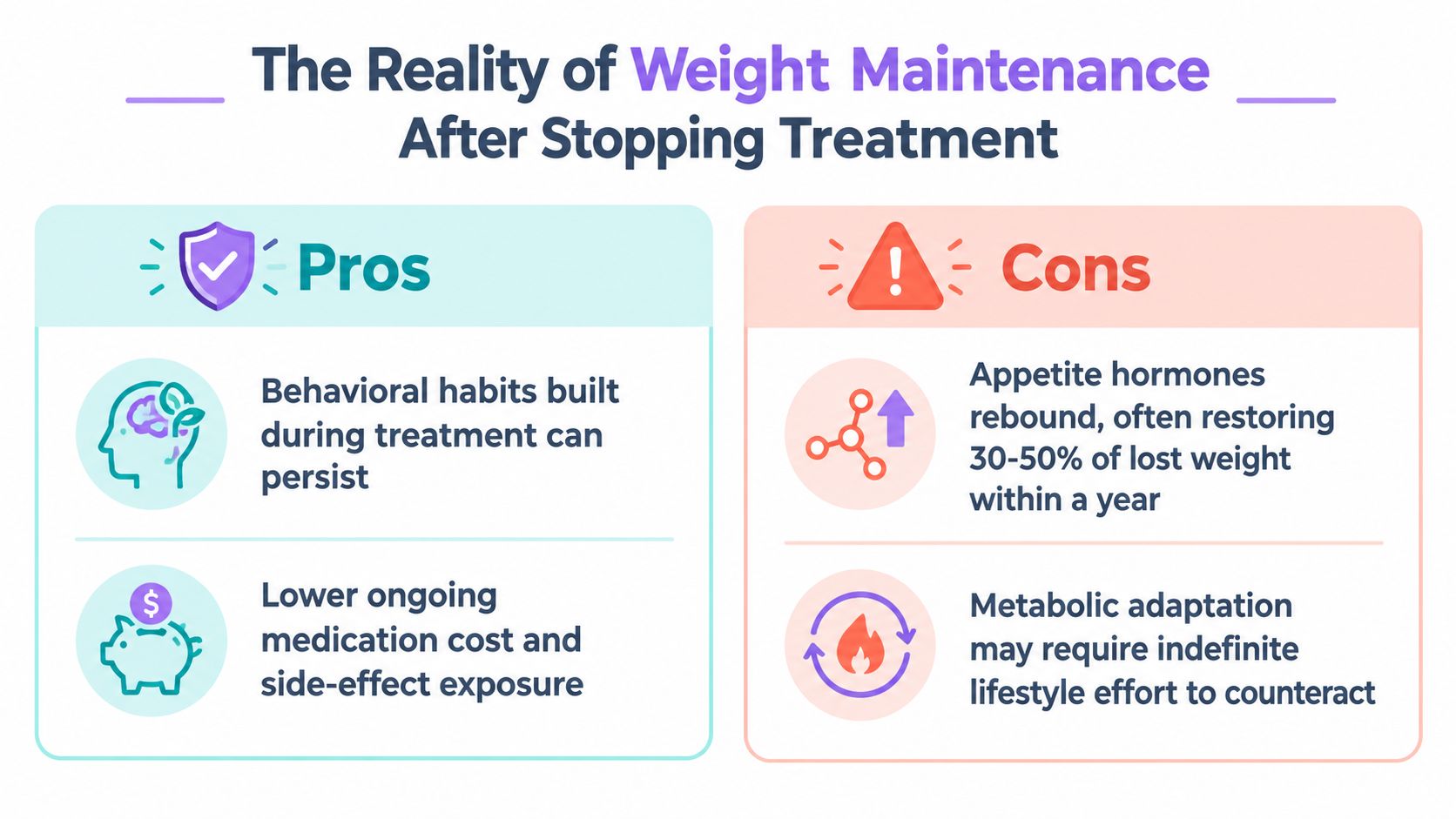
Reaching a target weight is not necessarily the end of medical care. GLP-1 medicines influence appetite while they're being taken, so stopping treatment can change hunger, fullness and eating patterns. Patients should discuss any decision to stop with their prescriber rather than treating discontinuation as a purely personal choice.
A 2025 Oxford-led review found average weight regain of 0.4 kg per month after stopping weight-loss medication, rising to about 0.8 kg per month after semaglutide or tirzepatide cessation, as reported in this UK clinical discussion of weight-loss medicines after stopping treatment. The review also modelled a possible return towards pre-treatment weight in roughly 1.5 to 2 years, although individual experiences vary.
Maintenance needs its own plan
Weight regain isn't proof that a patient has failed. It reflects the fact that appetite regulation and energy balance can change when treatment is withdrawn. Some habits built during treatment may continue, but increased hunger can make those habits more difficult to maintain without structured support.
A maintenance plan may include regular clinical reviews, realistic eating goals, activity that fits the patient's health, and early action if weight or appetite begins to change. NICE updated its quality standard in 2025 to state that people stopping weight-loss medicines should receive advice and support to maintain changes. That makes post-treatment care part of responsible practice, not an optional extra.
Stopping treatment should begin a planned review, not end the relationship with the prescriber.
People often search for a “lasting weight loss plan” after seeing weight regain concerns. A resource such as this lasting weight loss plan may help with general planning, but patients should adapt any approach with a qualified healthcare professional when they have medical conditions or prescribed treatment.
Further practical questions about discontinuation are addressed in what happens when you stop taking Mounjaro. The appropriate course may differ between patients, particularly where side effects, pregnancy plans, other medicines or health conditions are involved.
The following video provides additional educational context on weight maintenance after treatment:
UK Eligibility Criteria and Regulatory Safety Standards
GLP-1 medicines aren't automatically available because someone wants to lose weight. A prescriber must decide whether the treatment is clinically appropriate after reviewing health history, current medicines, previous weight-management efforts, contraindications, expected benefits and potential risks.
NICE's original recommendation for semaglutide covered adults with obesity who had a BMI of at least 35 kg/m² and at least one weight-related condition, with use within specialist weight-management services for a maximum of two years, as set out in NICE's announcement on semaglutide. Current NHS pathways and eligibility can depend on the medicine, local commissioning arrangements, ethnicity-related thresholds and individual clinical circumstances.
NHS England states that Wegovy can be prescribed for obesity through a specialist weight-management service. Its eligibility information includes a BMI of 35 or more, or 32.5 or more for some ethnic groups, with lower thresholds only when other criteria are met, as explained in NHS England's information on weight-management injections.
What a safe service should do
A legitimate online pharmacy isn't a website where a patient selects an injection. The service should establish who is prescribing, how the consultation is performed and how follow-up will work.
Look for these safeguards:
- Clinical assessment: A licensed prescriber reviews relevant medical information before issuing prescribed medication.
- Clear dose instructions: The service explains how dose escalation works and what to do if a dose is missed or side effects occur.
- Ongoing monitoring: Patients can contact an appropriate clinician and receive review when symptoms or progress raise concerns.
- Legal supply: A UK-registered pharmacy regulated by the GPhC dispenses the medicine through the proper prescription pathway.
- Transparent limitations: The provider explains that treatment isn't suitable for everyone and doesn't promise a specific before-and-after result.
Tirzepatide has its own guidance. NICE recommends Mounjaro for adults with overweight or obesity in defined circumstances, while its tirzepatide guidance notes the importance of assessment, counselling and follow-up checklists. NHS England also states that it should be used alongside a reduced-calorie diet and increased physical activity.
Be particularly cautious of sellers that avoid medical questions, offer treatment without a proper consultation, or describe GLP-1 injections as cosmetic products. An in person aesthetics clinic offering botox, dermal fillers, skin boosters and polynucleotides (salmon DNA) is a different type of service from a regulated weight-management pathway. The distinction matters because a prescription-only treatment requires appropriate prescribing and clinical oversight.
Taking the Next Step with Regulated Clinical Support
A patient considering treatment may start with a simple question: “Will my result look like the photographs I've seen?” A safer question is: “Can a qualified clinician assess whether this treatment is suitable for me, explain the likely limitations and support me through dose changes and maintenance?”
That distinction is increasingly important as access expands. A 2026 Great Britain survey estimated that 2.9% of adults, or about 1.6 million people, had used a GLP-1 or GLP-1/GIP medicine for weight loss in the past year. The same survey estimated that 1.7%, around 910,000 adults, had used these medicines exclusively for weight loss, and 91.4% of that group reported using medicines licensed for this purpose in Great Britain, most commonly Mounjaro at 80.2%, according to the peer-reviewed Great Britain survey.
Questions to ask before treatment
A regulated telehealth service should make the process understandable rather than rushing you towards payment. Before completing a consultation, check:
- Is the medicine prescribed after an individual clinical assessment?
- Is the dispensing pharmacy UK-registered and regulated by the GPhC?
- Can you access follow-up support if you develop side effects or reach a plateau?
- Does the service discuss diet, activity and weight maintenance, rather than focusing only on rapid loss?
- Will the prescriber explain eligibility, treatment duration and what happens if treatment stops?
An online pharmacy can be convenient, but convenience shouldn't remove clinical safeguards. A UK-registered pharmacy may provide remote consultations and delivery, while a patient should still receive clear information, appropriate review and a route to ask questions. The same principle applies whether treatment is arranged through an NHS specialist service, a private clinic or an online provider.
For context, an online consultation may be suitable for some adults, while others need an in-person assessment because of complex medical history, symptoms or uncertainty about eligibility. Don't conceal information to obtain a prescription. Accurate answers help the prescriber select safer options or advise that another form of care is more appropriate.
GLP-1 weight loss before and after results are best judged by health, sustainable habits and clinically monitored progress, not by the most striking photograph. A good treatment plan includes an assessment before the first dose, supervision during treatment and a practical approach to maintaining progress afterwards.
XO Medical provides online consultations with UK-registered clinicians and dispenses prescribed treatments through a pharmacy regulated by the GPhC, while XO Clinic provides in-person medical aesthetics care. To explore regulated healthcare options and arrange an appropriate assessment, visit XO.
Reviewed by: Qualified UK healthcare professional
Review date: 30 September 2026
This content is for informational purposes only and does not constitute medical advice. Always consult a qualified healthcare professional before starting or changing any treatment.


0 comments