


You've stepped on the scales and seen a change, but the number alone doesn't tell the whole story. Losing a particular number of kilograms can represent very different progress for people who started at different weights. That's why weight loss percentage is a useful way to understand change relative to your own starting point.
The calculation is simple, but accurate interpretation requires consistency. This guide explains how to calculate weight loss percentage, avoid common measurement errors, and understand what your result may mean within UK health guidance. It's also important to remember that weight is only one measure of health, and a percentage result shouldn't be used as a substitute for clinical assessment.
Reviewed by: Qualified healthcare professional
Review date: 4 October 2026
Table of Contents
- Understanding the Importance of Tracking Progress
- The Formula for Calculating Weight Loss Percentage
- Worked Examples Across Different Body Sizes
- Common Mistakes in Weight Loss Calculations
- Interpreting Your Results Against UK Clinical Guidelines
- Conclusion and Next Steps for Safe Monitoring
Understanding the Importance of Tracking Progress
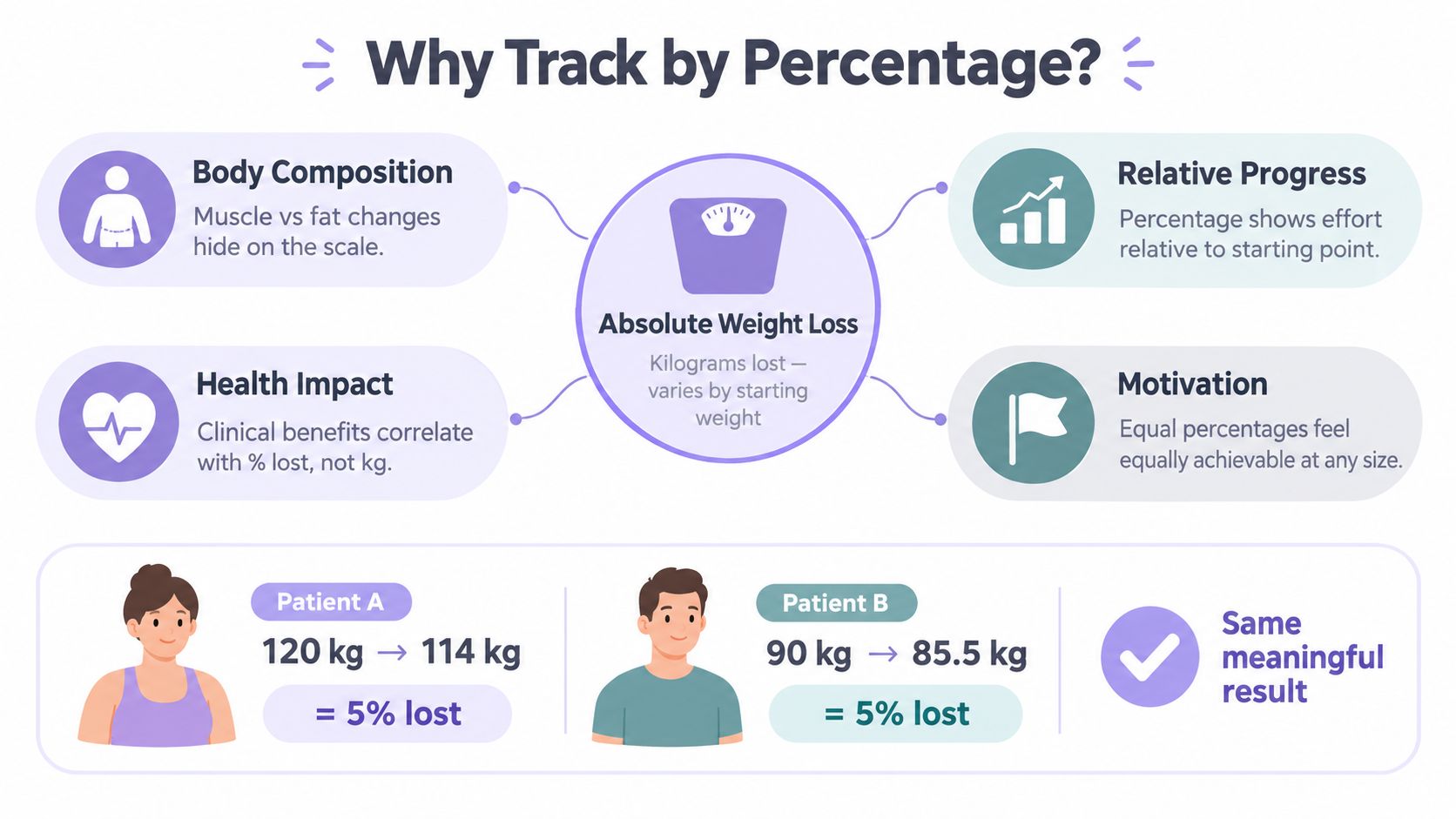
Standing on the scales during a weight-management journey can feel discouraging if you focus only on kilograms. A change that seems small may represent meaningful progress for your body, while the same absolute change can mean something different for another person.
Percentage tracking solves this problem by relating the change to your starting weight. It gives you a standardised measure that can be followed over time, whether your starting point is relatively lower or higher. This is particularly helpful when you're reviewing progress with a prescriber, pharmacist, dietitian, or other healthcare professional.
The percentage doesn't make the scale more accurate. It makes the result easier to interpret.
Why relative progress matters
Your weight can change because of food, fluid, clothing, bowel movements, exercise, and other short-term factors. Percentage tracking is most useful when you compare measurements collected under similar conditions, rather than reacting to a single reading.
It can also sit alongside other measures, such as waist measurements, mobility, fitness, blood pressure, or blood glucose where clinically appropriate. Weight loss may be one part of a broader health plan, not the sole definition of success.
Practical rule: Use the percentage to understand the direction and scale of your progress, not to judge your worth or make abrupt treatment decisions.
A structured routine can make tracking feel more manageable. The XO guide to starting a weight-loss journey may help you organise your goals, while people who want support with food organisation can find the best meal planning app. Choose tools that support steady habits rather than encouraging constant checking.
The Formula for Calculating Weight Loss Percentage
The formula is:
Weight loss percentage = (starting weight − current weight) ÷ starting weight × 100
Use the same unit for both weights. You can use kilograms or stones and pounds, but you must not place a weight in kilograms into a calculation with a weight in stones or pounds.
Breaking down the calculation
- Record your starting weight. This is the weight at the beginning of the period you're assessing.
- Record your current weight. Use a comparable measurement taken under similar conditions.
- Subtract the current weight from the starting weight. This gives the absolute amount lost.
- Divide the amount lost by the starting weight.
- Multiply by 100. The result is your percentage loss.
For example, if your starting weight was 90 kg and your current weight is 81 kg, the calculation is:
(90 − 81) ÷ 90 × 100 = 10.0%
This worked example and the calculation method are also set out in UK guidance explaining weight loss percentage.
The starting weight is the denominator because the percentage describes how much of your original body weight has changed. Using your current weight as the denominator would answer a different question and would make comparisons over time less consistent.
What if your weight has increased?
If the current weight is higher than the starting weight, the result will be negative. For example, the difference between the two measurements represents a gain rather than a loss, so the calculation may show a negative percentage. That isn't a calculation failure. It accurately indicates that your weight is above the selected baseline.
For broader body-composition planning, a body recomposition calculator may be a separate reference, but it doesn't replace a clinical assessment of your health, medication, or nutritional needs.
Worked Examples Across Different Body Sizes
A 5 kg change does not represent the same proportion for everyone. Comparing the same loss across different starting weights shows why percentage provides useful context alongside kilograms. The table applies the standard calculation described in UK weight-loss percentage guidance.
| Starting Weight | Current Weight | Absolute Loss | Percentage Loss |
|---|---|---|---|
| 60 kg | 55 kg | 5 kg | 8.3% |
| 90 kg | 85 kg | 5 kg | 5.6% |
| 100 kg | 95 kg | 5 kg | 5.0% |
Each person has lost the same absolute amount, yet the relative change is greatest for the person who began at 60 kg. Kilograms are the size of the parcel; percentage is the parcel's size compared with the original load. That comparison makes progress easier to interpret across different starting points.
The percentages do not rank effort or determine whose health outcome is more valuable. Clinical meaning depends on factors such as body composition, medical conditions, treatment, nutritional status, and the time taken to lose weight. NHS and NICE guidance can provide context for health and weight management, but a percentage alone does not establish whether a target is appropriate.
Applying the method to your own figures
Write both measurements down before calculating. If your starting weight was 100 kg and your current weight is 95 kg, the change is 5 kg. Dividing that change by the starting weight gives 5%, using the standard approach outlined in NHS weight-management advice.
Record the dates and measurement conditions as well. A percentage calculated over a short period answers a different question from one calculated over several months, even when the final figure looks similar. This result can support a clinical conversation, but it cannot show whether your rate of loss is safe or whether treatment should change.
A percentage measures change. It is not, by itself, a diagnosis or treatment recommendation.
Compare your result with another person's only when the starting points and measurement periods are clear. Mixing baselines can make the overall change appear larger or smaller than it really is.
Common Mistakes in Weight Loss Calculations
Suppose your scale shows a change that seems larger than expected. Before trusting the percentage, check whether both measurements were taken under comparable conditions. A correct formula cannot correct inconsistent inputs.
Keep the measurement conditions consistent
Use the same scale where possible and weigh at a similar time of day. A morning measurement after emptying your bladder gives a more consistent reference because food, fluid, clothing, and normal daily variation can alter the reading. See this guidance on consistent weighing conditions for weight-loss tracking for practical measurement advice.
One unusual reading does not necessarily represent a change in body fat. A heavier result after a meal or a lighter result after a period without food may reflect short-term fluid and food-related variation. Treat the reading as one observation, not the whole trend.
Check your units before calculating
Stones and pounds, pounds alone, and kilograms are all usable units. The starting and current weights must use the same unit, however. Convert one measurement before applying the formula if your records combine units.
Common errors include:
- Mixing units: A starting weight in kilograms and a current weight in stones cannot produce a valid percentage.
- Changing scales: Different scales may show slightly different readings, creating an artificial change when you switch between them.
- Changing the time of day: Morning and evening measurements are not directly comparable because food and fluid intake vary.
- Changing the baseline: A result based on your original starting weight answers a different question from one based on a later weight.
- Rounding too early: Keep measurements as precise as the scale reasonably allows, then round the final percentage.
Understand a negative result
If your current weight is above your starting weight, the result will be negative. That does not mean the calculation failed. It means the measured weight increased during the period you selected.
If your weight has fluctuated around the baseline, describe the period accurately rather than choosing the lowest reading as your starting point. A consistent method makes the result more useful when discussing progress with a clinician and reduces decisions based on temporary variation.
Interpreting Your Results Against UK Clinical Guidelines
You have calculated a 7% loss since your starting weight. The next question is not just whether the arithmetic is correct. You may want to know whether that change is meaningful for your health, how it compares with a structured programme, or whether it meets a review point for prescribed treatment. The same percentage can answer different questions depending on the time period and purpose of the measurement.
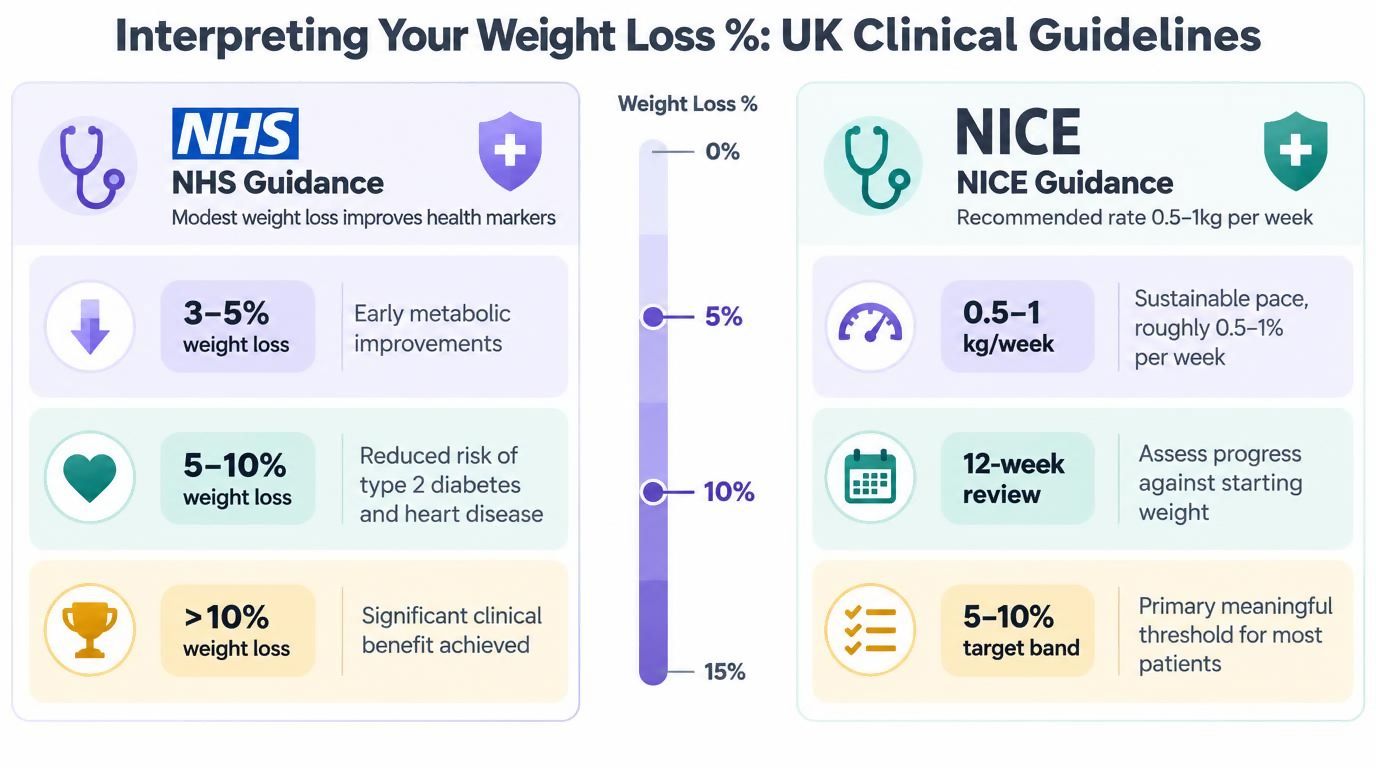
UK health guidance commonly uses 5% to 10% of starting body weight as a clinically meaningful range associated with health benefits, including improvements in blood pressure and blood glucose control. The NHS also recommends gradual progress of 1 to 2 lb, or 0.5 to 1 kg, per week, as described in its weight-management advice. A weekly rate and an overall percentage measure different parts of the same journey. One shows the pace of change, while the other shows the change relative to your starting weight.
A percentage is not a pass or fail mark
The 5% to 10% range is a clinical reference point, not a compulsory target for every adult. Your appropriate goal can depend on your health, starting weight, medicines, eating pattern, physical activity, and conditions that affect weight or nutrition. A result below this range can still represent useful progress, particularly when it forms part of a wider plan agreed with a healthcare professional.
Programme results also need careful interpretation. NICE-linked benchmarks cited in UK studies describe a successful 12-week programme as achieving at least 3% average weight loss, with at least 30% of participants reaching 5% or more after three months. In the evaluation of the NHS Weight Loss Plan app, 94% of completers reported some loss, 64.2% of completers reached at least 5% loss, and 17.1% of starters reached that level. Completers lost a mean 6.5%, while all starters averaged 2.4%, which is why completion rates and denominators matter when interpreting programme outcomes. The figures are reported in the UK evaluation evidence and the government evaluation of the NHS app.
A personal result from a completed plan should not be compared automatically with an average that includes people who started but did not complete it. Check what group the figure describes before using it as a benchmark for your own progress.
How medication reviews use the percentage
For some prescription-only weight-management treatments, clinicians use percentage weight reduction during a treatment review. NICE states that, when medicines are used to manage overweight and obesity, the percentage should be assessed after 6 months on the highest tolerated dose. If less than 5% of initial weight has been lost at that point, continuation should be reviewed by weighing potential benefits and risks, as set out in NICE prescribing guidance.
This review point does not tell you to stop prescribed medication. Speak with the prescriber first. The decision may involve side effects, treatment response, eligibility, other medicines, and health risks, so the percentage is one part of a clinical assessment.
BMI can provide additional context, but it is a screening measure rather than a complete description of health. The NHS and NICE BMI calculator guide explains its role in assessment. Access criteria for some services vary. NHS England's interim commissioning guidance for tirzepatide uses an initial BMI of at least 35 kg/m², with thresholds adjusted downward by 2.5 kg/m² for people from specified ethnic backgrounds because of different cardiometabolic risk profiles, as explained in the NHS England guidance.
Medicines used for weight management are prescription-only treatments where applicable. An online pharmacy should assess whether treatment is clinically appropriate, use a UK-registered prescriber, and follow UK medicines and pharmacy requirements. Look for a UK-registered pharmacy regulated by the GPhC, rather than assuming that an online consultation guarantees access to medication.
Conclusion and Next Steps for Safe Monitoring
To calculate weight loss percentage, subtract your current weight from your starting weight, divide the difference by your starting weight, and multiply by 100. Use the same unit for both measurements and keep your weighing conditions consistent. The result tells you how much your weight has changed relative to your own starting point.
The number becomes more clinically useful when you interpret it alongside the time period, your health goals, and any treatment you're using. UK guidance commonly uses gradual progress and the 5% to 10% range as important reference points, but your own target should be discussed with a qualified healthcare professional.
A practical monitoring routine is straightforward:
- Choose a baseline: Record the weight and date you're using as your starting point.
- Repeat consistently: Use the same scale and similar conditions for later measurements.
- Calculate periodically: Avoid reacting to every short-term fluctuation.
- Record the context: Note relevant changes in treatment, illness, activity, or eating patterns.
- Review safely: Discuss unexpected changes or treatment concerns with a clinician.
Weight is only one part of a health assessment. A clinician may also consider medical history, BMI, waist measurement, blood pressure, blood glucose, medicines, nutritional status, and how you feel day to day. The XO resource on protein intake for weight loss provides general educational information, but it shouldn't replace individual nutritional advice.
XO Medical is a UK-registered online pharmacy and telehealth service where eligible patients are assessed by UK-registered clinicians before prescribed medication is considered. Its weight-management support includes clinical review and ongoing health tracking, while an in-person aesthetics clinic offering botox, dermal fillers, skin boosters and polynucleotides (salmon DNA) is a separate service, so patients should ensure they're speaking to the appropriate healthcare team for their needs.
This content is for informational purposes only and does not constitute medical advice. Always consult a qualified healthcare professional before starting or changing any treatment.
If you're tracking weight change and want regulated clinical support, visit XO to learn about its UK-registered pharmacy services and clinician-led assessment process. Use your percentage result as a starting point for a safe, informed conversation rather than as a reason to begin or change prescribed medication without professional oversight.


0 comments