


If your skin feels tight, dull or flaky, are you missing water, or are you missing a stronger barrier? That's the question many are asking when they search for a hyaluronic acid moisturiser, because hydration and barrier repair are related but not the same thing.
A hyaluronic acid moisturiser is best understood as a humectant product. It helps bind water in the outer skin layers, which can improve comfort and make the skin look smoother, but it isn't the same as a rich barrier cream built around ceramides, glycerin, or occlusive lipids. In UK skincare, that distinction matters because the best choice depends on dryness, sensitivity, climate, and whether the skin barrier is intact.
Table of Contents
- What a Hyaluronic Acid Moisturiser Actually Does
- The Science Behind Hyaluronic Acid and Skin Hydration
- How Hyaluronic Acid Moisturisers Are Actually Formulated
- Clinical Benefits and Supporting Evidence
- Hyaluronic Acid Compared With Ceramides and Glycerin
- How to Apply a Hyaluronic Acid Moisturiser in a UK Routine
- Safety, Side Effects and UK Regulatory Positioning
- Frequently Asked Questions About Hyaluronic Acid Moisturisers
What a Hyaluronic Acid Moisturiser Actually Does
A lot of people buy hyaluronic acid because they want plumper skin, but the more useful question is whether they need water binding or barrier support. Hyaluronic acid mainly helps with the first. It attracts and holds water near the skin surface, which can make skin feel less tight and look more refreshed.
Hydration is not the same as repair
That difference matters if your skin is dehydrated versus dry, irritated, or barrier-impaired. A hyaluronic acid moisturiser can support comfort, but it does not replace the job of an emollient or occlusive cream when the barrier is struggling. Harvard Health describes hyaluronic acid as a humectant that works best when paired with a sealant moisturiser, which is a good practical summary for everyday use (Harvard Health).
The British consumer-facing shorthand often calls it a “hydrating” ingredient, and that's fair, as long as you remember what kind of hydration it offers. It's more like adding water to the top layers than rebuilding the wall underneath. For a simple example, a lightweight serum or gel cream can feel excellent after cleansing, while a richer cream is often better if your skin is cracking, sore, or persistently rough.
If you're comparing products and want a neutral educational example, a resource such as hyaluronic acid serum 30ml can help you see how a single-ingredient approach is usually presented in practice.
Practical rule: if your skin feels tight after washing but settles once you moisturise, hyaluronic acid may help. If your skin stings, flakes, or stays irritated, you may need a barrier-first formula instead.
The Science Behind Hyaluronic Acid and Skin Hydration
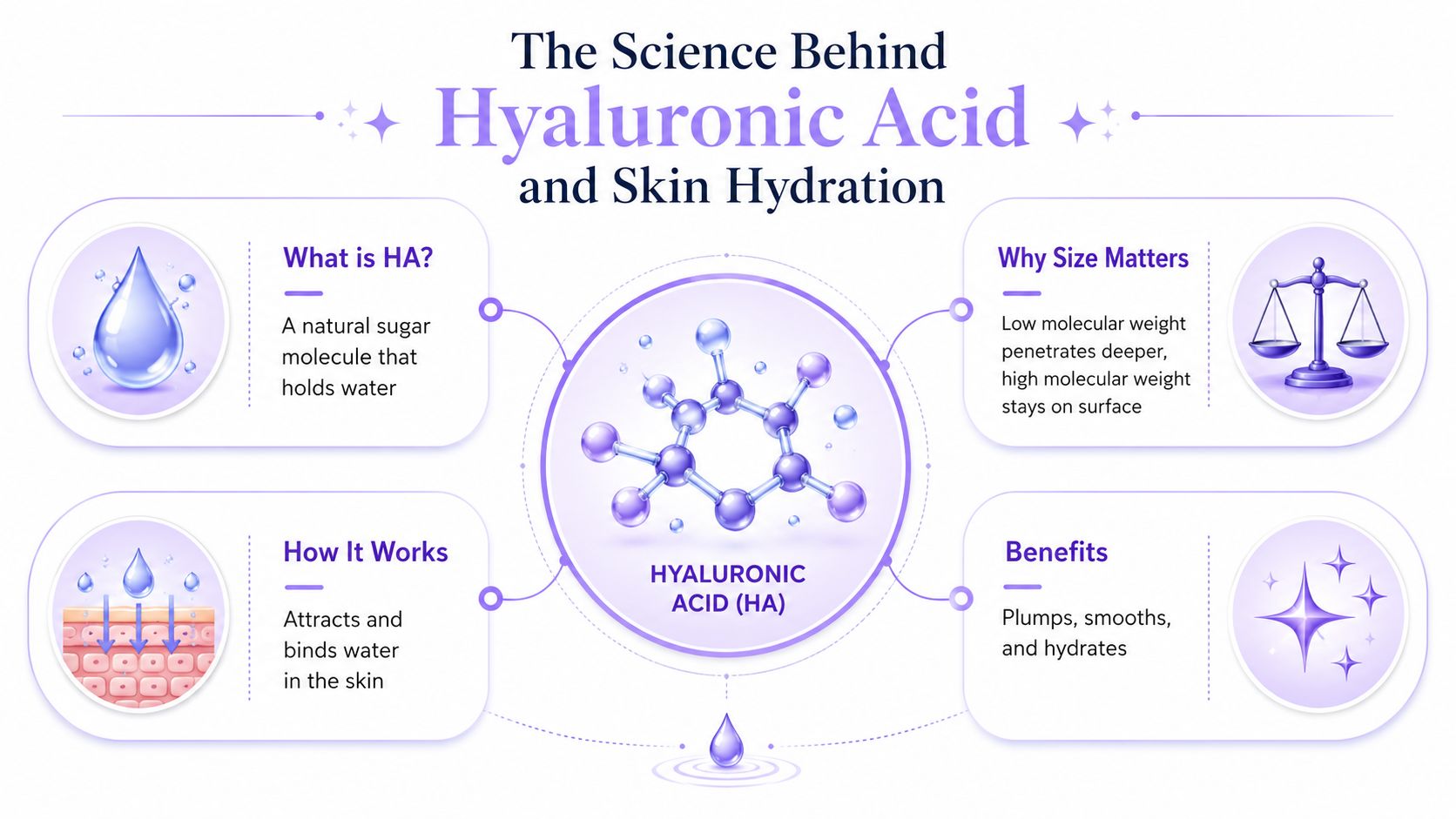
What does a moisture-binding molecule do for skin? In skincare, hyaluronic acid acts as a humectant, so it attracts and holds water in the outer skin layers instead of sealing the surface in the way an occlusive cream does. Cleveland Clinic explains that even a small amount can bind a large volume of water, which is why it appears in creams, lotions, ointments and serums (Cleveland Clinic).
Why molecular weight changes performance
HA does not behave the same way in every formula. Its molecular weight affects how it sits on skin and how the product feels, which is why a label that says “hyaluronic acid” leaves out some important detail. UK-facing guidance distinguishes low-molecular-weight HA at roughly 2.0×10^5 to 4.0×10^5 Da from high-molecular-weight HA at 1.8×10^6 to 2.2×10^6 Da. Higher-molecular-weight forms tend to stay nearer the surface and form a film, while smaller fractions can move more readily into the upper epidermis (Typology UK).
That difference helps explain why two products with the same headline ingredient can feel so unlike each other. One may feel light and quick to settle, while another leaves a more cushioned, film-forming finish. In a damp British winter, that film can feel welcome on exposed or tight skin. In warmer months, or on skin that already feels greasy, the same texture may seem less comfortable.
How formulators think about it
Formulators often do not rely on one size of HA alone. They may combine molecular sizes so the product gives an immediate surface feel, while also supporting hydration across the upper layers over time. That approach is practical because skin care rarely needs a single effect in isolation.
Evidence summaries also suggest that hyaluronic acid can show benefits within hours, with some effects lasting over weeks (PMC review). The useful point is not that HA is universally ideal, but that it works best as part of a formula matched to the skin's condition and the season. For barrier-impaired skin, a humectant alone may be too little. For skin that is mostly thirsty rather than damaged, it can be a good fit, especially when the rest of the routine supports the barrier too.
How Hyaluronic Acid Moisturisers Are Actually Formulated
The concentration matters, but so does the feel of the product. In UK cosmetic formulation guidance, hyaluronic acid is typically used at 0.05 to 0.5% on a powder basis, with 0.1 to 0.3% recommended for aqueous serums and creams (technical guide). That range is popular because more is not always better.
Why more HA can feel worse
HA increases viscosity quickly in water. If formulators push the loading too far, the product can become heavier, tackier, and less easy to spread. That's a sensory problem as much as a performance issue. A moisturiser that feels sticky on application often gets used less consistently, which defeats the point.
A well-made hyaluronic acid moisturiser should feel usable every day. If it's overly gel-like or sticky, the formula may be asking the skin to tolerate too much HA and not enough support ingredients.
What to look for on the label
You don't need a long ingredient list to get better hydration. In fact, a shorter, more sensible formula is often easier to tolerate. The useful question is whether the HA sits alongside emollients or light occlusives, because those ingredients help reduce transepidermal water loss while HA handles water binding.
That design logic matters in online pharmacy shopping too. On a UK-registered pharmacy site or in a regulated skincare range, you'll usually see products positioned by texture and skin type rather than by hype. A good formulation should read like a considered moisturiser, not just a single trendy ingredient suspended in water.
If you're checking a broader skin-care routine for sensitivity, a clinically framed guide such as face cream for sensitive skin can help you think about texture, barrier support and tolerability together.
Clinical Benefits and Supporting Evidence
The clearest benefits of a hyaluronic acid moisturiser are modest but useful. It can improve hydration, soften the feel of the skin, and make dehydration lines look less obvious. Evidence from a topical hyaluronic acid evaluation reported higher hydration after application, with improvements in smoothness, plumping, hydration, fine lines, and wrinkles over the follow-up period (PMC evaluation).
What that means in everyday use
The first change is usually the easiest to notice. Skin may feel less tight soon after application, which fits with HA's humectant role and the way many people experience it in practice. The later changes are usually more restrained. Smoothness and a fresher surface look are more consistent than any dramatic change in etched lines or deeper wrinkles.
That makes HA a maintenance ingredient rather than a repair treatment. It can help with daily comfort and the look of dehydration, but it does not replace treatment for acne, eczema, rosacea, or other inflammatory skin conditions. The benefit is real, but it has limits.
Why the evidence still matters
A useful way to read the research is to separate skin feel from skin repair. HA helps attract and hold water, so it can give a quicker cosmetic effect than ingredients that work mainly by rebuilding the barrier. That is why people often notice it on first use, even though the longer-term results depend on the rest of the formula and on the skin's baseline dryness. Evidence reviews also describe HA as generally well tolerated in topical products (PMC review).
Climate and routine matter. In a damp British winter, a lightweight HA product may still feel comfortable, especially under a richer cream. In cold, windy weather, or on skin that is already stripped, HA on its own can feel too light unless it sits alongside emollients or occlusives that slow water loss. That is one reason the same ingredient can suit one person in summer and feel underpowered for another in winter.
Why it remains so widely used
Hyaluronic-acid-based moisturisers stay popular because people want quick hydration without a heavy finish. The ingredient also fits many skin-care routines because it can be added to gels, lotions, and richer creams without changing the overall direction of the formula.
Its main strength is practical rather than dramatic. Used well, it gives skin a more comfortable surface and a better hydrated look, especially when the formula also supports the barrier.
Hyaluronic Acid Compared With Ceramides and Glycerin
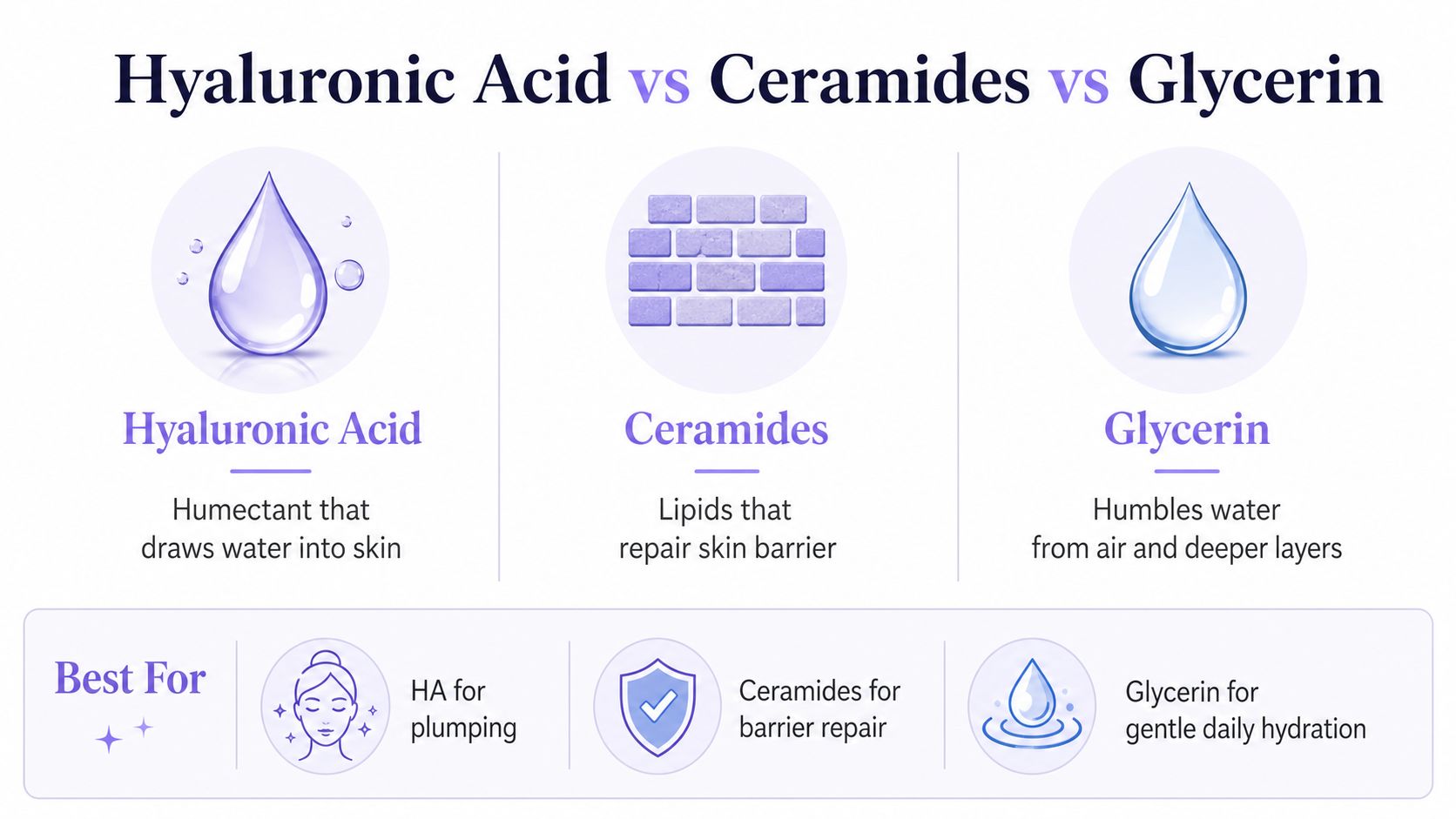
Many product guides become too simplistic. Hyaluronic acid, ceramides and glycerin all support hydration, but they do it in different ways. HA is a humectant. Ceramides are barrier lipids. Glycerin is another humectant, but it is often better tolerated in richer, more straightforward moisturiser bases.
Which ingredient suits which problem
If the skin is mainly dehydrated and needs a lighter cosmetic boost, HA makes sense. If the skin barrier is compromised, ceramides usually matter more because they help reinforce the skin's lipid structure. Glycerin sits in the middle for many people, because it gives reliable hydration without needing a specialist formula.
The comparison becomes more important in eczema-prone skin. NHS information shows eczema affects around 1 in 5 children and 1 in 10 adults in the UK, so a lot of readers are not shopping for “glow”, they're trying to manage chronic dryness and irritation. In those cases, a pure HA product can feel too light unless it's layered under a richer moisturiser or used alongside a barrier cream.
A practical explainer on barrier-first care, including after procedures, is available in improve outcomes after laser sessions, which is useful if your skin has been stressed by treatment or irritation.
Layering often matters more than the single ingredient
A simple HA product can still fit into a barrier routine, but it should usually not be the whole routine. A more resilient approach is to use humectants for water binding and then seal that hydration with lipids or emollients. That's why many people do better with a HA serum under a ceramide cream than with HA alone.
For readers choosing a sensitive-skin base, a clinically minded guide such as skincare routine for sensitive skin helps clarify how to build around the barrier rather than around one ingredient.
How to Apply a Hyaluronic Acid Moisturiser in a UK Routine
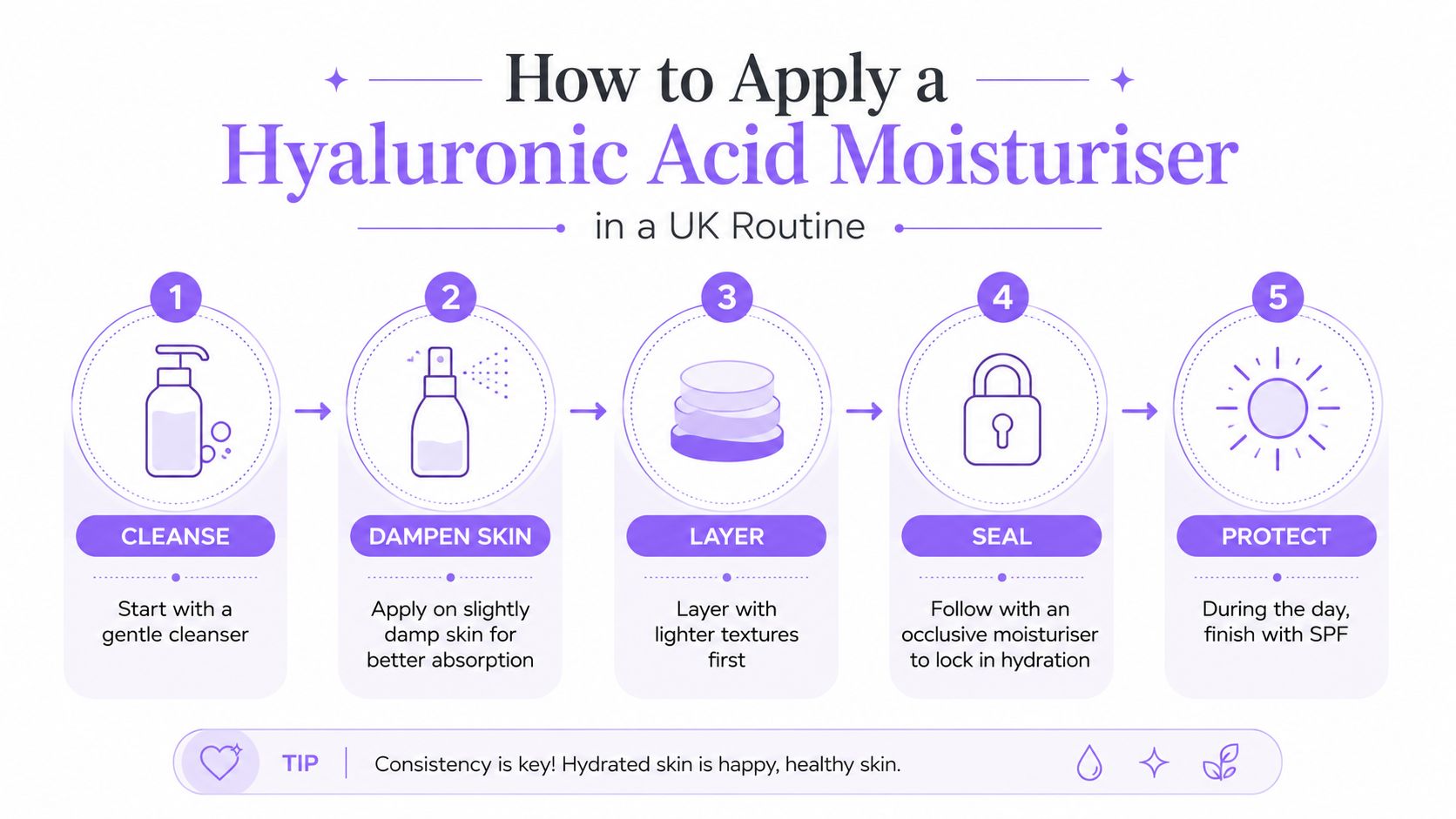
How you apply a hyaluronic acid moisturiser often matters more than the bottle itself. HA binds to water at the skin surface, so it tends to work best on slightly damp skin. If you spread it onto very dry skin and do not follow with a cream, it can feel underwhelming rather than hydrating.
A practical order that keeps things simple
- Cleanse gently. Use a non-stripping cleanser so the skin does not start off tight or uncomfortable.
- Leave the skin slightly damp. That gives the humectant water to bind to.
- Apply lighter textures first. Serums come before creams, not after them.
- Seal with a richer moisturiser if needed. This matters most in colder months, in windy weather, or if your skin is naturally dry.
- Use SPF in the daytime. Hydration and sun protection address different problems, and both matter.
In a UK winter, central heating can make a humectant feel less effective because indoor air is drier. If your HA layer seems to disappear in January but works more comfortably in summer, the setting may be the issue rather than the ingredient.
That seasonal pattern is one reason a hyaluronic acid product often works best as part of a layered routine rather than on its own. HA draws water in, while an occlusive or emollient top layer helps keep that water in place. In practice, barrier-supporting products such as ceramides or glycerin can do more of the heavy lifting, especially if your skin is dry, irritated, or exposed to cold weather for long periods. A simple guide on skincare routine for sensitive skin can help if you need a calmer, barrier-first way to build the rest of the routine.
If you also use actives such as retinoids or acids, a neutral guide on avoid irritation with skincare acids is useful for working out sequence and reducing the chance of stinging.
A helpful video overview is embedded here for readers who like to see the routine in action.
Safety, Side Effects and UK Regulatory Positioning
A hyaluronic acid moisturiser is usually a low irritation cosmetic product, but low irritation does not mean suitable for every face. The first point to understand is that HA is a cosmetic ingredient, not a medical treatment. In the UK, cosmetic products must comply with the UK Cosmetics Regulation, so the finished product sits within a defined regulatory framework even if the ingredient is commonly used at low percentages.
When caution makes sense
If skin is actively inflamed, broken, or highly reactive, even a mild moisturiser can sting. That does not mean hyaluronic acid is unsafe, it means the skin barrier may be too disrupted for routine cosmetic products to feel comfortable. People with persistent dermatitis, worsening eczema, or irritation that does not settle should seek a proper clinical assessment rather than trying to solve everything with skincare alone.
A useful distinction is between cosmetic claims and medical claims. A moisturiser can help with dryness, comfort, and the look of dehydration. It cannot diagnose, heal, or replace treatment for eczema, infection, acne that needs prescription therapy, or any other skin condition that calls for medical review.
Barrier-first care matters here. If your skin is sore, flaky, or easily irritated, products built around barrier support, such as ceramides or glycerin, may be a better first step than focusing on hyaluronic acid alone. If you want a plain-language guide to that approach, how to treat sensitive skin is a useful educational reference.
Where regulated care fits in
That distinction matters for adults shopping through an online pharmacy or looking for a prescription-only treatment. A pharmacy can supply prescribed medication only after proper assessment by a qualified clinician, and that governance is part of what keeps treatment safe. For skin concerns that go beyond simple dryness, a clinician-led pathway is the right place to start, not a cosmetic shelf.
Season also changes the picture. In a cold, dry UK winter, a hyaluronic acid product may feel less helpful if the barrier is already compromised and the air around you is stripping water away. In those cases, a richer cream or a barrier repair formula often makes more sense than adding more HA. In warmer or more humid months, the same product may feel lighter and more comfortable.
Frequently Asked Questions About Hyaluronic Acid Moisturisers
Can I use it with retinoids or exfoliating acids?
Usually, yes. Hyaluronic acid is a humectant, so it helps draw water into the outer layers of skin rather than exfoliating them. That makes it a common companion to retinoids or exfoliating acids, especially when the routine needs a bit more comfort.
If your skin is stinging, peeling, or feels raw, the problem may be irritation from the overall routine rather than the place of one product in it. In that situation, reducing the number of active products and giving the barrier time to recover is often more helpful than adding yet another hydrating step.
Is it suitable for acne-prone or eczema-prone skin?
It can be, but the formula matters more than the headline ingredient. Acne-prone skin often tolerates lighter textures better, while eczema-prone skin usually needs stronger barrier support alongside hydration, such as ceramides or glycerin.
That difference matters because hydration and barrier repair are not the same thing. A moisturiser can add water-binding support without doing much to restore a weakened barrier, so a product that feels good on paper may still be the wrong fit in practice.
If the skin problem is persistent, worsening, or difficult to settle, a clinician should assess it rather than treating it as routine dryness.
How fast should I expect to see results?
Some hydration can be noticed quickly, sometimes within hours, while smoother texture and a fuller look usually build over days to weeks. Reviews of hyaluronic acid moisturisers describe those changes as short-term support for skin feel and surface hydration, rather than a cure for the cause of dryness (PMC review; PMC evaluation).
If the skin still feels tight or looks dull after that, the routine may need a barrier cream rather than more hyaluronic acid. That is especially true in a dry indoor environment or during a cold UK winter, when water loss from the skin can outpace what a light hydrator can comfortably correct.
When should I stop self-managing and get help?
If the skin is painful, cracked, infected, or repeatedly flaring, it is time for a proper assessment. A hyaluronic acid moisturiser is a helpful cosmetic, but it should not delay treatment when a skin problem needs medical input.
The same applies if you are unsure whether the issue is simple dryness, eczema, contact irritation, or something else that needs prescribed care. In that setting, the safest next step is to speak with a qualified healthcare professional rather than trying to solve everything with a single moisturiser.


0 comments