


Which short cut makes fine or thinning hair look fuller, without turning a styling decision into an attempt to hide a medical problem? That's the useful question behind most searches for short hairstyles for thin hair men.
A haircut can change how hair sits, separates and reflects light. It can reduce the visual contrast between thicker and thinner areas, create a cleaner outline and make sparse sections look more deliberate. It can't increase hair density, reverse follicle miniaturisation or identify why hair is thinning.
That distinction matters. Male pattern hair loss, also called androgenetic alopecia, is common and often develops gradually, but sudden, patchy or unusually rapid loss can have other causes. This guide is educational, not personal medical advice. If you're comparing styling options, you might also find this guide to natural shampoo for fuller hair useful, but shampoo can't replace clinical assessment where it's needed.
Table of Contents
- 1. Textured Crop with Short, Even Layers
- 2. Classic Short Back and Sides with a Side Part
- 3. French Crop with a Short Fringe
- 4. Tapered Fade with a Textured Top
- 5. Short Slick-Back with Matte Styling
- 6. Clipper All-Over Cut
- 7. Short Cut Balanced with Beard Shape
- 8. When Thinning Warrants Clinical Assessment
- 8-Style Comparison: Short Hairstyles for Men with Thin Hair
- Choosing a Cut and Knowing When to Ask for Help
1. Textured Crop with Short, Even Layers
A textured crop is often a practical starting point for fine hair because it keeps the overall shape compact. Short layers create separation without leaving long, loose strands that can divide and expose the scalp. The effect is less about manufacturing volume and more about stopping the hair from collapsing into a few visible lines.
Ask your barber for a short, graduated crop with controlled texture, rather than aggressive thinning throughout the top. Removing too much bulk can leave obvious gaps, especially where density is already reduced. The finished cut should read as one consistent shape across the crown and sides.
The result depends on your natural density, scalp colour and the lighting around you. Hair that looks reasonably full in soft indoor light may show more scalp under overhead lighting, so a barber should set expectations before cutting.

The styling problem it solves
This cut works best when the problem is flat, separated hair on the crown. A small amount of matte paste or texture powder can help the strands sit apart, while finger styling keeps the finish less rigid than a combed style.
Practical rule: Texture should break up visible separation, not create a rough layer of product over the scalp.
A textured crop won't change the hairline or fill a bald patch. If you want more background on factors affecting thickness, read this educational resource on how to get thicker hair, while keeping cosmetic styling separate from treatment decisions.
2. Classic Short Back and Sides with a Side Part
A classic short back and sides with a side part gives fine hair a defined direction. Instead of allowing the top to fall randomly, the parting creates an organised shape that works well in professional settings. It's a sensible choice for men who want a conservative haircut rather than a visibly textured or fashion-led finish.
The parting should be subtle. A hard, sharply shaved part can expose the scalp along a line that's already becoming thin. A softer part made with scissors or a natural comb direction usually looks more convincing.
This style is most suitable when thinning isn't concentrated directly along the parting. If the part sits over a sparse area, directing hair away from it may make the gap more obvious rather than less.
Keeping the top controlled
A barber can leave enough length to create movement without allowing the hair to become long and stringy. Use a lightweight cream or matte paste, such as American Crew Fiber in a small amount, rather than a wet-look pomade that makes strands clump.
A side part can look particularly effective for a man with mild temple recession and reasonable density through the centre of the top. It gives the face a tidy frame and makes the haircut look intentional.
It doesn't create new density, and it shouldn't become a heavy comb-over. If you're moving large sections of hair across an increasingly open area, the contrast between covered and uncovered scalp can become more noticeable.
3. French Crop with a Short Fringe
The French crop combines short sides with a slightly longer top and a forward fringe. It suits men who want a modern cut that needs little daily styling. The fringe changes where the eye rests, drawing attention towards the front shape rather than asking the crown to carry all the visual interest.
Fringe length is the important decision. A short, broken fringe can soften a high forehead, but an excessively short fringe may expose more of the hairline. A barber should look at whether your thinning is centred at the temples, across the front or mainly at the crown.
Matching the fringe to the hairline
If the centre front remains reasonably dense while the temples are receding, a lightly textured fringe can make the transition look less abrupt. If the front is diffusely sparse, forcing hair forward may create strands that separate quickly.
A man with straight, fine hair might ask for a short, irregular fringe with texture through the top. Someone with a natural wave may need less product because the hair already breaks into shape.
The cut won't repair a receding hairline or disguise every area of scalp. It can make the front look cleaner when the remaining hair can still form a stable fringe. Matte clay should be used sparingly, because too much product can weigh fine hair down and produce visible clumps.
4. Tapered Fade with a Textured Top
A tapered fade creates a gradual transition from very short sides to a textured top. That contrast can give the top a stronger outline, especially when the sides remain denser than the crown. It offers more structure than an all-over crop without requiring the height and daily work of a full quiff.
The fade needs careful calibration. A very high skin fade exposes more scalp around the sides and may make a thin top look more prominent. A low or mid taper often gives a softer transition, particularly for men with diffuse thinning.
When contrast helps, and when it doesn't
A man with good side density and mild crown thinning may find that a taper makes the overall profile look sharper. The textured top then gives the eye a surface to follow instead of a flat, exposed area.
Someone with very sparse sides may find the opposite. Cutting them extremely short can emphasise the difference between the scalp and the remaining hair. Your barber should assess the full head, not apply the same fade height automatically.
This style doesn't increase density. It also needs regular maintenance to keep the taper clean. A matte product, such as Reuzel Matte Clay, can add separation, but the barber should avoid removing too much weight from a fragile top.
5. Short Slick-Back with Matte Styling
A short slick-back can look polished when the hairline is reasonably stable and the top has enough length to stay directed. Brushing the hair away from the forehead creates a deliberate shape that suits smart-casual clothing and formal workplaces.
The finish should be matte or low-shine. Heavy gels and greasy pomades can make fine strands stick together, leaving wider gaps between them. A light styling cream, sea-salt spray or matte paste is usually easier to control.
The main trade-off
The slick-back shows the hairline clearly. That's an advantage if you want a clean, confident outline, but a limitation if your main concern is frontal recession. A man with moderate density and a defined hairline may get a smart, controlled finish. A man with weak frontal density may expose more scalp by brushing everything backwards.
Blow-dry the hair into position before applying a small amount of product. Don't pull the hair tightly or flatten it against the scalp.
This cut cannot conceal a receding hairline indefinitely, and it won't make thin hair thicker. If the hair suddenly begins shedding or the scalp becomes inflamed, changing products or length isn't the right first response.
6. Clipper All-Over Cut
A clipper all-over cut uses one consistent short length across the head. It's the simplest option on this list and needs little styling beyond washing and occasional trimming. Even length can reduce the visual contrast between thicker and thinner zones, particularly when longer strands would otherwise separate.
The main decision is how much scalp you're comfortable showing. A very short guard may reveal the natural shape and colour of the scalp, while a slightly longer guard gives more coverage without creating loose, collapsing strands.
Who tends to suit it
This cut can work well for a man with diffuse thinning, a receding hairline or a crown that looks more uneven at longer lengths. It can also suit someone who doesn't want to spend time using a hairdryer or styling product each morning.
A realistic example is a man whose crown looks patchy when left longer but more uniform when clipped short. The cut doesn't hide the crown. It removes the contrast that made it stand out.
The trade-off is limited versatility. You won't be able to create a fringe, side part or swept-back shape until the hair grows out. Regular trims keep the length even, but the cut won't alter the cause of hair loss or prevent progression.
7. Short Cut Balanced with Beard Shape
A short haircut paired with a carefully shaped beard can give the face and head a unified outline. The beard adds visual weight lower down, while clean sideburns connect the haircut to the facial hair. This can make a very short cut look like a considered style rather than an unfinished one.
The beard should be proportionate. A large, unstructured beard alongside very short scalp hair can create an unbalanced profile. A neat short beard, defined stubble or a clean jawline may be easier to maintain.
The styling problem it solves
This combination is useful when the haircut itself needs to stay simple. For example, a man who chooses a close crop because of crown thinning may use a shaped beard to add definition around the face. The result depends on facial-hair density, jaw shape and personal preference.
A barber or skilled stylist can align the sideburns and neckline so the two areas connect naturally. Products such as King C. Gillette Beard Balm may help condition facial hair, but they won't change the appearance of the scalp.
Beard framing doesn't conceal scalp visibility, fill a receding hairline or treat male pattern hair loss. It changes the balance of the overall profile. If you can't grow a full beard, short stubble or clean-shaven skin can work just as well when the haircut has a clean outline.
8. When Thinning Warrants Clinical Assessment
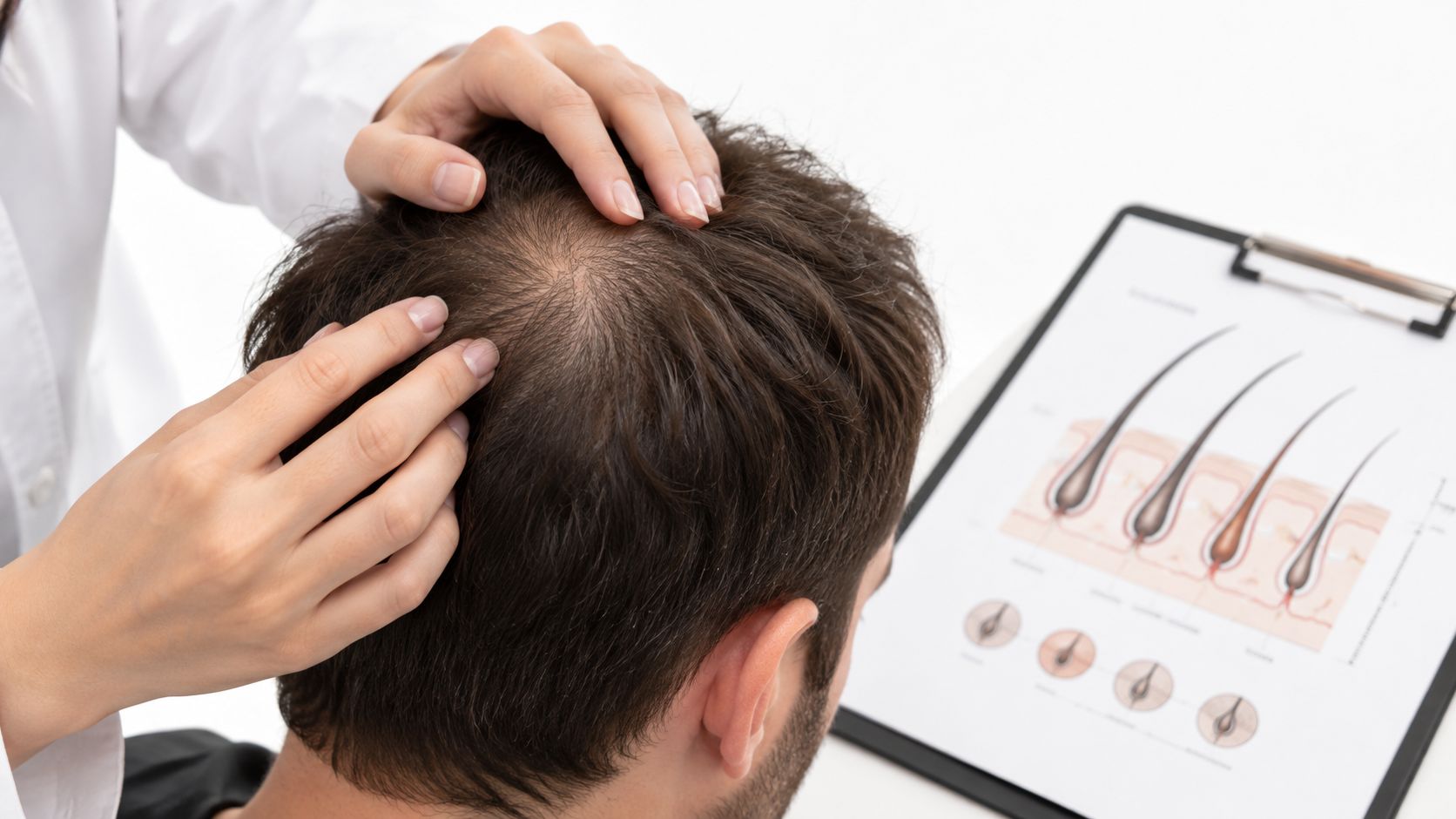
A haircut manages appearance. It doesn't treat the reason hair is falling out. Male pattern hair loss, medically known as androgenetic alopecia, is influenced by genetic and hormonal factors, including the effect of dihydrotestosterone on susceptible follicles. It may begin after puberty and commonly develops gradually over years or decades, with recession at the front or thinning over the top while the sides and back are preserved, as described by the British Association of Dermatologists' clinical information.
Gradual temple or crown thinning may fit that familiar pattern, but you shouldn't assume every change is male pattern hair loss. Sudden loss, patchy areas, scalp inflammation, marked itching or unusually rapid shedding should be assessed by a GP, pharmacist or other qualified clinician.
What treatment discussions involve
The NHS identifies minoxidil and finasteride as the main treatments for male pattern baldness. They don't work for everyone, and any benefit is maintained only while treatment continues, according to NHS hair-loss guidance. A haircut may make the current pattern look more uniform, but it can't stimulate follicles or reverse miniaturisation.
Finasteride for male pattern hair loss is a prescription-only treatment in the UK. The UK-authorised hair-loss dose is 1 mg, while 5 mg is used for benign enlargement of the prostate, so the doses aren't interchangeable. The MHRA warns about possible psychiatric and sexual side effects, including depressed mood, depression, suicidal thoughts and sexual dysfunction, and advises men who develop depression or suicidal thoughts while taking 1 mg for hair loss to stop and contact a doctor promptly, as explained in its finasteride safety announcement.
A UK-registered online pharmacy can be one route to assessment, but it shouldn't dispense prescribed medication automatically. A service such as XO Medical uses online clinical assessment and prescriber oversight through a pharmacy regulated by the GPhC. The decision to use online care or arrange an in-person appointment rests with the patient.
You can also read more about what causes male pattern baldness. Hair-restoration claims, including discussion of how stem cells restore hair, should be treated carefully where a treatment isn't approved or supported by established UK clinical guidance.
8-Style Comparison: Short Hairstyles for Men with Thin Hair
| Style | 🔄 Complexity | ⚡ Resources | ⭐📊 Expected outcomes | 💡 Ideal use cases | ⭐ Key advantages |
|---|---|---|---|---|---|
| Textured Crop with Short, Even Layers | Medium, needs graduated cutting and texturising | Low, matte paste/fibre; routine barber visit | Moderate, neat unified shape, reduces bulk but not add density | Low-maintenance looks; mild thinning across crown/sides | Conceals scatter; natural textured finish |
| Classic Short Back and Sides with a Side Part | Medium, precision part placement and blending | Low, regular trims (4–6 weeks), comb | Moderate, tidy, professional finish; no added volume | Professional settings; thinning not concentrated on part | Timeless, structured appearance |
| French Crop with a Short Fringe | Medium, careful fringe length assessment | Low, light cream/paste; barber trial recommended | Moderate, draws attention forward; can mask crown but may expose hairline | Modern style; front-focused shaping for mild frontal thinning | Minimal daily styling; strong face framing |
| Tapered Fade with a Textured Top | High, fade blending and texturising skill required | Medium, volumising powder, more frequent shaping | High potential, tonal contrast can read as fuller when done well | Want structure without heavy styling; moderate thinning | Creates perceived fullness via contrast; contemporary look |
| Short Slick-Back with Matte Styling | Low–Medium, product technique matters | Low, matte pomade/clay, comb, optional hairspray | Moderate, polished, shows hairline; doesn't increase density | Smart-casual settings; hair with enough length to hold | Polished, controlled finish with low shine |
| Clipper All-Over Cut | Low, single guard clipper work | Very low, minimal styling; scalp care and sun protection | Low–Moderate, uniform short look with high scalp visibility | Prefer very short, minimal upkeep; comfortable with exposure | Simplest maintenance; consistent look |
| Short Cut Balanced with Beard Shape | Medium, coordination of head and beard outlines | Low, beard trims every 2–3 weeks, barber precision | Moderate, cohesive profile; shifts focus from scalp to face | Want integrated face-head framing; beard-friendly styles | Harmonises proportions; intentional, balanced appearance |
| When Thinning Warrants Clinical Assessment | Medium–High, diagnostic process and possible prescriptions | High, clinician consultation, tests, ongoing treatment | High, diagnostic clarity and access to medical treatments | Sudden/patchy thinning, scalp symptoms, progressive loss | Addresses underlying cause; access to evidence-based options |
Choosing a Cut and Knowing When to Ask for Help
The best short hairstyle for thin hair depends on where the hair is thinning, how much styling you'll do and how comfortable you are with scalp visibility. A textured crop may suit a flat crown. A French crop may work better when the front needs a soft frame. A clipper cut may be more practical when uneven length is creating too much contrast.
Your barber can test the shape without committing immediately to an extremely short cut. Ask for a conservative reduction first, then check the result in natural light. Bring a photograph of a style you like, but also explain what concerns you, whether that's temple recession, a visible crown, separation at the parting or hair that collapses after washing.
A useful consultation includes more than the haircut name. Tell the barber how often you're prepared to style your hair, whether you wear a helmet or work in a setting where a neat finish matters, and whether you're comfortable exposing more scalp. The right cut may be the one that needs less product, not the one that looks most dramatic in a photograph.
Short hair can make thinning look more consistent, but it doesn't alter the density of the scalp. Be cautious with products that promise regrowth, especially when they blur the distinction between cosmetic thickening and medical treatment. Styling powders, matte clays and careful blow-drying can change the surface appearance. They can't diagnose the cause or restore miniaturised follicles.
UK survey data also shows why this subject can feel significant to men. In a survey of 2,000 UK men, 61% said hair influenced their overall self-confidence and body positivity, while 37% said they worried about losing it, according to Regaine's UK survey report. Those figures describe perceptions from a branded survey, not national disease surveillance, but they help explain why a realistic, confidence-supporting haircut can matter.
The same survey reported that 40% of men had experienced noticeable hair loss by age 35, with 95% of those cases described as male pattern baldness. It also recorded a receding hairline as the first warning sign for 34%, a bald spot for 33% and thinning hair for 30%. These figures should not be used to diagnose an individual. A gradual pattern may be familiar, but sudden, patchy or symptomatic loss still needs appropriate assessment.
The choice of service is yours. You might speak to a GP, pharmacist or dermatologist in person, or use a regulated online pharmacy where a UK-registered clinician assesses whether prescribed medication is clinically appropriate. Finasteride and minoxidil are separate from a haircut, and finasteride carries safety considerations that require informed prescribing and follow-up.
If thinning is sudden, patchy, painful, inflamed or difficult to explain, arrange a clinical conversation before treating it as a barbering problem. If it's gradual and follows a familiar pattern, you can still choose a cut that works with the hair you have now while deciding whether further assessment is appropriate.
Reviewed by: Dr [qualified UK healthcare professional's name], UK-registered healthcare professional
Review date: 10 October 2026
This content is for informational purposes only and does not constitute medical advice. Always consult a qualified healthcare professional before starting or changing any treatment.
XO Medical provides online consultations with UK-registered clinicians for hair-loss concerns, while XO Clinic offers in-person aesthetics care, including botox, dermal fillers, skin boosters and polynucleotides (salmon DNA). Visit XO to learn how regulated services can support an informed discussion about thinning hair and suitable next steps.


0 comments