


Waiting for prescribed medication can feel very different from waiting for ordinary post. You're not just wondering when a parcel will turn up. You're often thinking about continuity of treatment, privacy at home, and whether someone else might see packaging you'd rather keep discreet. That's why a tracked delivery service matters more in healthcare than it does for a routine online purchase.
Many people using an online pharmacy want the same three things. They want their treatment to be clinically appropriate, supplied by a UK-registered pharmacy, and delivered in a way that feels predictable rather than vague. If you're new to remote care, the practical side can be the most confusing part. What does “tracked” mean? Is it the same as signed for? What happens if updates stop? And does a tracking page tell you anything about whether the supplier is properly regulated?
In the UK, tracked delivery has become a mainstream part of parcel services rather than a niche extra. Parcel volumes reached 3.9 billion items in 2023-24, up 8.3% year on year and close to the 4.0 billion peak recorded in 2020-21, while parcel revenues still totalled £13.0 billion in real terms across UK operators, according to Ofcom's 2023-24 postal monitoring report. For patients, that scale matters because tracking is now part of normal delivery infrastructure.
A useful place to start is understanding that parcel visibility and clinical safety are related, but they aren't the same thing. A tracking page can tell you where a parcel may be in the network. It can't tell you whether the prescription-only treatment was prescribed appropriately, dispensed by a pharmacy regulated by the GPhC, or supplied under the right governance framework.
If you're choosing between remote healthcare options, it helps to read delivery promises alongside pharmacy standards. The practical questions patients usually ask about regulation, prescribing and parcel handling are closely connected to the wider idea of an online pharmacy in the UK.
Table of Contents
- Introduction to Tracked Delivery in UK Healthcare
- How Tracked Delivery Works From Order to Doorstep
- Tracked vs Signed For vs Standard Delivery Compared
- Benefits and Limitations You Should Understand
- Safety Regulation and Prescription Delivery in the UK
- What to Expect From XO Medical Tracked Next Day Delivery
- Common Tracking Problems and How to Fix Them
Introduction to Tracked Delivery in UK Healthcare
A common real-life scenario goes like this. You complete an online consultation for a prescribed medication, the clinical review is approved, and then the waiting starts. The important question usually isn't “Has it been posted?” It's “Can I rely on this arriving safely, privately and close to when I expect it?”
That difference matters most with healthcare items that need trust around them. A skincare refill may feel time-sensitive. A sexual health treatment may need discretion. A menopause medicine or hair loss treatment may need to arrive without friction, delay, or repeated guesswork.
Why healthcare delivery feels different
With general retail, a late parcel is inconvenient. With a pharmacy order, the emotional tone is different. People often check tracking more often because the parcel may contain prescribed medication, and the consequences of uncertainty feel more personal.
Tracking is useful only when it reduces uncertainty. If updates create more ambiguity, reassurance quickly turns into repeated checking.
In the UK, people place high value on parcel tracking. Ofcom found that 81% of people sending parcels said tracking was important or very important, and 89% of people choosing a delivery option for parcels they would receive said the same. For recipients, tracking was the single most important service feature, as summarised in this review of Royal Mail delivery expectations.
What patients usually want from tracking
Most readers aren't looking for logistics jargon. They want plain answers to simple questions:
- Privacy: Will the parcel arrive discreetly?
- Timing: Will I get a realistic delivery day or window?
- Control: Can I see what stage the parcel has reached?
- Proof: If there's a problem, is there evidence of delivery?
- Safety: Is the sender a legitimate UK-registered pharmacy rather than just a website with a checkout page?
Those questions become even more relevant when the treatment involved is a prescription-only treatment rather than an over-the-counter purchase.
How Tracked Delivery Works From Order to Doorstep
A tracked parcel moves through a series of checkpoints. The easiest way to think about it is as a travel itinerary. You don't see every metre of a train journey, but you do see the key stations. Parcel tracking works in a similar way.
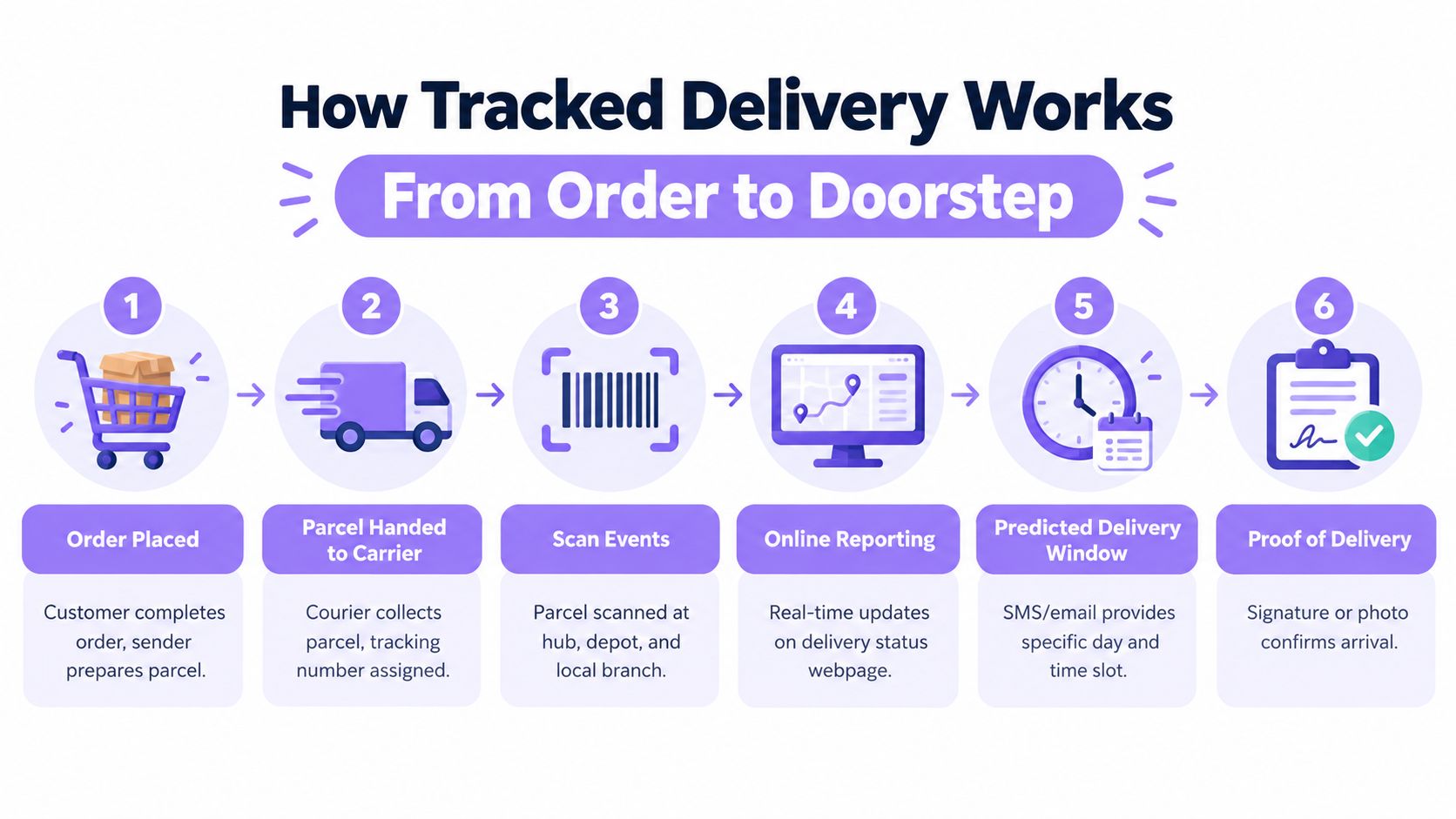
The core stages you'll usually see
For UK healthcare deliveries, a tracked delivery service often follows this pattern:
-
Order accepted after review
The pharmacy confirms that the order can move forward. If the item is a prescription-only treatment, that happens after clinical checks rather than before them. -
Parcel handed to the carrier
This is usually the first moment tracking becomes visible. A tracking number links your parcel to the courier network. -
Scan events through the network
Parcels are commonly scanned when they enter a hub, move between sites, or arrive at a local delivery unit. -
Out for delivery update
The parcel is assigned for final delivery. This often signals that a delivery attempt is expected that day. -
Delivery confirmation
The final update may include confirmation that the parcel has been delivered and, depending on the service, further delivery evidence.
What Royal Mail tracked services include
Royal Mail states that Tracked 24 and Tracked 48 are end-to-end tracked from posting to delivery. They include online reporting, a predicted delivery day, an estimated time sent by SMS or email, in-flight delivery options, and online delivery confirmation with a GPS map of the delivered location, as set out in the Royal Mail parcels user guide.
That last part matters if a patient says, “It says delivered, but I can't see it.” A GPS-tagged delivery confirmation can help clarify whether the parcel reached the intended location or whether there may be a neighbour, safe-place, or proof-of-delivery issue.
Practical rule: Tracking isn't a live video feed. It's a sequence of recorded events that becomes more useful when paired with realistic timing information.
Basic tracking and enhanced tracking aren't the same
A lot of confusion comes from the word “tracked” being used too broadly. Some services give stage-and-day updates only. Others provide more detailed ETA information and narrower windows.
UK consumer research cited by Ingrid distinguishes between core tracking and enhanced tracking, where enhanced tracking includes real-time information plus a two-hour delivery slot. The same research also found that 55% of shoppers cite inaccurate delivery times as their biggest post-purchase frustration, 49% are frustrated by wide delivery windows, 37% don't want to stay home waiting for a parcel, and 35% dislike repeatedly checking sparse updates, according to Ingrid's UK consumer research.
If you want a useful primer on delivery evidence after a parcel arrives, Fleetalyse has a clear explainer on electronic proof of delivery, which helps make sense of signatures, timestamps, and digital confirmation records.
For practical details on one pharmacy's shipping process, patients often compare the tracking language used in a provider's shipping policy with the updates they later receive from the courier.
Tracked vs Signed For vs Standard Delivery Compared
Patients often assume these terms mean the same thing. They don't. The main difference is how much visibility you get during transit, and what evidence exists at the end.
Choosing Between Standard Tracked and Signed For Delivery
| Feature | Standard Delivery | Tracked Delivery | Tracked and Signed For |
|---|---|---|---|
| Journey visibility | Limited or basic | Ongoing scan-based updates | Ongoing scan-based updates |
| Predicted delivery information | Often limited | Usually better visibility on progress and timing | Usually better visibility on progress and timing |
| Proof of delivery | May be minimal | Delivery confirmation may be available | Delivery confirmation plus signature requirement |
| Need for someone to be present | Not always | Depends on service and delivery options | More likely |
| Suitable for discreet medical parcels | Can be acceptable, but less transparent | Often the most balanced option for visibility and convenience | Useful where stronger handover evidence is needed |
| If there's a dispute | Fewer data points to review | More scan history and delivery evidence | More scan history plus signed receipt evidence |
The common misunderstanding
“Tracked” doesn't automatically mean “signed for”. A parcel can be fully tracked through the network and still be delivered without a signature, depending on the service rules and delivery method.
That's one reason patients should read the delivery terms rather than relying on labels alone. If your priority is a clear transit history and estimated arrival updates, tracked delivery may be enough. If your priority is handover evidence to a named person, a signed-for option may be more appropriate.
Which option suits healthcare best
For many routine online pharmacy orders, tracked delivery offers the clearest balance between discretion and visibility. It tells you more than standard post, but it doesn't always require someone to remain at home waiting for a signature.
Signed-for services can still be sensible in selected cases, especially if the sender wants a tighter proof trail. Standard delivery may work for less time-sensitive items, but it gives the least certainty if something goes wrong.
Benefits and Limitations You Should Understand
The strongest reason to use a tracked delivery service isn't speed on its own. It's reduced ambiguity. Good tracking helps you judge whether a parcel is moving normally, whether you need to stay available, and whether there's evidence if delivery is disputed.
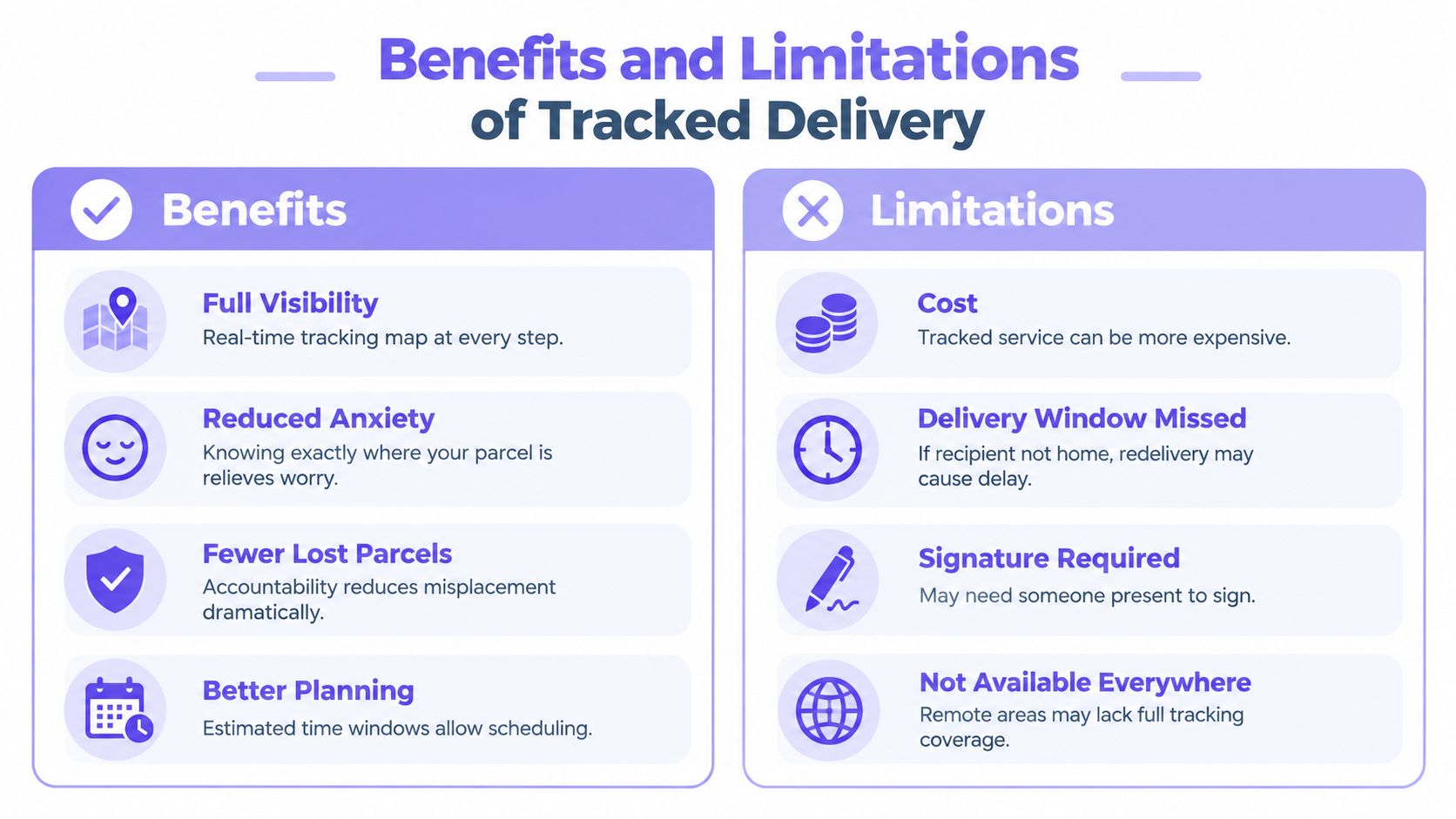
Where tracking genuinely helps
A few benefits are practical rather than abstract:
- Better planning: A predicted day and estimated time can help you avoid missing a parcel.
- More control: In-flight options may let you change delivery preferences while the parcel is still moving through the network.
- Clearer problem solving: Delivery confirmation and scan history make it easier to investigate missing parcels.
- Lower uncertainty: You aren't relying on a simple “dispatched” message with nothing after it.
These benefits matter because parcel delivery problems are common enough to affect confidence. Ofcom's parcels research found that 67% of parcel recipients had experienced a delivery issue in the previous six months, including delayed parcels, failure to deliver, or insufficient or incorrect tracking information, according to Ofcom's assessment of tracking in consumer parcels.
Why tracking can still disappoint
Tracking can also create false certainty. A patient may see no movement for hours and assume something has gone wrong, when the parcel is travelling between scan points. The opposite problem can happen too. A string of updates can look reassuring, but if the final timing estimate is poor, the customer experience still feels frustrating.
The same Ofcom research noted that around half of respondents would pay 25p for tracking, which suggests many people see it as a trust feature rather than an automatic entitlement. That's useful context. People value tracking, but what they're really paying for is confidence.
Good delivery communication should answer two questions. Is the parcel still on course, and if not, what should I do next?
Geography still affects expectations
A tracked service doesn't create the same delivery promise in every postcode. Royal Mail states that Tracked 24 and Tracked 48 delivery aims apply to the majority of UK addresses, but several remote postcode areas don't have a delivery target time, including parts of the Scottish islands, Northern Ireland, the Channel Islands and the Isle of Man, as explained on the Royal Mail Tracked 24 and 48 service page.
For patients in those areas, the most sensible expectation is visibility rather than a uniform nationwide SLA. That's an important distinction. Tracking can still be useful even when timing is less predictable.
Safety Regulation and Prescription Delivery in the UK
A parcel can be tracked perfectly and still come from the wrong kind of seller. That's the point patients often miss. Delivery visibility is helpful, but clinical governance comes first.
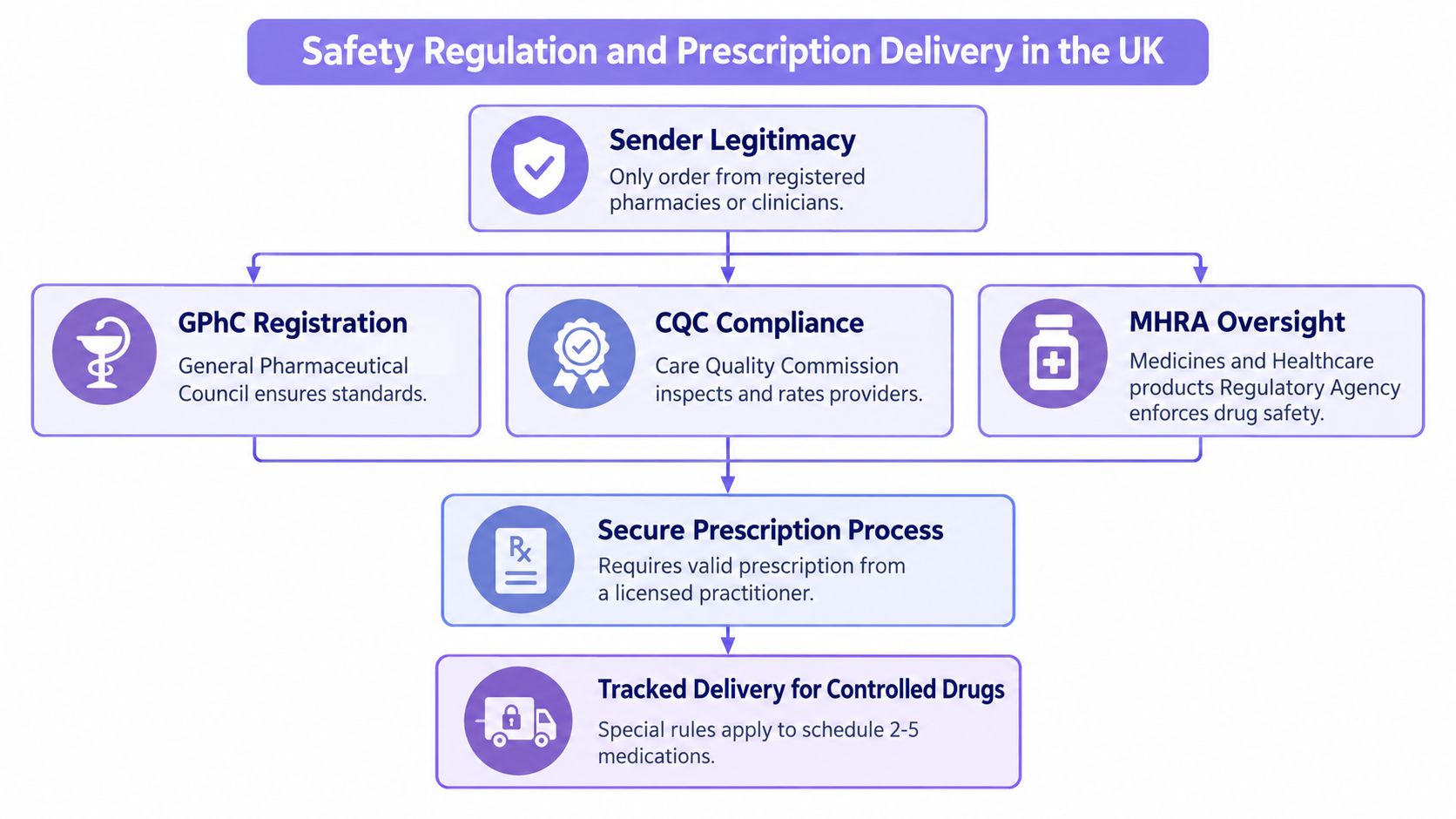
What makes an online supplier legitimate
In Great Britain, all pharmacies providing services online must be registered with the General Pharmaceutical Council, and they must meet the standards for registered pharmacies. The GPhC has also published updated guidance for pharmacies providing services at a distance, including online, which adds safeguards for remote supply, as explained on the GPhC online pharmacy registration and standards page.
That means a genuine online pharmacy doesn't step outside normal pharmacy rules just because the patient interaction happens through a screen.
You should also check whether the seller appears on the MHRA medicines seller register. That register exists so people can identify websites authorised to sell medicines online in the UK.
Prescribing still has to happen properly
If a medicine is a prescription-only treatment, it must be supplied on the basis of a legally valid prescription. The relevant standards make clear that internet supply isn't a shortcut around normal clinical controls. Private prescribers must be regulated healthcare professionals, and they're expected to follow the same professional standards and national clinical guidance as their NHS counterparts, as set out in the UK Government call for evidence on private non-NHS prescribing.
That's the practical order of events:
- Clinical assessment first: a prescriber decides whether treatment is appropriate
- Pharmacy supply second: a pharmacy dispenses under professional standards
- Delivery last: the parcel is then sent through a suitable tracked route
A tracking link can confirm movement through the delivery network. It cannot confirm that the prescribing decision was safe, lawful, or appropriate.
A note on broader provider settings
Some readers compare remote pharmacy care with face-to-face services. That's reasonable. A UK-registered pharmacy and an in person aesthetics clinic offering botox, dermal fillers, skin boosters and polynucleotides (salmon DNA) operate in different clinical settings, but both still depend on regulated professionals, consent, record-keeping, and safe governance.
What to Expect From XO Medical Tracked Next Day Delivery
For patients using a remote healthcare service, the most useful question is often very simple. What will happen after my consultation is approved?
The patient journey in plain terms
With XO Medical, the tracked process starts only after the clinical part is complete. If a treatment is approved, the order is dispensed by a pharmacy regulated by the GPhC and then sent using tracked next-day delivery. That sequence matters because delivery follows prescribing. It doesn't replace it.
Patients generally want to know four practical things:
- When dispatch happens: after the consultation has been reviewed and approved
- How the parcel is presented: in discreet packaging suitable for home delivery
- What the tracking is for: to follow progress and prepare for arrival
- Where support sits: alongside the pharmacy service rather than separate from it
For readers comparing home-delivered care pathways, the service details around online pharmacy next-day delivery give useful context about timings, handling, and expectations.
What the tracking page should help you do
A good tracking page should do more than show a parcel number. In practice, it should help you answer three everyday questions:
- Has the parcel entered the courier network yet?
- Is it still moving normally through the expected stages?
- Do I need to be available, or take any action today?
That matters especially for patients ordering ongoing treatment for weight management, sexual health, hair loss, skincare, women's health, mental health or general wellbeing. It also matters for adults who prefer discreet care at home rather than discussing treatment in person.
Here's a short walkthrough of what patients tend to find helpful when using remote pharmacy services:
Privacy and continuity of care
A clinically supervised delivery model should keep the parcel side and the care side connected. If a patient has a question after dispatch, the answer shouldn't be “ask the courier” for everything. Some concerns are logistical. Others are clinical.
That distinction matters because a delayed parcel might affect treatment timing, but only a qualified clinician or pharmacy team can advise on the treatment implications. For remote or harder-to-reach postcode areas, timing expectations may also vary by destination geography rather than a single promise across the whole UK.
Common Tracking Problems and How to Fix Them
Most tracking problems aren't really about tracking. They're about uncertainty. A scan looks late, appears out of sequence, or says “delivered” when the parcel isn't immediately visible. The important thing is to respond methodically rather than assume the worst.
If the tracking hasn't updated
A pause in updates often means the parcel is travelling between scan points or waiting for the next processing event. It doesn't always mean the parcel is lost.
Start with a short check:
- Look at the last event carefully: “Dispatched” and “out for delivery” mean very different things.
- Check the expected day, not just the latest scan: a parcel can still be on time even if the page hasn't refreshed for several hours.
- Review delivery options: if the courier offers in-flight changes, see whether a safe-place or redelivery option has been applied.
If it says delivered but you can't find it
This is one of the most common anxiety points. Before escalating, check nearby safe places, reception areas, household members, and any message left by the courier. If delivery confirmation includes location evidence, review that too.
For readers interested in how courier systems handle route visibility and local handover data more generally, Routelink has a practical overview of local delivery tracking solutions.
When to escalate: If the delivery page shows a completed delivery and the parcel still can't be located after basic checks, contact the carrier and the pharmacy promptly so the logistics record and the dispensing record can both be reviewed.
When to contact the pharmacy
Contact the pharmacy, rather than only the courier, if:
- The item is time-sensitive: especially if a treatment course may be interrupted
- You're unsure whether to start late: this is a clinical question, not just a parcel question
- The address or patient details may be wrong: the pharmacy record may need checking
- The delivery problem affects a prescribed item: especially if replacement, redispensing, or treatment timing may need discussion
Tracking should reduce ambiguity. When it doesn't, the safest next step is a calm check of the delivery record followed by contact with the right team.
XO provides regulated online pharmacy care with clinician review, discreet dispensing, and tracked home delivery for prescribed treatments. If you want to see how remote assessment, pharmacy governance and delivery fit together in one patient journey, visit XO.
Reviewed by: XO Medical editorial team
Review date: 19 September 2026
This content is for informational purposes only and does not constitute medical advice. Always consult a qualified healthcare professional before starting or changing any treatment.


0 comments