


Private weight loss injections in the UK typically cost £130 to £350 a month, depending on the medicine and dose. For eligible NHS patients, prescriptions cost £9.90 per item in England, while prescriptions are free in Scotland, Wales and Northern Ireland.
That difference makes the phrase “weight loss injections cost” deceptively simple. The monthly figure you see in an advert may describe a starter dose, exclude clinical reviews, or apply only to a private route. It may not tell you what treatment will cost once the dose increases, how long prescribing will continue, or whether you can access NHS care at all.
This guide approaches the decision as a UK clinical pharmacist would. It separates NHS charges from private pricing, explains why titration changes the bill, and sets out the safety checks to complete before paying for prescribed medication.
Table of Contents
- What weight loss injections actually cost in the UK
- How GLP-1 weight loss injections work
- NHS pricing and eligibility across the UK
- Private monthly and annual costs for Wegovy and Mounjaro
- Private clinics versus online pharmacies and telehealth
- What drives the price you pay
- Why the cheapest headline price can still be expensive
- Practical steps before you pay for weight loss injections
What weight loss injections actually cost in the UK
Private UK prices commonly fall between £130 and £350 per month, depending on the medicine, dose and provider. UK comparisons of private Wegovy and Mounjaro pricing show that prices rise as patients move towards maintenance strengths.
The NHS position is very different. In England, an eligible patient normally pays the standard prescription charge of £9.90 per item, although a valid prescription charge exemption or prepayment certificate may change what they pay. Prescriptions are free at the point of use in Scotland, Wales and Northern Ireland. Those rules apply only when the treatment has been prescribed through an NHS pathway, and eligibility is restricted.
| Option | Typical monthly cost | Who it applies to |
|---|---|---|
| NHS prescription in England | £9.90 per item | Eligible NHS patients, subject to prescription rules |
| NHS prescription in Scotland, Wales or Northern Ireland | Free at the point of use | Eligible NHS patients |
| Private weight loss injection | £130 to £350 | Patients assessed and prescribed privately |
The headline monthly price rarely represents the full annual outlay. A private quote may include the pen but not a consultation, blood tests, delivery, a sharps bin, follow-up monitoring or a change in dose. Some services combine prescribing and dispensing, while others charge separately for clinical reviews.
Practical rule: Ask for the expected cost at the maintenance dose, not only the first month.
Dose escalation is the main reason a low introductory price can become unaffordable. Providers generally start with a lower strength and increase it gradually when clinically appropriate. A patient who budgets around the starter pen may therefore underestimate the cost of ongoing treatment.
The sensible comparison is not “Which provider is cheapest this month?” It's “What will this treatment cost over the first year, what support is included, and what happens if the medicine is stopped?” That approach also exposes the difference between an online pharmacy, a telehealth service and an in-person clinic.
How GLP-1 weight loss injections work
Most modern weight loss injections act on hormone pathways involved in appetite and blood glucose regulation. GLP-1, or glucagon-like peptide-1, is a gut hormone. Medicines that mimic its action can slow stomach emptying, increase feelings of fullness, reduce appetite and support blood sugar control.
In practical terms, the medicine can make it easier for some patients to eat less without experiencing the same level of hunger. It isn't a substitute for nutritional support, physical activity or clinical monitoring, and the response varies between individuals.
The UK injectable options need careful naming:
- Semaglutide is marketed as Wegovy for weight management. Ozempic contains semaglutide but is licensed for type 2 diabetes, not general weight management.
- Tirzepatide, marketed as Mounjaro, acts on both GIP and GLP-1 pathways.
- Liraglutide, marketed as Saxenda for weight management, is administered daily and is now less commonly discussed than the newer weekly options.
Semaglutide and tirzepatide are generally administered once weekly, while liraglutide is administered daily. The dose starts low and is usually increased at four-week intervals if the prescriber considers that safe and appropriate. This staged process helps clinicians manage tolerability, but it also means the cost isn't fixed from the first prescription.
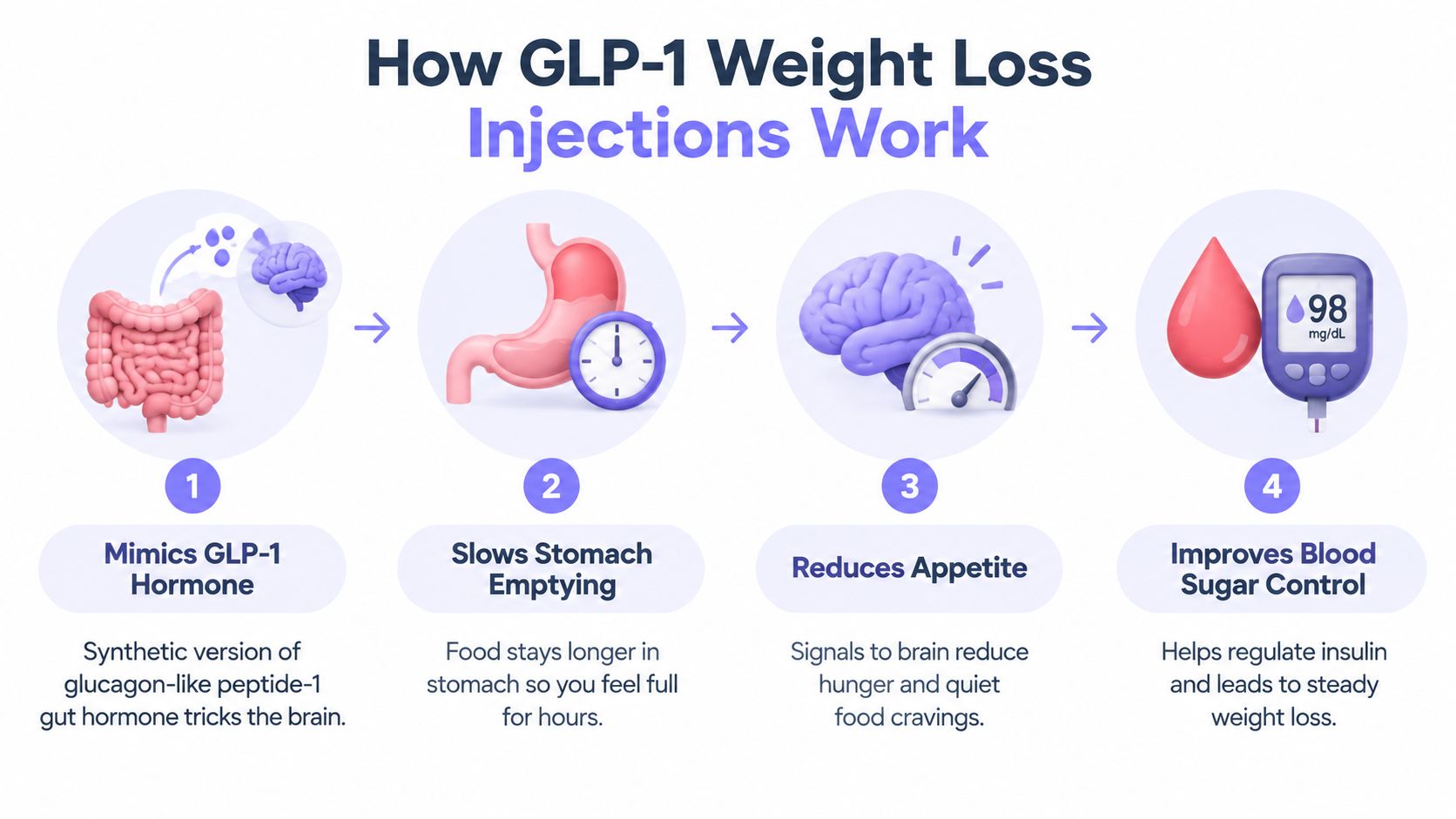
The mechanism matters financially because a higher-strength pen can cost noticeably more than a starter pen. A useful explanation of the medicines and their UK use is available in this guide to GLP-1 medication in the UK.
These treatments are prescription-only medicines. A lawful prescriber should review medical history, current medicines, relevant conditions and suitability before issuing a prescription. A short questionnaire may form part of an online assessment, but it shouldn't replace meaningful clinical screening where further information is needed.
Common gastrointestinal effects can include nausea, diarrhoea and constipation. Severe or persistent symptoms need medical attention, particularly if you can't maintain fluids or take other medicines reliably.
NHS pricing and eligibility across the UK
NHS access can reduce what an eligible patient pays, but eligibility comes before price. A low prescription charge does not provide automatic access to a weight management injection.
| Nation | NHS prescription cost | Weight loss injections on NHS | Typical BMI threshold |
|---|---|---|---|
| England | £9.90 per item, unless exempt or covered by a valid PPC | Available through restricted NHS pathways | BMI of 35 or more, or 30 to 34.9 with specialist referral under NICE criteria |
| Scotland | Free at the point of use | Available when prescribed through local NHS arrangements | Local clinical eligibility applies |
| Wales | Free at the point of use | Available when prescribed through local NHS arrangements | Local clinical eligibility applies |
| Northern Ireland | Free at the point of use | Available when prescribed through local NHS arrangements | Local clinical eligibility applies |
NICE recommends semaglutide for adults with a BMI of 35 kg/m² or more, or a BMI of 30 to 34.9 kg/m² when the person is referred to specialist services under NICE obesity criteria. The NICE recommendation for semaglutide confirms that this is not a general-access treatment.
England uses specialist weight management routes and a phased NHS rollout. Mounjaro access is also being introduced through a phased approach, so service capacity and local implementation affect practical availability. An eligible patient may face a delay or be directed to a specialist service rather than receiving a prescription immediately.
The patient charge is separate from the medicine's NHS cost. A UK health-cost explainer notes that the NHS pays about £122 per month per user at the maximum maintenance dose of 15 mg weekly for Mounjaro. This UK explanation of NHS and private costs shows why England's £9.90 prescription charge does not represent the full cost of supplying treatment.
The UK split matters. England patients usually pay the prescription charge unless exempt or covered by a valid PPC, while prescriptions in Scotland, Wales and Northern Ireland are free at the point of use. In every nation, however, local clinical eligibility and NHS service arrangements decide whether treatment is available.
Ask your GP or relevant NHS weight management service whether you meet the criteria and where your local pathway operates before assuming private treatment is the only option. The realistic budget may be a prescription charge, no charge, or the substantially higher private annual cost covered in the next section.
Private monthly and annual costs for Wegovy and Mounjaro
A starter pen is rarely a sensible annual budget. Dose escalation means the amount paid each month can rise sharply before maintenance, so compare the full treatment year rather than the opening offer.
For Wegovy, NICE lists a UK price of £73.25 per pack for the 0.25 mg, 0.5 mg and 1.0 mg strengths, £124.53 per pack for 1.7 mg, and £175.80 per pack for 2.4 mg, excluding VAT. NICE's technology appraisal for semaglutide confirms that it is administered as a weekly subcutaneous injection.
Once dispensing and other provider operating costs are added, a realistic private Wegovy budget can move from around £130 per month at initiation to more than £250 at maintenance, depending on the provider and strength. A maintenance year may therefore approach £3,000 before separate consultation or dispensing charges. Treat those figures as an illustrative calculation based on the listed pack prices, not as a guaranteed quote.
Mounjaro also follows a stepped schedule, starting at 2.5 mg and progressing towards higher strengths, including 10 mg and 15 mg maintenance options. Private maintenance prices commonly reach £300 to £350 per month, making an annual private budget of £3,600 to £4,200 realistic for some patients. Pharmica's Mounjaro pricing information shows the listed price rising from £179.99 at 2.5 mg to £309.99 at 15 mg.
| Dose step | Wegovy monthly (£) | Mounjaro monthly (£) | Estimated annual at maintenance (£) |
|---|---|---|---|
| Starter | Around 130 | Around 130 to 180 | Not a reliable maintenance estimate |
| Early titration | Higher than starter price | Higher than starter price | Depends on time at each strength |
| Intermediate | Often around 200 or more | Often around 200 or more | Depends on provider and dose |
| Maintenance | More than 250 in some private services | Around 300 to 350 | Wegovy may approach 3,000, Mounjaro may reach 3,600 to 4,200 |
These ranges help with planning, but they are not fixed quotes. The final bill depends on the strength prescribed, time spent at each dose and the provider's charging model.
Check every low first-month offer carefully. Confirm whether it applies only to the lowest strength, includes a four-week supply, and excludes a separate clinical fee. Ask whether the quoted amount covers one pen or a pack intended to last four weeks.
Calculate the year as a blended cost. Add each titration stage, the expected maintenance dose, clinical reviews, delivery and dispensing charges. Multiplying the starter price by 12 gives a falsely reassuring total.
Private clinics versus online pharmacies and telehealth
The provider model changes both the service and the final bill. A private clinic may offer face-to-face assessment, injection training and follow-up. An online pharmacy may combine a remote consultation with dispensing. Neither setting is automatically safer. The standard of assessment, prescribing governance and follow-up matters more than the appointment location.
Private clinic costs
Some clinics charge an initial consultation of roughly £75 to £250, followed by review fees of about £40 to £80 per month, before the medicine is added. Treat these figures as an illustration, not a standard tariff. Ask for the clinic's current written price list and confirm whether reviews are compulsory or optional.
Blood tests, body-composition scans and nutrition support may also appear as separate services. They can be useful in particular cases, but the provider should explain why each one is needed and whether it is included in the quoted package.
Face-to-face care suits patients with several health conditions, multiple medicines or a history that needs a fuller physical assessment. It usually costs more because the price covers premises, staff time and in-person appointments.
Online pharmacy and telehealth costs
Online pharmacies and telehealth services may combine a remote consultation with the pen price. As an illustration, combined charges can range from roughly £130 to £300, depending on the medicine and dose. Remote reviews may use an app, structured questionnaire or video consultation, but a prescriber must still decide whether treatment is appropriate before issuing a prescription.
Remote care has limits. A brief form cannot replace every physical examination or resolve an uncertain diagnosis and complicated treatment history. Patients with significant symptoms, complex comorbidities or several medicines should seek face-to-face NHS or private assessment rather than choosing solely by price.
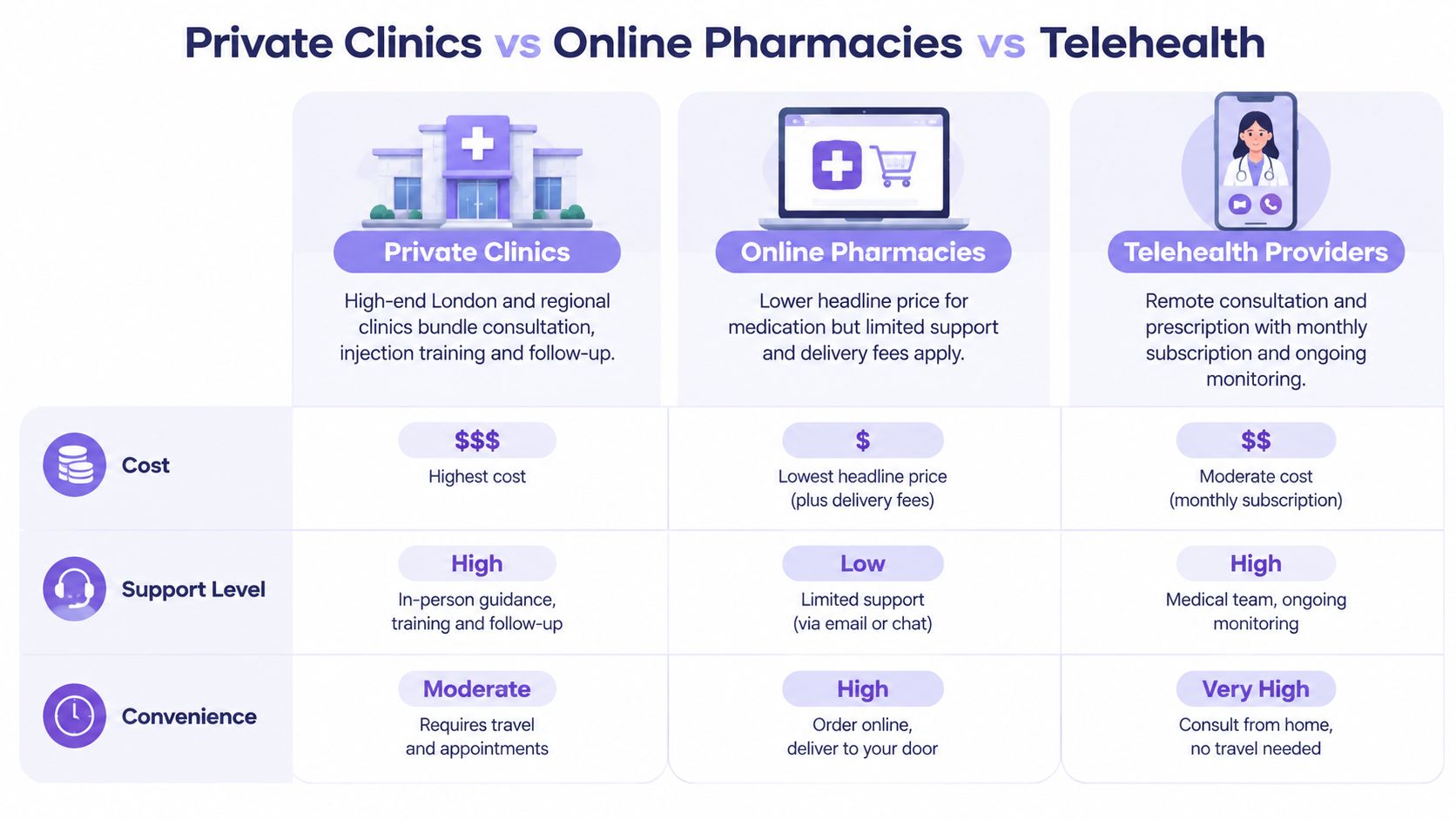
Before paying, request a written breakdown covering:
- Prescription issue: Is the prescribing assessment included?
- Pen quantity: How many doses or weeks does the pack provide?
- Follow-up: Are dose reviews included, and are they done by app, phone or video?
- Delivery: Is tracked shipping included or added at checkout?
- Sharps disposal: Is a sharps bin supplied, and are replacements charged?
- Dose changes: Does a higher strength trigger a new consultation or fee?
A provider operating as a UK-registered online pharmacy should clearly state its registration and clinical process. Check for General Pharmaceutical Council regulation, usually shown as GPhC registration, and identify who reviews your medical information.
Choose the service that can manage dose changes, side effects, missed doses and supply interruptions safely. The lowest first payment is not a reliable guide to the annual cost.
What drives the price you pay
The headline monthly price rarely reflects the amount a patient will spend over a full treatment year. Private cost depends on dose changes, how often the provider charges, and whether clinical services sit inside or outside the medicine price. NHS charges follow different rules and should be separated from private budgeting.
The main cost levers
Dose progression can change the bill sharply. Moving from a starter pen to a higher maintenance strength can more than double the monthly cost. Suppliers may charge disproportionately more for stronger pens because each pack contains a greater dose, so request prices for every planned step rather than relying on the first prescription.
Maintenance cost compounds across the year. A 12-month budget should combine the starter, escalation and maintenance stages. For example, six months at a lower private price followed by six months at a higher maintenance price gives a more realistic annual figure than multiplying the introductory price by 12. Use the pricing table above as a guide, then ask the provider to confirm its own current charges.
Pack size changes the calculation. Confirm how many weekly doses the product contains and whether the quoted amount covers one pen or the complete supply. A low-looking price may relate to a shorter supply than another provider's comparison figure.
Clinical support adds value and cost. Face-to-face consultations, blood tests, dietetic input and body-composition measurements may be charged separately. Ask what each fee covers and whether reviews are included when the dose changes.
Delivery and pharmacy charges matter. Temperature-sensitive medicines need suitable handling. Check whether shipping is included, how replacement deliveries are managed and whether a sharps bin or disposal service carries a separate charge.
Ask for the annual total: Request a written estimate covering the titration period, expected maintenance stage and every recurring fee. A guide to private prescription costs in the UK explains why the medicine charge and clinical service charge may appear separately.
Supply interruptions can also increase costs. A prescriber may need to review treatment, alter the plan or manage a restart if a medicine is unavailable. Do not switch products or strengths independently, because the safe approach depends on the medicine, timing and clinical circumstances.
Why the cheapest headline price can still be expensive
A low first-month price answers the wrong question. The meaningful question is whether the treatment remains affordable after titration, clinical review and the point at which the prescriber decides whether it is working.
For an eligible NHS patient in England, a Wegovy prescription attracts the standard £9.90 charge per item, subject to exemptions and prescription payment arrangements. In Scotland, Wales and Northern Ireland, NHS prescriptions are free at the point of use. The Asda guide to NHS weight loss injections explains why private affordability can't be assessed without first considering NHS eligibility.
Three affordability traps
The NHS route may be available, but not immediately. Specialist criteria and phased implementation mean that access depends on clinical eligibility and local service capacity. Paying privately may provide a faster route for some people, but speed shouldn't be confused with entitlement.
Dose escalation changes the monthly bill. A Wegovy starter strength may cost around £130, while a 2.4 mg maintenance supply can cost more than £250 privately, depending on the provider. Mounjaro can reach around £300 to £350 at higher maintenance strengths. The UK pharmacy comparison from Which? documents the broad private range.
Treatment has a clinical review point. NICE recommends considering stopping semaglutide if a patient has lost less than 5% of their initial body weight after six months of treatment. NICE's recommendation on semaglutide response means that some patients may pay for months of treatment before the prescriber decides that continuing offers insufficient value or benefit.
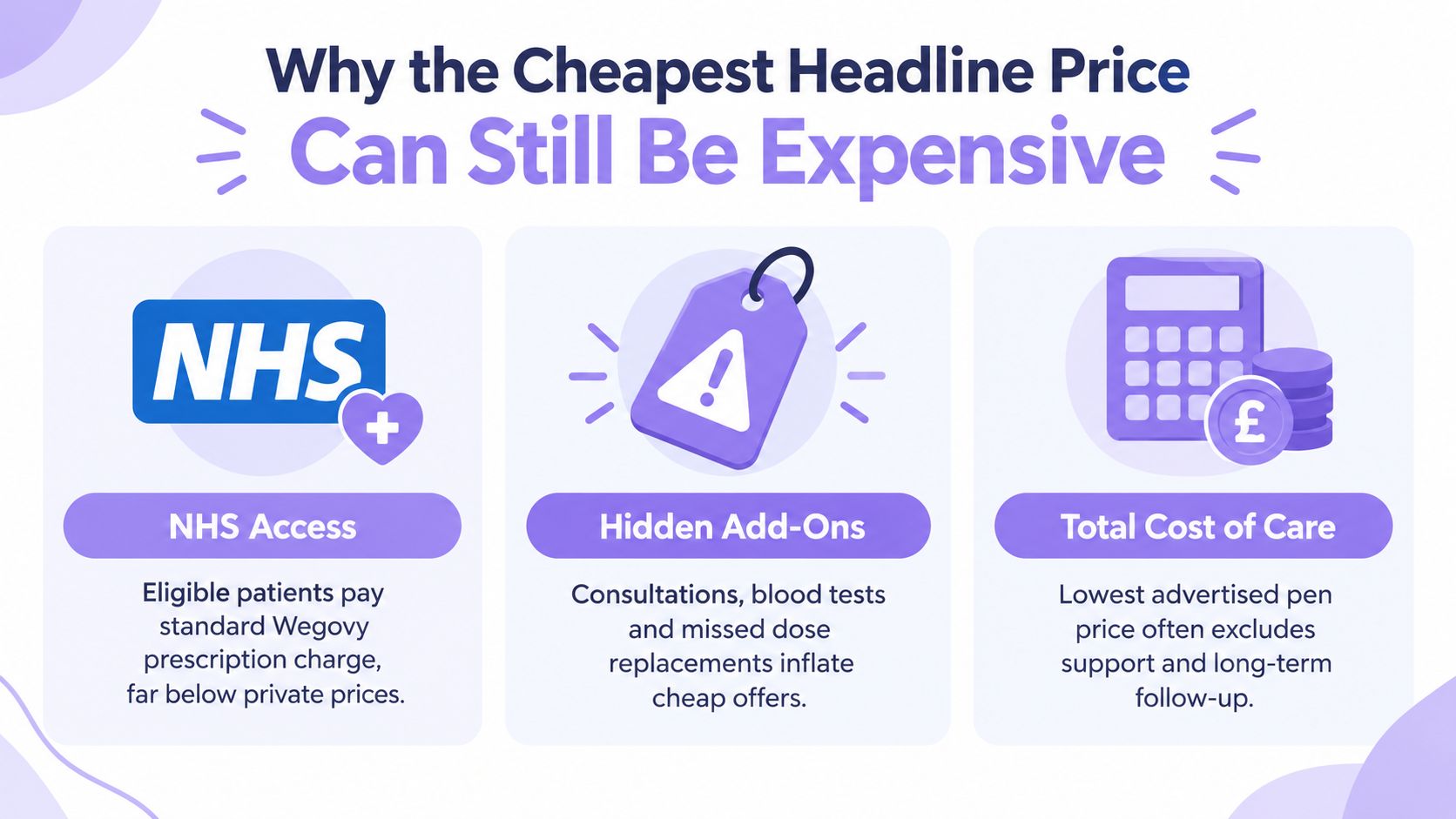
A cheap starter deal can therefore become expensive in three ways. The patient may not qualify for NHS care, may progress to a much higher private price, or may stop after a clinical review because the expected response hasn't occurred.
Clinical view: Don't choose a treatment based on the first prescription. Choose it only after you understand the likely maintenance cost and the review criteria.
Practical steps before you pay for weight loss injections
Use this checklist before entering payment details:
- Verify the supplier. Confirm that an online pharmacy is registered with the General Pharmaceutical Council. For an in-person clinic, check the relevant Care Quality Commission registration and ask who dispenses the medicine.
- Check the prescriber. The assessment should be completed by a UK-registered doctor, pharmacist independent prescriber or nurse independent prescriber. You should know how to contact the clinical team after the prescription is issued.
- Request a complete quote. Ask for the drug name, strength, pen quantity, consultation fee, follow-up cost, blood-test charges, delivery fee and expected maintenance price in writing.
- Confirm the supply chain. Ask whether Wegovy or Mounjaro comes from a licensed UK wholesaler. Don't accept unlabelled, relabelled or grey-import stock. Check the batch number, packaging integrity and expiry date when the delivery arrives.
- Discuss the treatment endpoint. Ask what happens if weight loss stalls, side effects develop or the planned maintenance dose isn't tolerated. The NICE response checkpoint should form part of that conversation.
- Check NHS eligibility first. Speak with your GP or local weight management service before committing to private treatment. Eligibility, referral requirements and local implementation can affect both access and cost.
- Report suspected adverse effects. Patients and healthcare professionals can report suspected medicine reactions through the MHRA Yellow Card scheme.
If your health history is complex, a structured assessment may be more suitable than a quick purchase form. Resources describing hospital-grade weight loss assessments can help you identify the clinical questions a responsible service should address.
This content is for informational purposes only and does not constitute medical advice. Always consult a qualified healthcare professional before starting or changing any treatment.
XO Medical provides remote clinical assessment and prescribed medication through a UK-registered online pharmacy model, with clinician follow-up and tracked delivery, while XO Clinic offers in-person aesthetics care including botox, dermal fillers, skin boosters and polynucleotides (salmon DNA). Visit XO to review the available services and decide which assessment route is appropriate for your needs.


0 comments