


A useful way to frame weight loss medication side effects is this. In UK real-world reporting, gastrointestinal reactions are the dominant problem, not a niche complication. The MHRA said on 24 October 2024 that it had received 7,228 reports of nausea, vomiting and diarrhoea linked to GLP-1 receptor agonists used for weight management, and that these common side effects may affect more than 1 in 10 patients and can persist for several days, according to the MHRA Drug Safety Update on GLP-1 receptor agonists.
That changes the conversation. Many people still approach Wegovy, Mounjaro, Saxenda or orlistat as though the main question is whether side effects happen at all. In practice, the better question is which side effects are common, which are serious, and what you should do if they start.
This guide is written for UK adults looking at prescription-only treatment through the NHS, a private prescriber, or an online pharmacy. It uses UK regulation, NHS patient information and MHRA Yellow Card reporting to turn safety data into practical, plain-English guidance. It isn't personal medical advice, and it doesn't assume that one medicine suits everyone.
Reviewed by: Medical content prepared in a UK clinical education style
Review date: 21 September 2026
Clinical perspective: Post-marketing reports don't just tell us what can happen in theory. They show what patients and clinicians are actually seeing after medicines are widely used.
Table of Contents
- What UK Readers Mean by Weight Loss Medication Side Effects
- The Main Prescription Weight Loss Medicines Available in the UK
- Common Side Effects of GLP-1 Weight Loss Medicines
- How Orlistat and Other Non-GLP-1 Options Compare
- Serious but Less Common Side Effects to Recognise
- Managing Side Effects Day to Day and Over Time
- UK Regulation, Yellow Card Reporting and NICE Access Rules
- Who Should Avoid These Medicines and What to Ask a Prescriber
What UK Readers Mean by Weight Loss Medication Side Effects
People searching this topic are trying to answer a very practical question. “If I start a prescribed medication for weight loss, what is likely to happen in the first few days, first few weeks, and later on if I stay on it?”
In the UK, that usually means one of a few medicines. The most talked-about are GLP-1 medicines such as semaglutide and liraglutide, and the related medicine tirzepatide. Some people are comparing those with orlistat, and a smaller number are asking about older appetite suppressants or combination tablets available on private prescription.
Why side effects vary so much between people
Two people can take the same medicine and have very different experiences. That's because side effects are shaped by more than the drug name alone.
A prescriber will usually think about:
- Drug class: GLP-1 and GIP-related medicines mainly cause stomach and bowel symptoms, while orlistat causes bowel effects through fat malabsorption.
- Dose stage: symptoms often appear when treatment starts or when the dose increases.
- Personal history: previous reflux, constipation, gallstones, pancreatitis, migraine, anxiety, or bowel conditions can all matter.
- Other medicines: diabetes treatments, especially those that can lower blood sugar, can change the risk profile.
- Pregnancy potential: this is a key prescribing question for weight management medicines.
What usually confuses patients
Many readers mix up common side effects with dangerous side effects. They're not the same thing. Nausea is common. Severe persistent abdominal pain is not something to watch and wait with.
Another common point of confusion is licensing. Some medicines are licensed specifically for weight management. Others are better known from diabetes treatment, and the brand matters.
That's also why UK regulation matters. A prescription-only treatment shouldn't be supplied automatically. Whether you use a face-to-face service or a UK-registered pharmacy regulated by the GPhC, safe prescribing depends on clinical assessment, not checkout speed.
The Main Prescription Weight Loss Medicines Available in the UK
The easiest way to understand side effects is to group medicines by how they work. The mechanism usually predicts the pattern of adverse effects.
GLP-1 receptor agonists
This group includes semaglutide and liraglutide. In plain language, they copy the action of a natural gut hormone involved in appetite and fullness. They slow stomach emptying and help people feel full sooner.
For weight management, brand and indication matter. Wegovy is used for weight management, while Ozempic is primarily known as a diabetes medicine. Saxenda contains liraglutide and is used for weight management.
Because these medicines act heavily on the gut, they're the ones most strongly associated with nausea, vomiting, constipation, diarrhoea and reduced appetite.
Dual GIP and GLP-1 agonists
Tirzepatide, sold as Mounjaro, works on related hormone pathways. Patients often hear it discussed in the same breath as GLP-1 medicines because the day-to-day experience can overlap, especially with gastrointestinal symptoms.
From a safety point of view, many readers can think of tirzepatide as sitting in the same family of “gut-hormone based” weight loss treatments, even though its pharmacology is slightly broader.
Lipase inhibitors
Orlistat works very differently. It doesn't mainly act on appetite or stomach emptying. It reduces how much dietary fat is absorbed in the bowel.
That difference matters because the side effects also differ. If you eat a fatty meal while taking orlistat, the unabsorbed fat stays in the gut and tends to cause bowel symptoms rather than the nausea-led pattern often seen with GLP-1 medicines.
Other non-GLP-1 options
Some readers ask about naltrexone-bupropion and older sympathomimetic appetite suppressants such as phentermine where privately available. These don't produce the same classic gut-hormone side-effect pattern.
Instead, they may raise questions about sleep, mood, blood pressure, heart rate, agitation or stimulant effects. That's one reason a full prescribing history is important.
If you're also researching private healthcare more broadly, it helps to separate services clearly. A regulated prescribing pathway for weight loss medicines is different from an in person aesthetics clinic offering botox, dermal fillers, skin boosters and polynucleotides (salmon DNA), even if both operate under the same wider brand.
Common Side Effects of GLP-1 Weight Loss Medicines
Around half of the Yellow Card side effects reported for tirzepatide, semaglutide and liraglutide between 2020 and 2025 were gastrointestinal, according to the Pharmaceutical Journal feature on GLP-1 medicines for weight loss. That pattern matters because Yellow Card totals are best read as a map of what gets reported most often, not as a headcount of how many people will personally develop a problem.
For UK patients, the practical message is straightforward. The common side effects of GLP-1 weight loss medicines usually centre on the stomach and bowel.
As noted earlier in the MHRA October 2024 Drug Safety Update, nausea, vomiting and diarrhoea are reported frequently in people using GLP-1 medicines for weight management, and these effects may affect more than 1 in 10 patients. Post-marketing reports build up over time from many different people and settings. They cannot prove the exact chance for any one individual, but they do show the direction of travel clearly. In this case, the signal is overwhelmingly gastrointestinal.
What these side effects usually feel like
A useful way to understand GLP-1 symptoms is to picture the stomach working in a lower gear. Food sits for longer, fullness arrives earlier, and the body pushes back if intake outpaces tolerance.
Patients commonly describe:
- Nausea, often worse after dose increases, large meals, greasy food, or eating quickly
- Vomiting, usually after nausea has built up or when someone keeps eating despite feeling full
- Diarrhoea, ranging from a few loose stools to more urgent repeated episodes
- Constipation, which can appear more gradually as food volume drops and fluid intake falls
- Bloating or upper abdominal discomfort, sometimes described as pressure, cramping, or food “just sitting there”
- Injection-site irritation, such as mild redness, itching, or soreness with injectable medicines
The NHS semaglutide medicine information also lists nausea, vomiting, constipation, diarrhoea, tiredness, itchy or red skin where the injection was given, and hair loss among recognised side effects.
Why the pattern is so consistent
These medicines change appetite signalling and slow gastric emptying. That is part of how they help with weight loss. It also explains why side effects often cluster around meals.
A simple analogy helps here. If the stomach empties more slowly, eating a normal old portion can feel like pouring more into a sink that is already draining at reduced speed. The result is often queasiness, pressure, belching, reflux-like discomfort, or vomiting.
Dose escalation is a common sticking point. Someone may manage the starting dose reasonably well, then struggle in the first days after stepping up. That does not automatically mean the medicine is unsafe or unsuitable, but it does mean the gut has not fully adapted yet.
| Side effect | What UK patients often notice | When it tends to show up | What Yellow Card patterns suggest |
|---|---|---|---|
| Nausea | Early fullness, queasiness, food aversion | After starting, after dose increases, or after rich meals | One of the main reported problems across GLP-1 medicines |
| Vomiting | Bringing food back up, difficulty finishing meals | Usually during more intense nausea or poor tolerance of a dose step | Part of the same common GI cluster seen repeatedly in UK reporting |
| Diarrhoea | Loose or urgent stools | Often early in treatment or during titration | Frequently reported in post-marketing safety data |
| Constipation | Hard stools, less frequent bowel motions, straining | Can build over days to weeks | Common in routine patient guidance, though often less talked about than nausea |
| Bloating or abdominal discomfort | Fullness, cramping, pressure | Often after eating more than the gut will comfortably handle | Fits the slowed-emptying mechanism seen across the class |
| Injection-site irritation | Redness, mild itching, tenderness | Soon after injection | Recognised with injectable treatment, usually local and short-lived |
What to do with this information
The safest way to use report volumes is as context. Large cumulative numbers do not mean a medicine is causing severe harm in everyone taking it. They mean many people report a similar pattern, which gives patients and prescribers a realistic expectation before treatment starts.
That expectation helps with day-to-day choices. Smaller meals, slower eating, enough fluid, and caution with heavy or high-fat foods often make more difference than people expect. If you want medicine-specific practical examples, XO Medical has a factual guide to Wegovy side effects.
Some patients also find structured meal planning useful while appetite is low or unpredictable. If that would help, try AI Meal Planner.
How Orlistat and Other Non-GLP-1 Options Compare
GLP-1 medicines dominate current discussion, but they aren't the only prescribed option. The side-effect trade-off changes quite a lot once you step outside that class.
Orlistat has a different problem pattern
Orlistat blocks fat absorption in the gut. That means the most typical side effects are bowel-related and closely tied to how much fat is in the diet.
People often describe oily stools, urgency, wind, leakage, or loose bowel motions after a high-fat meal. The mechanism is straightforward. Unabsorbed fat passes through the bowel.
A practical starting point for patients comparing this option is XO Medical's article on Alli weight loss pills, which explains the over-the-counter and prescription context.
Other tablets bring different risks
Naltrexone-bupropion is better understood as a centrally acting weight management medicine. Questions around nausea can still arise, but prescribers also think about mood, sleep and suitability based on psychiatric and medical history.
Older sympathomimetics such as phentermine, where prescribed privately, raise a different set of concerns. These include insomnia, palpitations, raised blood pressure, jitteriness and stimulant effects.
| Medicine | Class | Most common side effects | Notable risks | UK reporting context |
|---|---|---|---|---|
| Orlistat | Lipase inhibitor | Oily stools, urgency, loose motions, wind | Problems worsen with high-fat intake, possible vitamin-related issues | Reporting pattern is qualitatively different from GLP-1 bowel slowing |
| Naltrexone-bupropion | Centrally acting combination | Nausea, sleep disturbance, appetite-related effects | Mood and psychiatric suitability need review | Requires careful history rather than assuming “tablet equals easier” |
| Sympathomimetics such as phentermine | Appetite suppressant | Insomnia, dry mouth, palpitations, agitation | Cardiovascular and stimulant concerns | Use is more restricted and clinically selective |
| Semaglutide, liraglutide, tirzepatide | Gut-hormone based injectables | Nausea, vomiting, diarrhoea, constipation, abdominal discomfort | Pancreatitis, gallbladder disease, dehydration and other recognised serious risks | High volume of UK Yellow Card GI reporting compared with other classes |
The key comparison is simple. GLP-1 medicines tend to be nausea-led. Orlistat tends to be bowel-led. Stimulant-type options tend to be sleep and cardiovascular-led.
Serious but Less Common Side Effects to Recognise
UK Yellow Card reports for weight loss medicines are cumulative safety signals, not a headcount of how often a problem will happen to an individual patient. That distinction matters. A medicine with many thousands of users will usually generate more reports than a rarely used one, so report volume helps regulators spot patterns, then judge whether those patterns are consistent enough to change advice.
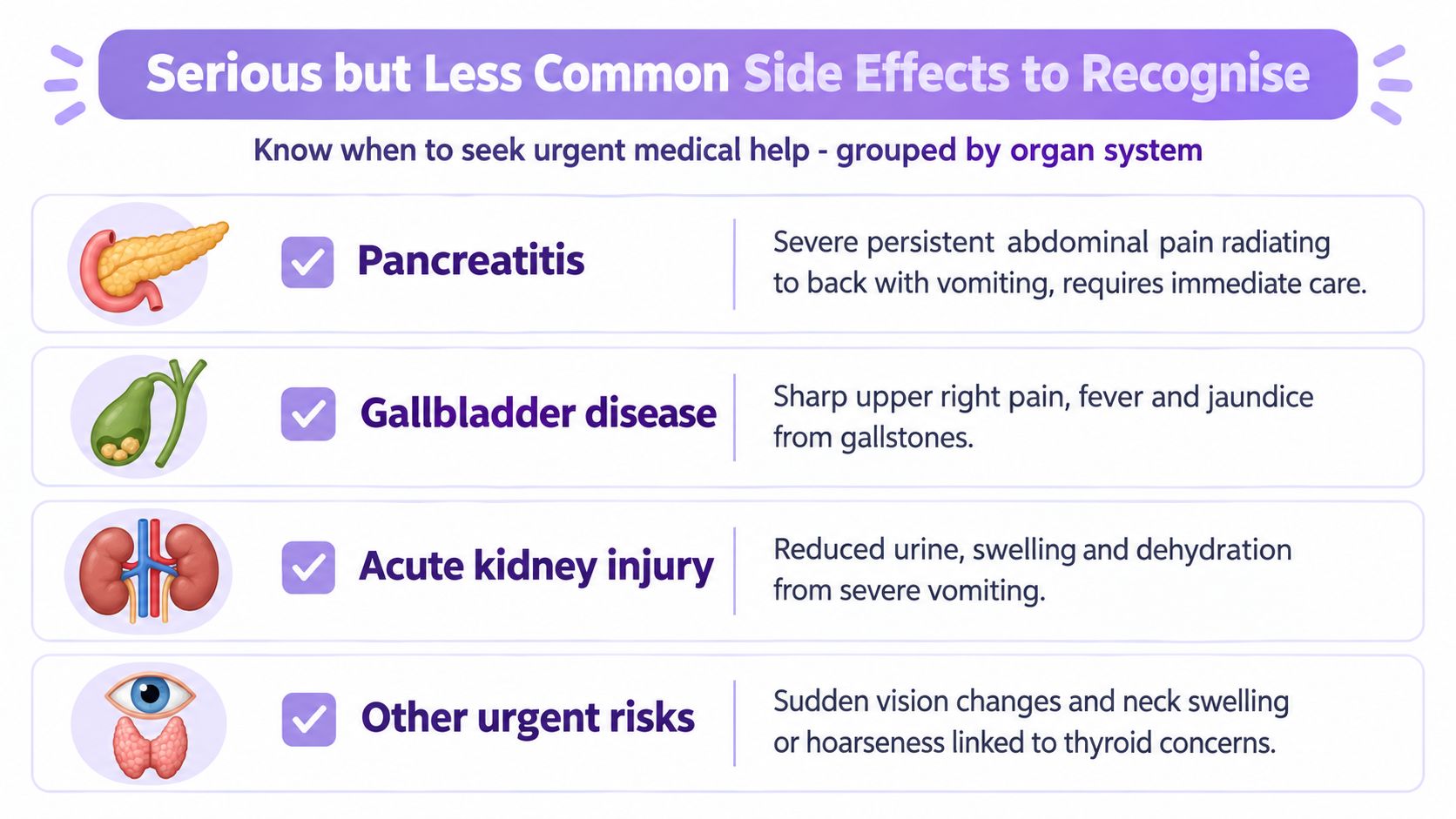
The current MHRA position is that acute pancreatitis is a recognised but uncommon risk with GLP-1 medicines. It also highlights acute gallstone disease, serious allergic reactions, and hypoglycaemia in some people using GLP-1 receptor agonists for weight management, as set out in the MHRA guidance update for GLP-1 prescribers and patients.
Gastrointestinal red flags
Ordinary treatment-related nausea usually comes and goes. It often tracks with dose increases, larger meals, or the first few weeks of treatment. The symptoms below sit in a different category because they may point to inflammation or dehydration rather than routine intolerance.
Severe, persistent abdominal pain is the main example. If the pain is marked, spreads through to the back, or comes with repeated vomiting, clinicians worry about pancreatitis. That needs urgent medical assessment.
Pain under the right ribs, especially with fever, jaundice, or vomiting, can suggest gallbladder disease such as gallstones or gallbladder inflammation. Rapid weight loss can add to that background risk, which is one reason prescribers ask about pain pattern rather than just whether the stomach feels upset.
Allergic, metabolic and eye symptoms
Serious allergic reactions are rare, but the pattern is well recognised. Swelling of the lips, tongue, or throat, wheeze, widespread rash, or collapse needs emergency help.
Low blood sugar is less straightforward, because the risk depends on the person and the medicines around the GLP-1 treatment. In practice, concern is higher in people who also use glucose-lowering treatment for diabetes. Sweating, shaking, confusion, or unusual drowsiness should not be dismissed as “just not eating enough” without checking.
Visual symptoms need care too. Sudden blurring, a rapid drop in vision, or other acute change is not a routine weight loss medicine effect. It needs prompt assessment, especially in anyone with diabetes or previous eye disease.
Dehydration is often the middle step between a common side effect and a serious one. Repeated vomiting, very poor fluid intake, reduced urine output, dizziness on standing, or marked weakness can put strain on the kidneys. The medicine may not be the only cause, but the combination of appetite suppression, nausea, and poor intake can push someone into trouble.
Urgent rule: Symptoms that are severe, persistent, progressive, or clearly out of keeping with expected early nausea need same-day clinical advice.
Why Yellow Card context matters
Yellow Card reports work a bit like an early warning system in general practice. One report proves very little on its own. Repeated reports of the same serious pattern across many patients make regulators look harder, compare with trial data, and update prescribing advice if needed.
For patients, the practical message is simple. A large number of cumulative reports does not mean a side effect is common for you personally. It means the risk is real enough to recognise early and act on quickly. That is why NHS-aligned advice focuses on warning patterns, not panic. The aim is to tell apart symptoms that can be watched from symptoms that need urgent review.
Managing Side Effects Day to Day and Over Time
Good side-effect management starts before the first dose. Most problems become easier when patients know what pattern to expect and when to pause.
Practical steps that usually help
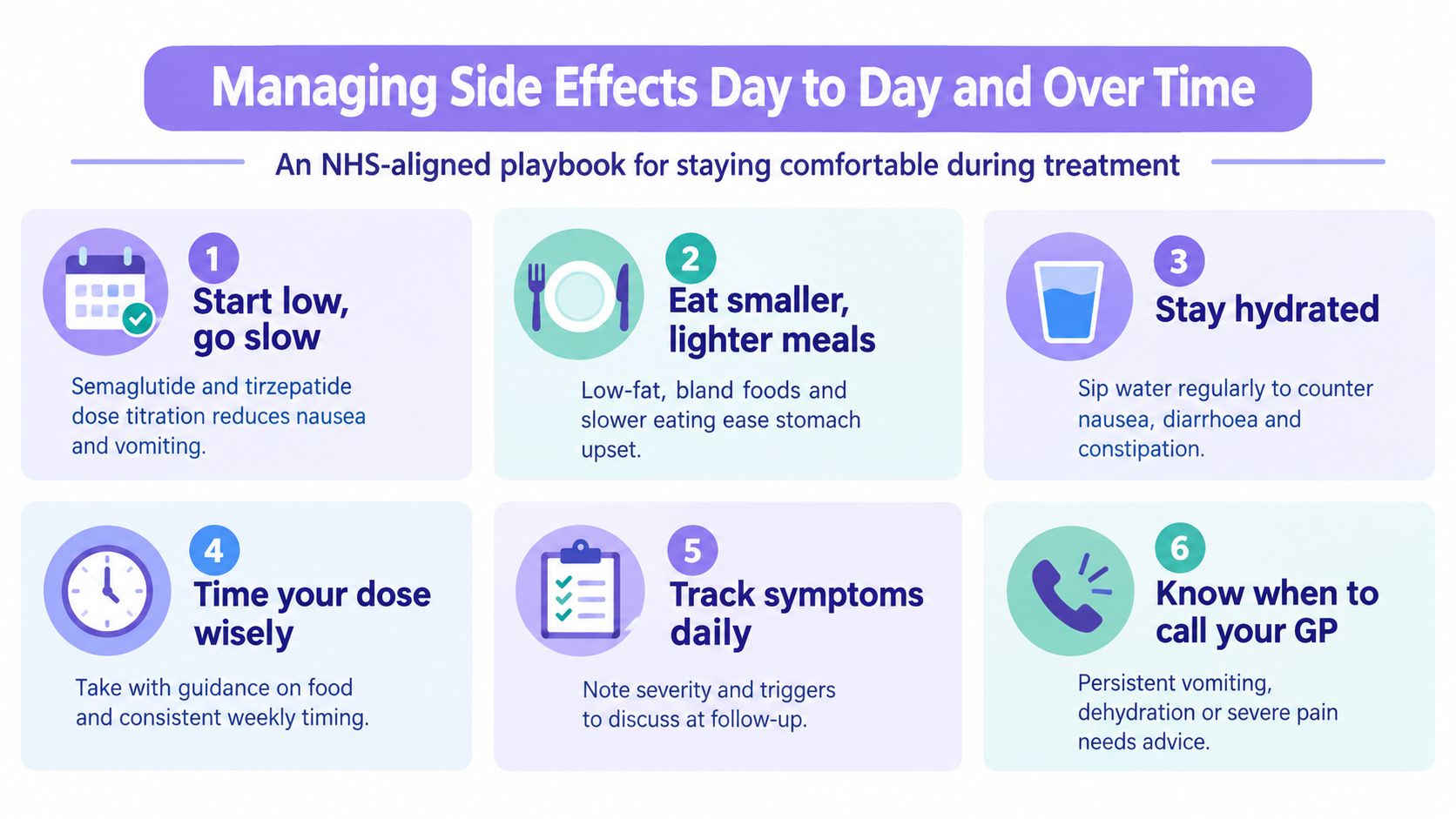
- Start low and titrate slowly: dose increases are a common trigger for nausea and vomiting.
- Eat smaller meals: many people do better with lighter portions and slower eating.
- Keep fluids steady: regular sips can be easier than large drinks if nausea is active.
- Avoid rich meals: greasy, very sweet or heavy foods often worsen symptoms on GLP-1 medicines.
- Rotate injection sites: this may reduce local skin irritation with injectable treatment.
- Track patterns: symptoms linked to dose day, meal size or specific foods are easier to adjust.
For orlistat, the advice is different. A lower-fat diet usually reduces bowel side effects because there is less unabsorbed fat left in the gut.
When to pause and ask for advice
Temporary pauses can be sensible when someone has an intercurrent illness, poor oral intake, repeated vomiting or dehydration risk. Planned pregnancy also needs discussion well before treatment continues.
A regulated prescriber should explain what to do around illness, surgery and missed doses. That's part of safe prescribing, not an optional extra.
This short explainer can help some readers visualise the basics of symptom management and what follow-up should look like in practice.
Who to contact
Different symptoms call for different routes:
- Prescriber or pharmacy team: ongoing nausea, constipation, appetite suppression that feels excessive, difficulty stepping up dose
- NHS 111: worsening symptoms out of hours when you're unsure if urgent review is needed
- A&E or emergency help: severe abdominal pain, signs of anaphylaxis, collapse, severe dehydration, major visual changes
Many side effects can be managed. Persistent vomiting, inability to keep fluids down, or severe pain should never be handled as a routine inconvenience.
UK Regulation, Yellow Card Reporting and NICE Access Rules
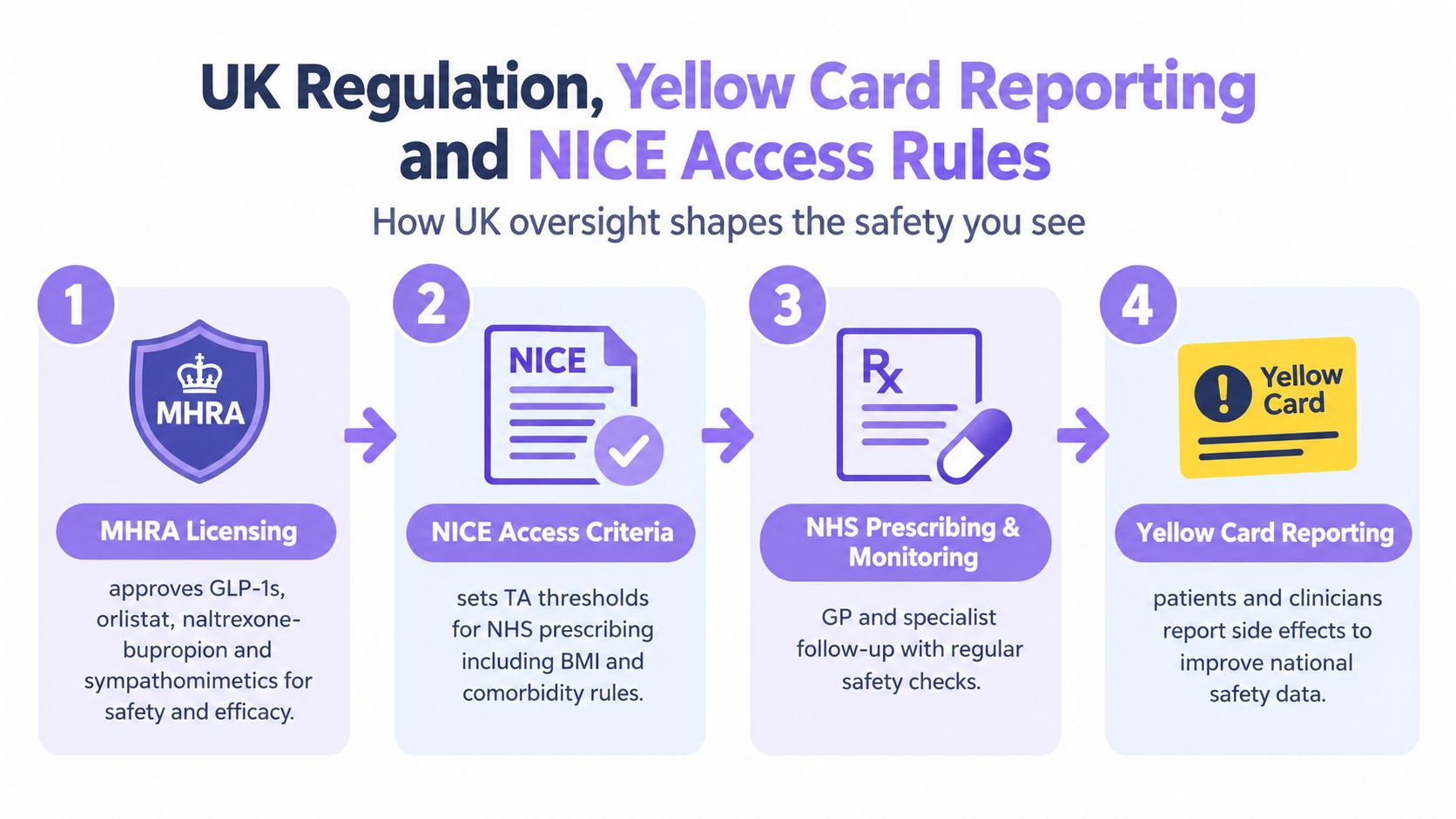
In the UK, safety doesn't depend only on the medicine itself. It also depends on the system around it. Licensing, prescribing standards, pharmacy regulation and reporting rules all shape the patient experience.
What NICE says about access
NICE says semaglutide is an option for weight management only in a specialist overweight and obesity management service, and treatment should be stopped if less than 5% of initial body weight has been lost after 6 months, according to the NICE guide for prescribing medicines to manage overweight and obesity.
That matters because safe use isn't just about starting treatment. It's also about reviewing whether it's working and whether the side-effect burden remains proportionate.
How to think about Yellow Card reports
Yellow Card reports are valuable, but they don't prove that a medicine caused every event reported. They are a signal-detection tool.
What they do show very clearly is pattern. For GLP-1 medicines used in weight management, the pattern is heavily gastrointestinal in everyday use.
If you're looking for a plain-English overview of the prescribing process, XO Medical's guide to GLP-1 medication in the UK is a helpful companion read.
Why regulated supply matters
A UK-registered pharmacy regulated by the GPhC should be working within a proper prescribing framework. That means identity checks, medical questionnaires, clinician review, medicine-specific counselling and follow-up where appropriate.
That standard is different from websites that imply automatic access. Weight loss injections and tablets used this way are prescribed medication and should be treated as such.
Who Should Avoid These Medicines and What to Ask a Prescriber
Not everyone is a suitable candidate for weight loss medicines. Some people have clear reasons to avoid a specific drug class. Others need much closer review before a prescriber could decide safely.
Who may need to avoid treatment
A prescriber will usually look carefully at these issues:
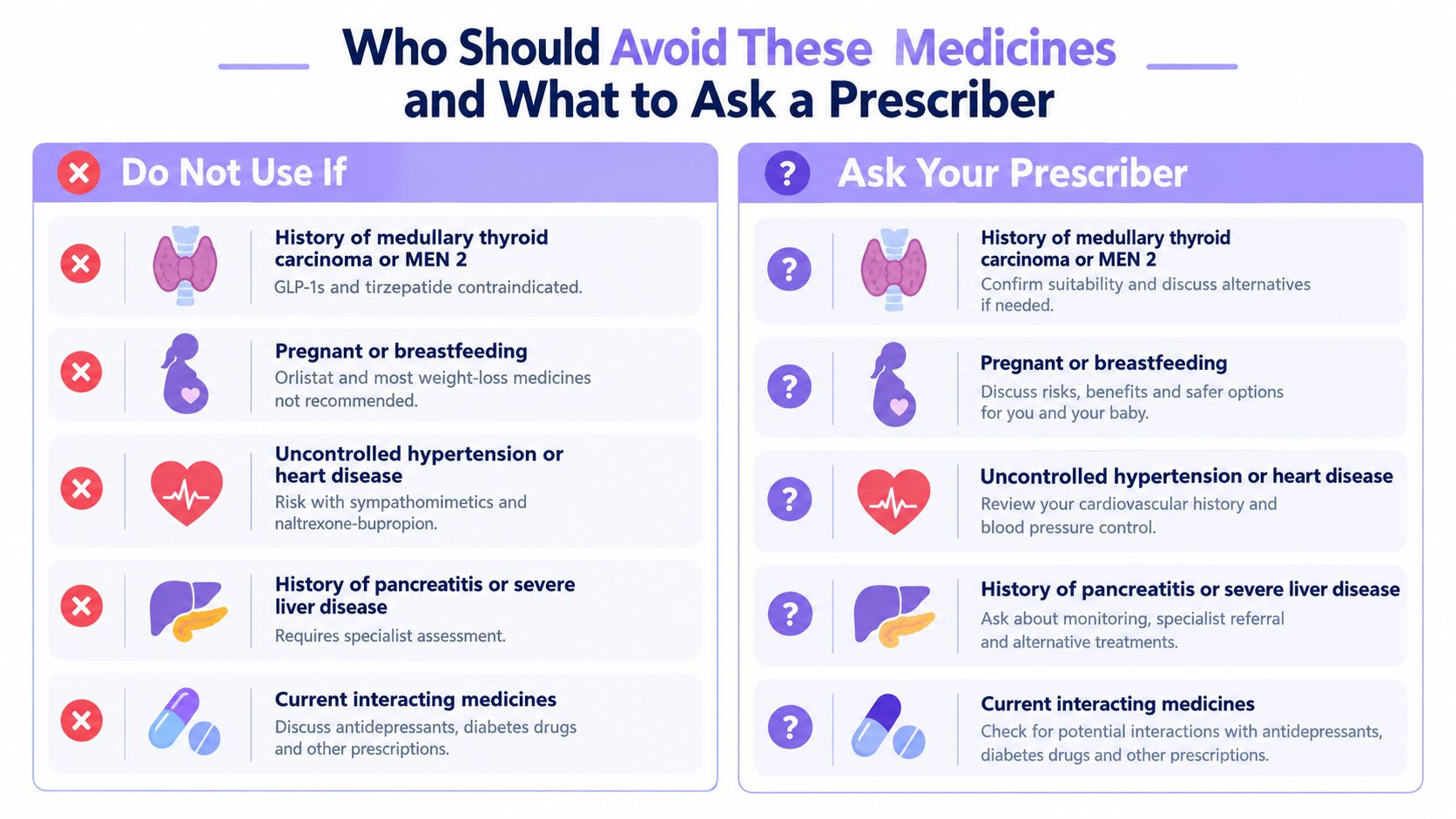
- Thyroid cancer history: GLP-1 medicines and tirzepatide may not be suitable if there is a personal or family history of medullary thyroid carcinoma or MEN 2.
- Pregnancy or breastfeeding: weight management medicines are generally not the place to continue or start treatment without specialist advice.
- Previous pancreatitis or significant gallbladder disease: these histories can alter risk-benefit decisions.
- Severe gastrointestinal disease: if the gut is already difficult to manage, side effects may be harder to tolerate.
- Concurrent diabetes medication: especially where low blood sugar is already a concern.
- Eating disorder history: appetite-suppressing treatment needs thoughtful assessment, not shortcuts.
Questions worth asking before you start
Bring specific questions to the consultation. Good prescribing is a conversation.
Ask things such as:
- What side effects are most likely with this exact medicine?
- What happens at each dose increase?
- What symptoms mean I should pause and contact someone the same day?
- How will this fit with my other medicines, including over-the-counter products and supplements?
- What should I do if I'm trying for pregnancy, become pregnant, or can't keep food down?
- Will I be shown how to inject it properly if it's an injectable treatment?
- What monitoring will you arrange during treatment?
Four practical takeaways
- GLP-1 and tirzepatide medicines: gastrointestinal side effects are the main issue and may improve with slower titration and meal adjustment.
- Orlistat: bowel effects are the defining problem, especially with higher-fat meals.
- Serious adverse events: these are less common, but they matter because they need rapid recognition.
- Follow-up matters: ongoing review is part of safe treatment, not an administrative extra.
A regulated UK prescriber should take a full history before issuing a prescription. That applies whether treatment is arranged through an in-person service or an online pharmacy. If you suspect a side effect, report it through the MHRA Yellow Card scheme and keep your scheduled review appointments.
This content is for informational purposes only and does not constitute medical advice. Always consult a qualified healthcare professional before starting or changing any treatment.
XO brings together a GPhC-regulated online pharmacy and clinician-led healthcare pathway for adults seeking prescribed medication, including weight management treatment, with assessment by UK-registered prescribers before supply. If you want regulated, medically reviewed information and a consultation route that fits this topic, visit XO.


0 comments