


You've typed “weight loss treatment near me” into your phone and found a mixture of pharmacies, private clinics and injection packages. Some offer appointments locally; others promise convenient online access. Before comparing prices or travelling to a clinic, establish something more important: who will assess you, who can prescribe, and who will remain responsible for your care.
Table of Contents
- What 'Near Me' Actually Means for Weight Loss Treatment in the UK
- Treatment Types You Will Come Across
- In-Person Clinic vs Online Pharmacy - How to Choose
- The Eligibility Assessment a Clinician Should Run
- Cost, Pricing and What Follow-Up Should Include
- Red Flags and How to Verify a UK Provider
- Booking, First Appointment and Ongoing Follow-Up Checklist
What 'Near Me' Actually Means for Weight Loss Treatment in the UK
Suppose you're searching from Manchester after struggling to find support that fits around work. A nearby appointment sounds practical, but the results don't necessarily describe comparable services. A GP referral, an NHS specialist service, a private medical clinic and an online pharmacy can offer different routes into treatment.
The scale of need helps explain the crowded search results. In England, 64.5% of adults were estimated to be overweight or living with obesity in 2023–2024, according to the government's obesity profile commentary. That population figure doesn't establish your eligibility or identify the right service for you.
Start with the pathway, not the postcode
Your practical options may include:
- Your GP: A starting point for discussing health risks, local support and referral requirements.
- An NHS specialist weight-management service: A route for assessment and treatment within local referral and commissioning arrangements.
- A private clinician or online pharmacy: An alternative assessment pathway, with private fees and its own clinical governance.
- An aesthetics clinic: A separate service category whose medical weight-management provision needs checking, rather than assuming.
For tirzepatide, NHS England's interim commissioning guidance describes phased access, initially prioritising people with the highest clinical need and extending primary-care provision over time. Meeting general clinical criteria therefore doesn't automatically mean that your local NHS service can start treatment.
If you're comparing physical locations, you can find your nearest Telomyx clinic as a starting point for checking location and contacting the service. A location listing isn't evidence that a particular medicine, NHS pathway or appointment is available.
Practical rule: A nearby address is useful only when the service can provide the assessment, treatment and follow-up you actually need.
Ask your GP what's commissioned locally if an NHS route appears unavailable. Your decisions are where to obtain a suitable assessment and how to verify the provider before paying.
Treatment Types You Will Come Across
Choose a treatment pathway before choosing a product. A useful service explains the available approaches and why one might suit your health profile better than another.
Lifestyle programmes and oral medicines
Structured lifestyle and behavioural support addresses eating patterns, physical activity and the practical barriers to making changes. It may involve digital sessions, group support or individual appointments. It's a foundation for care, not something to dismiss because it doesn't involve a prescription.
Oral prescription medicines are another category you may encounter through a pharmacy or medical clinic. Tablets aren't interchangeable with injections, and their suitability depends on the particular medicine and your clinical assessment. Ask the prescriber to explain the intended benefit, important risks and review arrangements rather than treating the tablet format as simpler.
NICE's medicines and surgery guidance states that weight-management medicines should accompany dietary and physical-activity changes. Buying prescribed medication without support for those changes misses an important part of treatment.
Injections and combined clinical programmes
Injectable medicines, including semaglutide and tirzepatide, are prescription-only treatments. Don't choose between them solely because of advertising, availability or someone else's experience. For a product-focused introduction, the guide to weight-loss injections available in the UK can help you prepare questions for a clinician.
A multidisciplinary clinician-led programme combines relevant medical treatment with nutritional, activity and behavioural support. Ask whether psychological support is available when eating patterns or emotional difficulties need more attention. The important distinction is between receiving a medicine and receiving coordinated care.
The setting also matters when deciding how that care will work.
An in-person aesthetics clinic offering Botox, dermal fillers, skin boosters and polynucleotides (salmon DNA) is a different service category. Don't infer weight-loss prescribing expertise from its cosmetic treatment menu.
My recommendation is to favour a provider that can explain why a treatment is appropriate and what happens if it isn't. A consultation should leave room for another approach, further assessment or no prescription.
In-Person Clinic vs Online Pharmacy - How to Choose
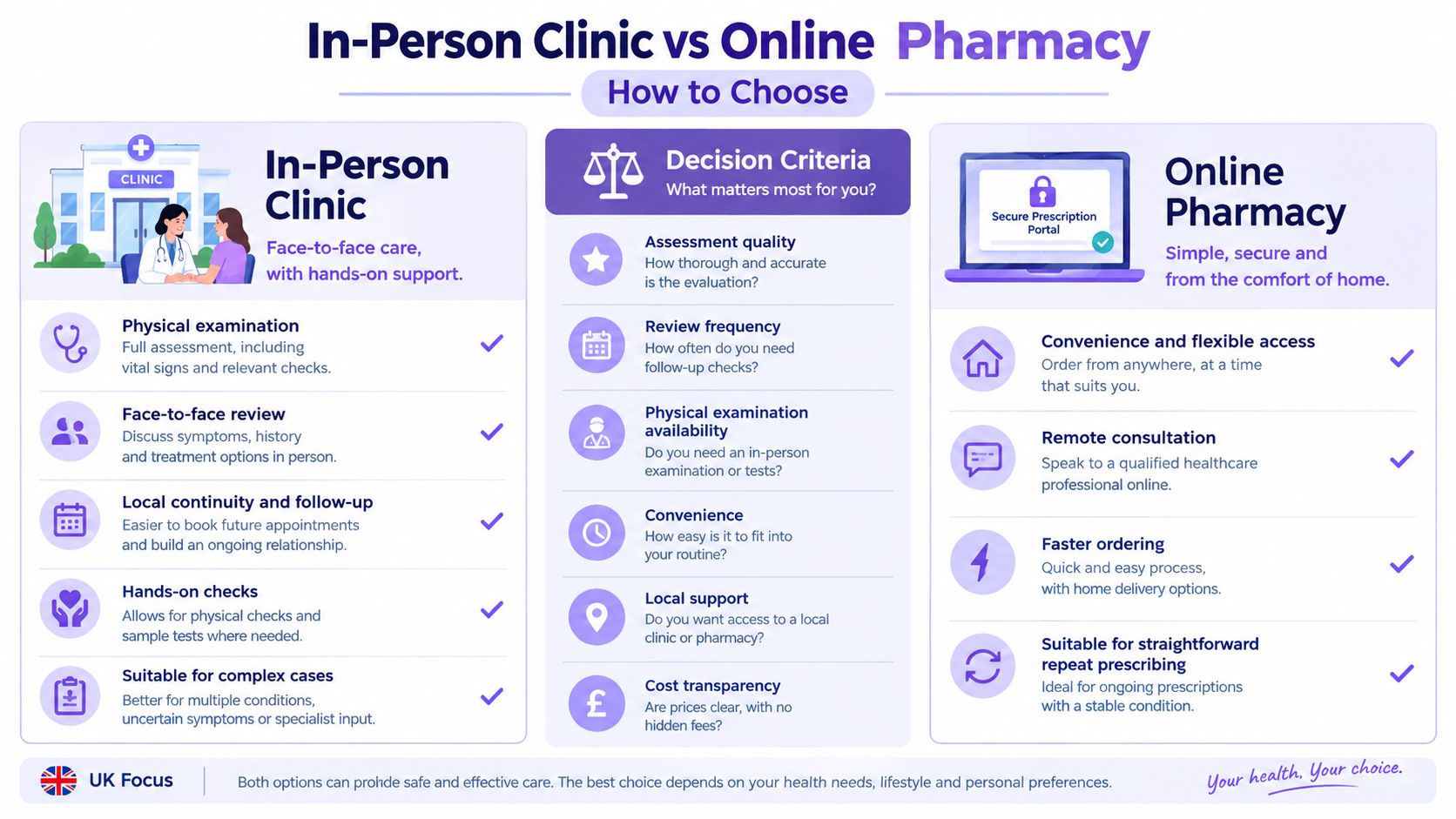
Choose an in-person appointment when you want face-to-face discussion, need hands-on assessment or find remote communication difficult. Choose an online pharmacy when remote appointments fit your circumstances and the provider can explain how it will obtain reliable clinical information. Neither format removes the need for a proper assessment.
| Decision point | In-person clinic | Online pharmacy |
|---|---|---|
| Examination | Ask what can be checked during the appointment | Ask when an examination or local check would be required |
| Communication | Consider travel and appointment availability | Check how to contact the clinical team beyond an online form |
| Prescribing | Identify the clinician making the decision | Establish who assesses the consultation and authorises treatment |
| Continuity | Check whether you can see the same team | Ask how records and previous decisions remain accessible |
| Practical access | Consider transport and time away from work | Consider delivery arrangements and remote review requirements |
Digital access can work, but it needs clinical ownership
The NHS Digital Weight Management Programme had received more than 358,000 referrals by March 2024. Its initial evaluation reported average weight loss of 3.9 kg over 12 weeks among programme completers, not everyone referred, as explained in the NHS account of the digital programme.
That supports digital delivery as a genuine care option. It doesn't establish that every online prescribing service offers equivalent assessment or follow-up, and it isn't a prediction of your outcome.
Ask both types of provider what happens when remote care isn't enough. A clear answer should identify how additional checks are arranged and who reviews the results.
Plan for a change of provider
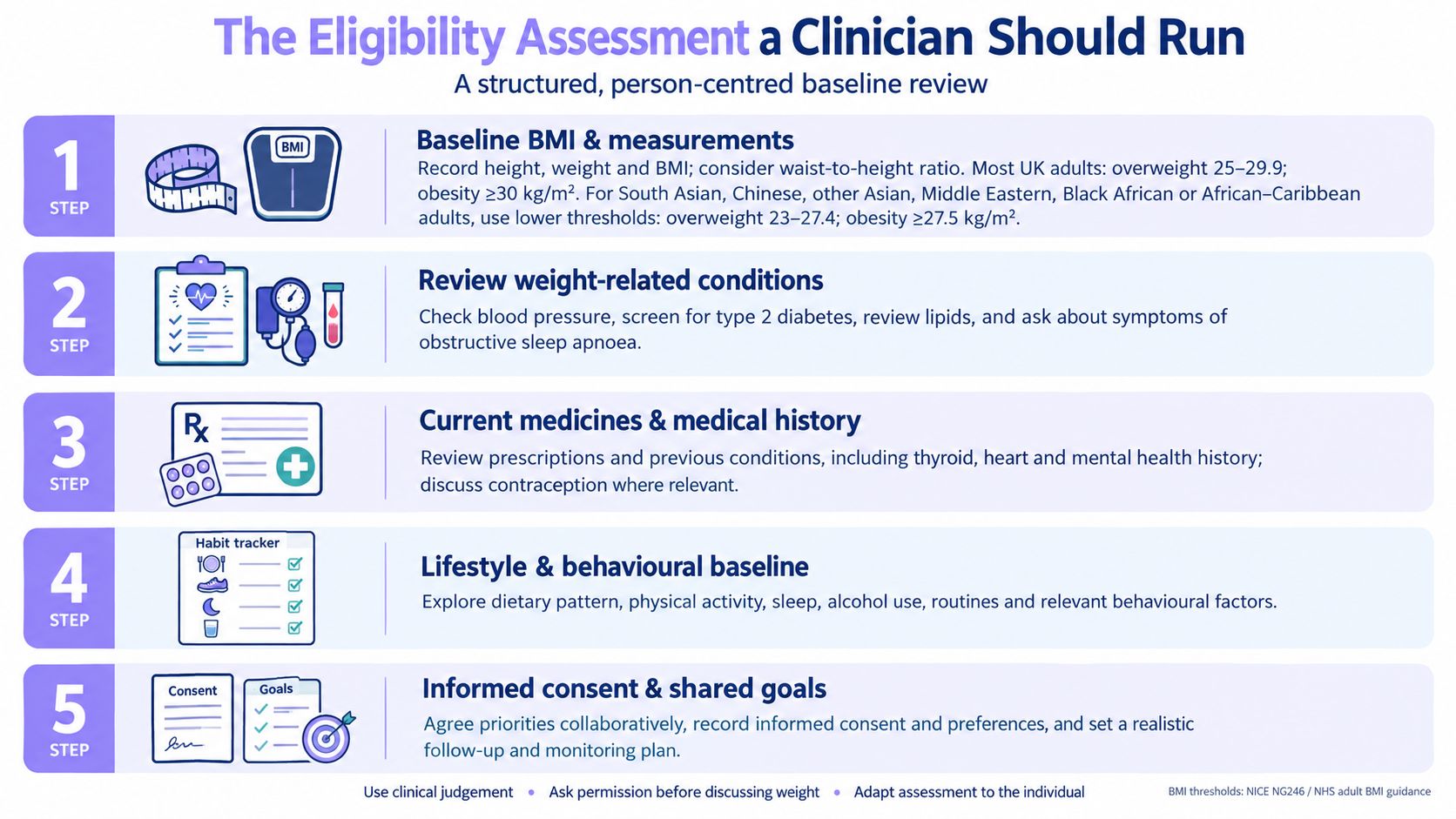
If you later move between an online service, your GP and NHS care, request a treatment summary. It should make the prescribed medicine, dose, progress and outstanding concerns clear to the next clinician.
Don't assume that your GP will take over a private prescription or that an NHS service will continue the same treatment. Establish who remains responsible until another clinician formally accepts care.
An impressive clinic premises or a CQC badge doesn't settle these questions. Registration needs to match the activity being offered, particularly where medical and aesthetic services share a location.
The Eligibility Assessment a Clinician Should Run
A serious first consultation should concentrate on your health and treatment suitability, not which package you'll buy. Use eligibility information to prepare for that conversation, not to diagnose yourself or secure a particular prescription.
Measurements and weight-related conditions
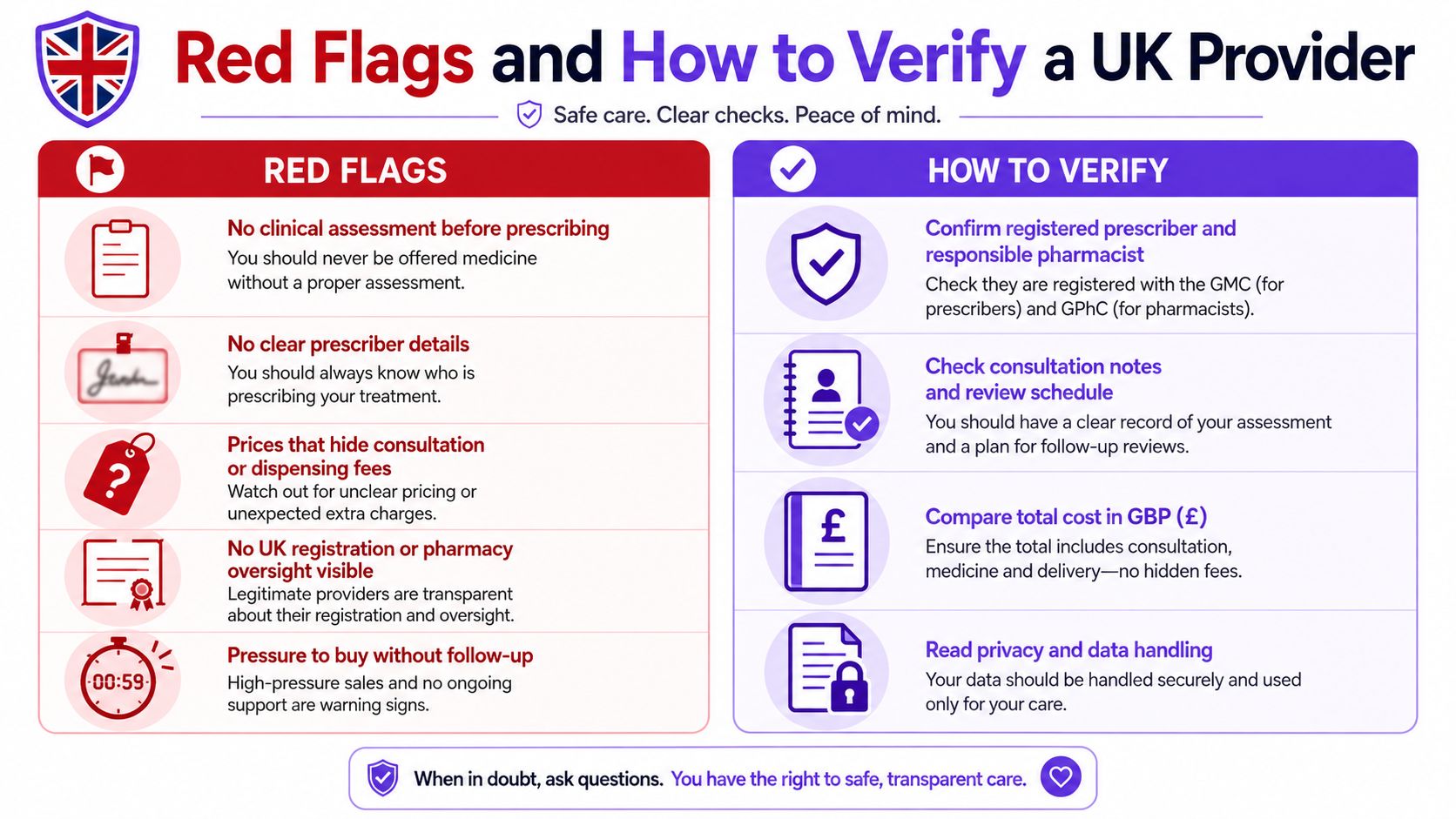
The clinician should establish your height, weight and body mass index, usually shortened to BMI. They should then consider weight-related conditions, including type 2 diabetes, hypertension, dyslipidaemia, cardiovascular disease and obstructive sleep apnoea.
Under NICE's clinical eligibility guidance, tirzepatide is generally recommended for adults with an initial BMI of at least 35 kg/m² and at least one weight-related condition. These are clinical criteria, not confirmation of local NHS funding or a promise of private prescribing.
For semaglutide, criteria include BMI of at least 35 kg/m² with a weight-related comorbidity, with an additional route at 30–34.9 kg/m² where specialist-service referral criteria are met, as described in NHS England's weight-management injection guidance.
NICE generally lowers relevant BMI thresholds by 2.5 kg/m² for people from South Asian, Chinese, other Asian, Middle Eastern, Black African or African-Caribbean backgrounds, as detailed in the NICE eligibility guidance above. Ethnicity-adjusted assessment matters; BMI shouldn't be interpreted in isolation.
History, risks and an agreed plan
Expect discussion of:
- Medical history and medicines: Existing diagnoses, prescribed treatment and anything else you take.
- Contraindications and pregnancy: Reasons a medicine may be unsuitable, including pregnancy status where relevant.
- Eating and activity patterns: Your current routine, previous approaches and capacity to make supported changes.
- Mental health and eating concerns: Issues that may require further assessment or a different form of support.
- Shared goals: What you hope to improve and how progress will be assessed.
An online consultation can support this process. It cannot turn a request into automatic access to prescription-only weight-loss treatment.
Before consenting: You should understand why the proposed treatment fits your circumstances, what its limitations are and which alternatives remain available.
If important information is missing, further questions are appropriate. A provider shouldn't treat assessment as an obstacle to completing a sale.
Cost, Pricing and What Follow-Up Should Include
Compare the full care package, not the opening price. A medicine-only figure tells you little about what you'll pay once consultations, reviews, delivery and ongoing support are included.
Ask for a written breakdown showing whether the medicine or dose changes the price. Establish which services are mandatory, which are optional and what happens financially if the clinician decides treatment isn't suitable.
What a UK Weight Loss Treatment Quote Should Include
| Line item | What to expect | Why it matters |
|---|---|---|
| Initial assessment | A clear consultation charge and refund policy | You can understand the cost even if no prescription is issued |
| Medicine and dose | The product, prescribed dose and any price changes | Starting costs may not describe later treatment |
| Clinical reviews | Whether scheduled and additional reviews are included | Monitoring shouldn't depend on an unexpected payment |
| Delivery and tracking | Delivery fees and the process for a failed delivery | You need a practical supply plan |
| Lifestyle support | Details of nutritional, behavioural or coaching provision | An app alone doesn't describe the support available |
| Pauses and transfers | Charges and arrangements for stopping or moving care | You can plan beyond the next order |
Aftercare should be defined before treatment starts
Ask who reviews adverse effects, authorises dose changes and responds when treatment is interrupted. You should also receive product-specific advice about storage and missed doses. Don't improvise a restart schedule or rely on instructions intended for someone else.
For tirzepatide, NICE advises reassessing continuation after six months on the highest tolerated dose if less than 5% of initial weight has been lost. This is a review benchmark, not a promised result, under NICE's practical tirzepatide prescribing guidance.
Ongoing dietary, activity and behavioural support belongs within the treatment pathway. NICE's prescribing guide also describes the importance of wraparound care, including within primary-care delivery.
A lower price isn't better value if you can't identify who will review a problem.
Compare projected total costs across the review period, using the provider's written figures rather than assumptions. If continued treatment would become unaffordable, discuss that before starting and agree how a pause or change would be managed.
Red Flags and How to Verify a UK Provider
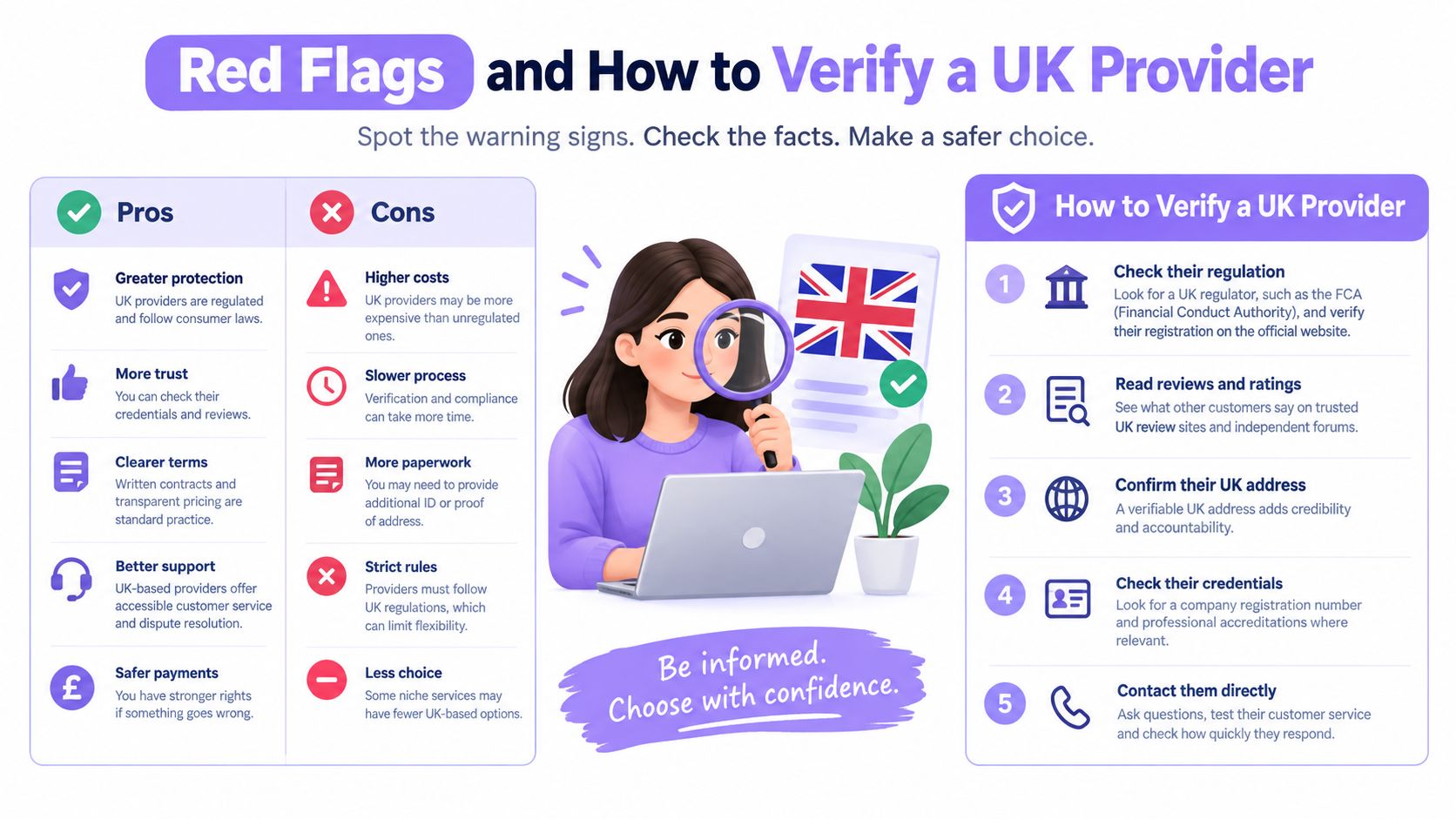
A polished website, local address and positive reviews aren't substitutes for professional checks. Verify the pharmacy and prescriber independently before paying for treatment.
Be cautious about offers that treat eligibility as a formality. A publicly displayed price list is reasonable; pressure to purchase a treatment package before suitability has been established isn't.
Reasons to stop and investigate
- No meaningful assessment: The provider offers prescribed medication without examining your health information.
- An unidentified prescriber: You can't establish who makes the prescribing decision or their professional credentials.
- Unclear pharmacy involvement: There's no identifiable UK-registered pharmacy responsible for dispensing.
- Promises presented as personal outcomes: Guaranteed results, or averages used as predictions, replace a balanced explanation.
- No usable aftercare route: You can order easily but can't establish how to obtain clinical help.
A number taken from a genuine programme evaluation can be informative, as the digital programme example shows. The problem is using a population average to imply what an individual patient will achieve.
Check registration and its scope
For a pharmacy in Great Britain, check that it's regulated by the GPhC, the General Pharmaceutical Council. Match the registered details to the business supplying your medicine, and ask who the Superintendent Pharmacist is where relevant. Don't rely solely on a registration logo displayed on a website.
Check the prescriber's professional registration separately. Then read the consent information, privacy arrangements, complaints process and aftercare policy. The guide to assessing online pharmacy reviews provides additional questions for evaluating a service beyond its customer ratings.
Aesthetics requires a separate distinction. The CQC's guidance on choosing cosmetic services explains that its scope includes relevant surgical procedures but doesn't cover subcutaneous cosmetic injections such as Botox or dermal fillers in the same way.
For skin boosters and polynucleotides, ask about qualifications, consent, product traceability, emergency arrangements and aftercare rather than making assumptions from CQC status. Cosmetic credentials don't establish that a service is suitable for prescription weight management.
Booking, First Appointment and Ongoing Follow-Up Checklist
Prepare for the appointment as a health consultation, not an order collection. Accurate information and direct questions will help you judge whether the provider can meet your needs.
Before you book
- Gather measurements: Have your height, current weight and recent BMI available if known. Tell the clinician if you're uncertain about them.
- Prepare your history: List diagnoses, previous weight-management treatment and relevant concerns.
- Bring a medicine list: Include current prescribed medicines and other products you take.
- Record your priorities: Explain whether your main concerns involve weight, daily function, an existing condition or access to support.
- Keep the paperwork: Save the service description, written quote and cancellation terms.
Don't omit a condition or medicine because you think it could prevent treatment. The clinician needs that information to make a safe decision.
At the first appointment
Ask who holds clinical responsibility, how frequently reviews will happen and how to contact the team between appointments. Establish how dose changes are authorised and when you would need an in-person assessment.
Agree what happens if treatment is unavailable, paused or no longer affordable. If another provider may become involved, ask how consent, records and prescribing responsibility will be handled.
Save this question: If I have a problem between scheduled reviews, who assesses it and how do I reach them?
At each review
Expect the clinician to consider weight, adverse effects, adherence, diet, activity and relevant condition-related outcomes, following the monitoring principles discussed earlier. Depending on your circumstances, progress may also involve measures such as blood pressure, glycaemic control, waist circumference or function, rather than scale weight alone.
Bring a record of symptoms, difficulties taking treatment and questions about your plan. Ask for a clear explanation when treatment is continued, adjusted, paused or stopped, and keep an updated record of what has been prescribed.
The right answer to “weight loss treatment near me” is the regulated, clinically supervised pathway that fits your health profile and practical needs. It isn't necessarily the closest address or the fastest checkout.
This content is for informational purposes only and does not constitute medical advice. Always consult a qualified healthcare professional before starting or changing any treatment.
XO offers clinician-led online weight-management assessment through its pharmacy service, with prescribed treatment subject to eligibility and ongoing support. Visit XO to review the service information, then confirm the assessment process, full costs and follow-up arrangements before booking.


0 comments