


In the UK, estriol cream is a prescription-only local oestrogen used mainly for menopause-related vaginal dryness, irritation, discomfort and pain during sex. It's applied to the vaginal lining, and sometimes to the vulva as well, where menopausal tissue changes have left skin feeling thin, dry or easily irritated.
So why does the word oestrogen lead so many people to expect their hot flushes to settle? Because menopause gets described as one condition when it's really a set of separate problems with separate treatments. A cream that restores tissue in one small area works on a different scale, and at a fraction of the dose, from hormone therapy that circulates around the whole body. Getting that distinction right changes what you should expect, how long you should give treatment before judging it, and which symptoms are worth reporting back to a prescriber.
What is estriol cream used for then? A short list of local symptoms, one possible use that sits outside its licence, and a set of situations that need a prescriber's judgement before anything is prescribed.
Table of Contents
- Conditions Estriol Cream Is Prescribed For
- How Estriol Cream Works in the Vagina and Vulva
- Local Estriol Cream Compared With Systemic HRT
- Benefits, Limits and Recurrent Urinary Infections
- Safety, Eligibility and UK Prescribing Rules
- How to Use Estriol Cream and How Long It Takes
- Frequently Asked Questions
- Speak With a UK Prescriber About Your Symptoms
Conditions Estriol Cream Is Prescribed For
Estriol cream is prescribed for a narrower set of symptoms than the word “oestrogen” may suggest. In the UK, its local vaginal use is for genitourinary symptoms associated with menopause, including vaginal dryness, discomfort, irritation and pain during sex, as described in the NICE menopause guidance. A clinician may also advise applying it externally to the vulva. The cream is not swallowed and is not whole-body hormone replacement therapy.
NICE guidance reports that vaginal oestrogen, including estriol, can reduce vaginal dryness and dyspareunia, the clinical term for pain during sex. The evidence also describes reductions in vulvovaginal discomfort and irritation. These are improvements in symptoms, not a cure, and they generally take consistent use over weeks.
| Symptom or use | Area affected | Basis in UK guidance | Notes |
|---|---|---|---|
| Vaginal dryness | Vagina | NICE menopause guidance | Licensed use for menopausal symptoms |
| Painful sex (dyspareunia) | Vagina | NICE menopause guidance | Reduced in the evidence NICE reviewed |
| Vulvovaginal irritation, burning or discomfort | Vagina and vulva | NICE; NHS prescribing guidance | Apply to the vulva externally only if clinically advised |
| Recurrent urinary tract infection prevention | Urinary tract | NICE evidence review | Use is outside the licensed indication and requires an individual clinical decision |
The table separates the usual local symptoms from a possible use that needs more careful consideration. Estriol cream is not prescribed to treat hot flushes, night sweats, mood changes or sleep problems. Those affect the body more widely, so a prescriber may discuss systemic HRT instead.
NICE describes vaginal oestrogen as a cost-effective option and recommends offering a choice of formulations, including creams, gels, tablets, pessaries and rings. The right form is one a person can use as directed. Cream can be applied inside the vagina and, when advised, to the vulva, which may suit symptoms affecting both areas.
Vaginal oestrogen may be used on its own when menopausal symptoms are mainly genitourinary, or alongside systemic HRT if vaginal symptoms continue. These symptoms can persist, so treatment may continue for as long as it remains necessary and effective, with clinical review rather than an automatic end date.
Urinary symptoms can overlap with continence problems after menopause. If leakage is part of your experience, continence support for older women may help you explore that aspect of care. If you are unsure whether your symptoms are related to menopause, a menopause symptoms checklist can help you organise what to discuss at an appointment. Unexplained vaginal bleeding, a history of hormone-sensitive cancer or another relevant condition should be discussed with a UK prescriber before starting treatment.
How Estriol Cream Works in the Vagina and Vulva
Start with what changes. After menopause, falling oestrogen reduces vaginal secretions and lubrication, and it thins the tissue of the vagina and urethra, making it less elastic and more easily irritated. This is a moisture and tissue problem, not an infection, which is why antibiotics don't fix it and why it doesn't settle on its own.
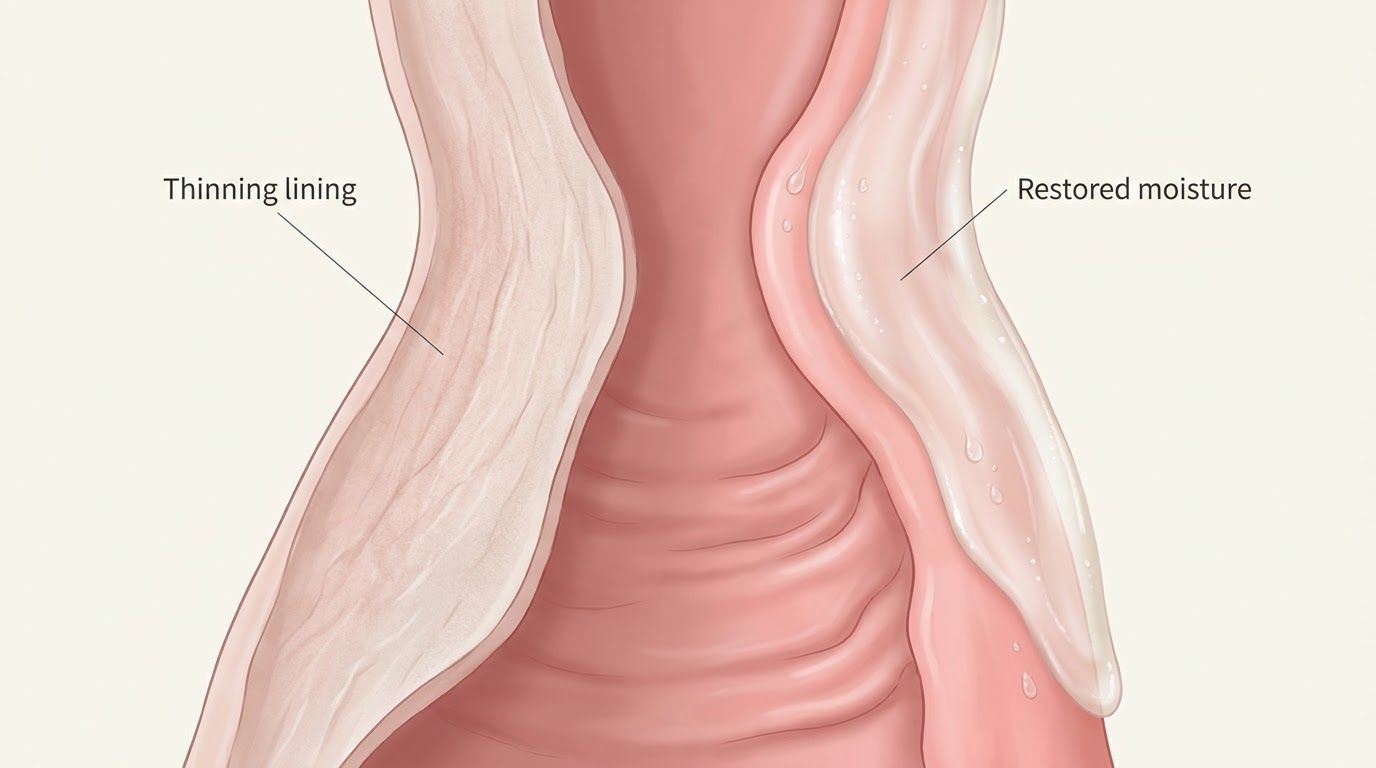
The diagram above shows the difference between a depleted lining and one that has recovered its thickness and surface moisture.
A garden bed, not a whole garden
Picture a garden bed that has dried out and thinned. You don't fix it by flooding the entire garden. You treat the soil where the plants are. Estriol cream works on the same principle: a low dose of oestrogen is delivered directly to the tissue that needs it, where it helps restore tissue integrity and moisture locally.
The cluster of symptoms this produces has a name worth knowing: genitourinary syndrome of menopause (GSM). It covers vaginal or vulval dryness, soreness, itching, burning, painful sex and some urinary symptoms. The word genitourinary is doing real work there, because the same oestrogen-sensitive tissue runs from the vagina to the lower urinary tract.
Why one application doesn't tell you much
These changes have usually been building for months or years, so the response is gradual and depends on regular use rather than a single dose. Tissue that has thinned over a long period takes weeks of consistent treatment to rebuild. Judging the cream after three applications is like judging a course of physiotherapy after one session.
Cream is particularly useful when symptoms involve the vulva as well as the vagina, because UK NHS prescribing guidance identifies estriol cream as beneficial at both sites. Prescribers commonly start with a loading phase and then step down to maintenance.
Bleeding after menopause is never assumed to be part of dryness. Unexplained vaginal bleeding, pain on passing urine with a fever, or blood in the urine all need assessment before menopause is accepted as the whole explanation.
Local Estriol Cream Compared With Systemic HRT
The most common confusion about this treatment is captured in one sentence people say in clinic: "I've been given HRT for my menopause." Estriol cream is a local treatment for vaginal and vulval tissue. It is not the same intervention as hormone therapy taken to relieve whole-body symptoms, and treating the two as interchangeable causes problems in both directions.
Some women avoid local treatment because of headlines about HRT that never applied to it. Others expect a cream to settle night sweats and conclude oestrogen "doesn't work" for them. Matching the symptom to the route is the prescriber's job. Describing the symptom is yours.
A key technical point explains the difference. Estriol cream acts predominantly locally, so systemic exposure is substantially lower than with systemic HRT, as NHS guidance on vaginal oestrogen sets out. UK NHS-linked prescribing data list a representative strength of 0.1% estriol cream, 500 micrograms per application for Ovestin, though the exact dose and schedule depend on the product prescribed and your clinician's instructions.
| Feature | Estriol cream (local) | Systemic HRT |
|---|---|---|
| Main target | Vaginal and vulval symptoms | Whole-body menopausal symptoms |
| Hot flushes and night sweats | Not treated | Commonly treated |
| Oestrogen exposure | Low, mainly in local tissues | Whole body, substantially higher |
| Typical role | Alone for genitourinary symptoms, or added to systemic HRT | Main treatment for systemic symptoms, sometimes with local oestrogen |
| Forms | Cream and vaginal pessaries | Tablets, patches, gels or sprays |
| Prescribing status in the UK | Prescription-only | Prescription-only |
When the two routes work together
Local oestrogen may be used alongside systemic HRT when vaginal symptoms persist, so the choice isn't always either/or. A woman whose hot flushes are well controlled on a patch can still need a cream for tissue symptoms that the systemic dose doesn't reach. NHS guidance also notes that treatment may need to continue long term, because symptoms can recur when it stops.
That combination case is worth flagging in a consultation, because it's easily missed. If you're already on systemic HRT and still have dryness or pain during sex, that's a specific problem with a specific local answer, not a failure of your existing treatment. Our guide to hormone replacement therapy in the UK explains how the routes differ in more detail.
Before your appointment, write down the two or three symptoms that bother you most, and when they occur. That list, more than anything else, decides whether local or systemic treatment is the sensible first move. Both routes are prescription-only, and a prescriber will weigh suitability against your history, including breast cancer, unexplained bleeding, thrombosis, liver disease or a possibility of pregnancy.
Benefits, Limits and Recurrent Urinary Infections
The strongest evidence for estriol cream concerns symptom relief. NICE found that vaginal oestrogen, particularly estriol, reduced vaginal dryness and painful sex, and reduced vulvovaginal discomfort or irritation. Read those as symptom improvements rather than a cure, and note that the benefit depends on continued use.
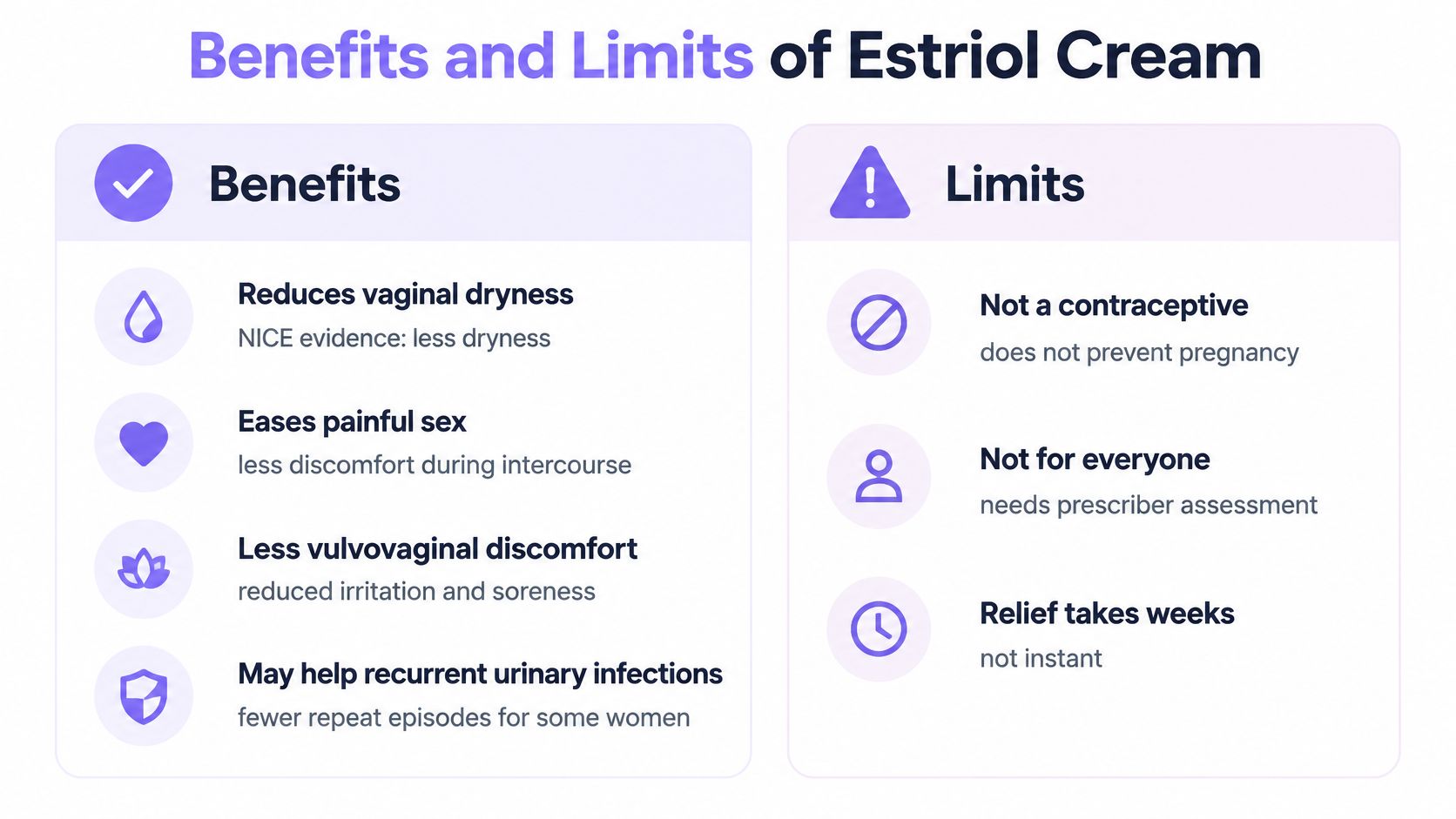
The limits are just as concrete. The cream has no effect on whole-body menopausal symptoms. Onset is slow, measured in weeks rather than days. Ongoing use is usual rather than exceptional, and periodic clinical review is part of the deal. None of that makes it a weak treatment. It makes it a treatment with a narrow, well-defined target.
The recurrent UTI finding, with its caveats kept in
UK evidence also supports estriol cream as a potential option for reducing recurrent urinary tract infections in postmenopausal women. This is a separate clinical consideration from the principal licensed use, and the detail matters.
In the NICE evidence review, one randomised controlled trial compared vaginal estriol cream, 0.5 mg applied nightly for 2 weeks and then twice weekly for 8 months, with placebo. Recurrent infection occurred in 16.0% of women receiving estriol compared with 62.8% receiving placebo, an absolute difference of 46.8 percentage points. The reported number needed to treat was 3, with a range of 2 to 4, meaning roughly one additional woman avoided a recurrence for every three treated.
NICE concluded that vaginal oestrogens were effective in reducing recurrent UTI risk after menopause, while noting that the evidence rested on small numbers and that the benefit appeared to diminish after treatment stopped. The guideline also states plainly that vaginal oestrogens are not licensed specifically for preventing recurrent UTI.
The practical reading: a promising signal from one small trial, in a use the product isn't licensed for, is a reason to ask a prescriber about it. It is not a reason to self-treat.
Where does that leave the everyday decision? For most UK patients, the role of estriol cream is restoring oestrogen-dependent vaginal and urinary tissue so that dryness, soreness and discomfort ease. Recurrent UTI prevention is considered only where symptoms, history and prescribing guidance justify it, and it stays a clinical decision from start to finish.
Non-hormonal options have their own place alongside treatment. If you want to understand where a vaginal moisturiser fits, our guide to Replens MD vaginal moisturiser covers the non-hormonal route and how it differs from oestrogen.
Safety, Eligibility and UK Prescribing Rules
Estriol cream is prescription-only in the UK. That isn't a technicality. It means the treatment has to be assessed and prescribed by a qualified prescriber and supplied by a UK-registered pharmacy, and that a pharmacy regulated by the General Pharmaceutical Council works to professional standards covering storage, supply and advice.

An online consultation is a route to clinical assessment, not a checkout. A clinician reviews your answers, may ask follow-up questions, and can decline to prescribe if the treatment isn't appropriate. That's the system working as intended.
The situations that need prescriber review first
Some details change the decision rather than delay it. Raise them before starting or continuing treatment:
- Unexplained vaginal bleeding: bleeding after menopause has causes that must be excluded first, so it needs assessment before oestrogen is considered.
- A history of breast or other hormone-sensitive cancer: suitability becomes an individual decision, often made with your oncology team.
- A history of thrombosis: clotting history shapes the risk conversation.
- Liver disease: relevant to how hormones are processed.
- A possibility of pregnancy: symptoms can overlap, and pregnancy changes the picture entirely.
- Other relevant medical conditions or current medicines: bring the full list, including anything bought over the counter.
NHS formulary guidance describes estriol vaginal cream or pessaries as an option for prevention of recurrent urinary-tract infection in post-menopausal women, while explicitly noting that this use is not licensed for that indication in the cited guidance, as the Greater Manchester Medicines Management Group guidance records. The same guidance identifies 0.1% estriol cream as a local treatment that may be applied externally to the vulva when clinically required, in addition to vaginal treatment.
Urinary symptoms that aren't a cream problem
Not every urinary symptom belongs in a menopause consultation. Painful urination, fever, blood in the urine or flank pain may indicate an active infection or another cause, and those need assessment and treatment in their own right. Applying oestrogen to tissue that has an untreated infection doesn't help and delays the right care.
If a symptom is new, severe or comes with fever, treat it as a separate problem until a clinician says otherwise.
Reporting side effects
Local irritation in the first applications is common and often settles as the tissue adjusts. Irritation that worsens rather than eases, or any unusual bleeding, should go back to your prescriber. Suspected side effects can also be reported through the MHRA Yellow Card scheme, which is how UK regulators track problems with licensed medicines.
No treatment is risk-free, and nothing here should be read as a guarantee of safety for any individual. The prescriber's role is to weigh your history against the evidence, and yours is to give that history accurately.
How to Use Estriol Cream and How Long It Takes
How often should estriol cream be used? The schedule depends on the product and your prescriber's instructions. One commonly used regimen starts with a measured dose each day, then reduces to maintenance use. Coventry and Warwickshire formulary guidance describes daily treatment for 2 to 4 weeks, followed by twice-weekly use. It also states that 0.1% estriol cream contains 1 mg estriol per gram, making a 0.5 g applicator dose equal to 0.5 mg estriol.
| Phase | Typical frequency | Typical duration | Notes |
|---|---|---|---|
| Loading phase | One applicator dose daily | 2 to 4 weeks | Follow the prescribed product and leaflet |
| Maintenance phase | Commonly twice weekly | Ongoing, with clinical review | Use the lowest effective frequency |
| Time to symptom improvement | Consistent use | Several weeks | Symptoms may return after stopping |
| External vulval use | As directed | As clinically required | Confirm suitability with a prescriber or pharmacist |
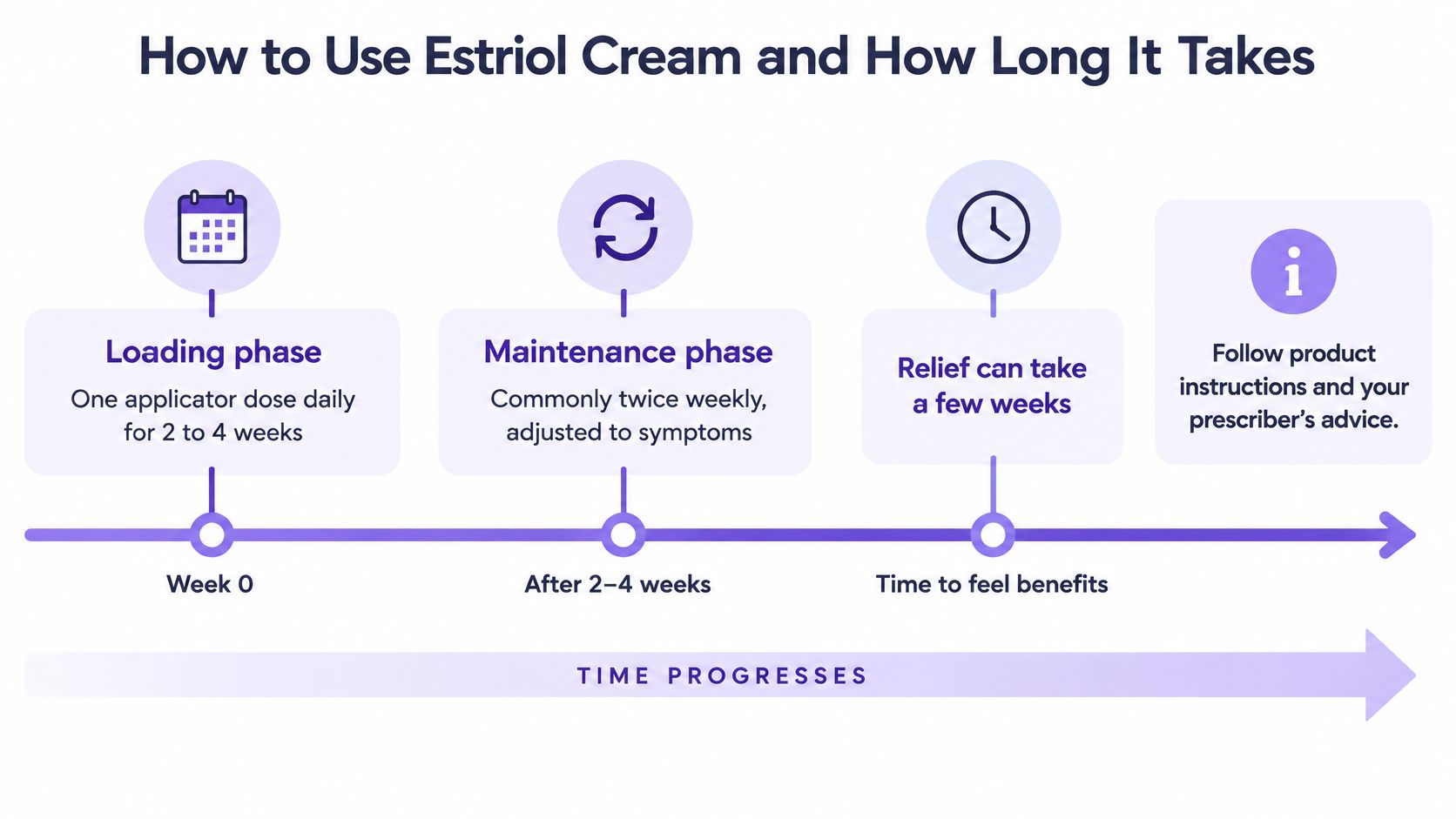
These are typical schedules, not personal instructions. Products can differ, so follow the leaflet supplied with your cream and the directions from your prescriber. Symptoms usually take several weeks of consistent use to improve. If there is little or no change, arrange a review rather than increasing the dose yourself.
Applying it properly
- Wash and dry your hands before handling the applicator.
- Fit the applicator as the leaflet explains, so it measures the dose correctly.
- Lie down comfortably and insert the prescribed dose gently. Use it at the time your prescriber advises, often at night.
- Withdraw and clean the applicator as directed in the leaflet.
- Keep a short note of your doses and symptoms. This can help make a review more specific.
- Ask a prescriber or pharmacist if you are unsure about the applicator, frequency or external vulval use.
Why the schedule steps down
The loading phase gives the vaginal tissue regular treatment while it responds. Maintenance use then aims to keep symptoms controlled with a lower frequency. In practical terms, the schedule shifts from more frequent initial treatment to less frequent ongoing use.
Improvement is gradual, not immediate. If symptoms persist despite consistent use, a prescriber can review how you are applying the cream, consider whether the formulation is suitable, or assess whether another cause needs attention. Symptoms can return after stopping, so continued use may be discussed at periodic reviews.
Frequently Asked Questions
Is estriol cream available without a prescription in the UK
No. It's a prescription-only treatment, so it must be assessed by a qualified prescriber and supplied by a UK-registered pharmacy.
Can it treat hot flushes or night sweats
No. It's a local treatment for vaginal and vulval tissue, and whole-body symptoms are considered under systemic HRT instead.
How long can it be used
Treatment is often continued long term with clinical review, because symptoms can return after stopping. There's no automatic short-term limit in UK guidance.
Does it treat a urinary infection
No. An active infection needs assessment and treatment in its own right. Recurrent UTI prevention is an individual clinical decision, not something to manage with leftover cream.
What should be reported to a prescriber
Persistent or worsening irritation, and any unusual vaginal bleeding, should be discussed promptly. Suspected side effects can also be reported through the MHRA Yellow Card scheme.
Is it suitable during pregnancy or after hormone-sensitive cancer
Possible pregnancy and a history of hormone-sensitive cancer both need prescriber review before any decision. No general claim of safety applies to these situations.
Speak With a UK Prescriber About Your Symptoms
The next step is a clinical assessment with a qualified healthcare professional. That might be your GP, a menopause clinic, or a UK-registered online pharmacy that requires a consultation with a UK-registered clinician before any prescription is issued. XO Medical is one such option among several: our consultations are reviewed by UK-registered clinicians, and a prescription is a clinical decision rather than a guaranteed outcome.
Bring four things to the appointment. A list of your symptoms in your own words, when they started, what you've already tried (including moisturisers and lubricants), and your current medicines plus any relevant history such as clot, liver or cancer history. Vague descriptions slow the process down. "Burning at the entrance during sex for eight months, worse since last winter" gets you further than "everything's dry".
Three questions worth asking: does local oestrogen suit these symptoms, which formulation and schedule would apply to me, and how long will treatment continue before it's reviewed?
If the answer is a prescription, fill it at a UK-registered pharmacy and read the leaflet before the first dose. If the answer is something else, that's useful information too, and it usually saves months of guessing.
Reviewed by: the XO Medical clinical team, UK-registered healthcare professionals, led by our Superintendent Pharmacist. Review date: 12 February 2026.
This content is for informational purposes only and does not constitute medical advice. Always consult a qualified healthcare professional before starting or changing any treatment.
If dryness, irritation or pain during sex has been shaping your week, XO can help you get a proper clinical answer rather than another guess. Our XO women's health service covers menopause consultations and prescription treatment, including topical oestrogen replacement from £29, with a secure online consultation reviewed by UK-registered clinicians and discreet next-day delivery. Start with the consultation, describe your symptoms, and let a prescriber decide what's clinically appropriate for you.


0 comments