


You might be comparing clinic websites on your phone, seeing the word filler used for several very different injectables, and wondering which one is safest if something goes wrong. That question matters. In UK practice, the choice is not just about shape or longevity, it's about material, reversibility, and who is doing the injecting.
Reviewed by: Clinical content review team
Review date: 16 October 2026
The UK Government's review of cosmetic-intervention regulation estimated that approximately 140 to 190 dermal-filler products were available in the UK, including CE-marked and non-CE-marked products, and it also noted that there was no central UK collection system for complications from cosmetic interventions at the time of the review (UK Government review). That means patients can't rely on a neat national safety scoreboard. They need to ask better questions before treatment, especially about what the product is made of and whether it can be rescued if there's a problem.
Table of Contents
- Why the Type of Filler Matters Before You Book
- What Dermal Fillers Are
- The Main Filler Materials Used in the UK
- Comparing the Main Types Side by Side
- How Clinicians Choose a Filler
- UK Regulation and What It Means for Patients
- Warning Signs and Pre-Treatment Checklist
- Choosing Safely and the Limits of This Guide
Why the Type of Filler Matters Before You Book
A typical consultation starts with a simple comparison on screen. One clinic lists hyaluronic acid, another offers calcium hydroxylapatite, a third mentions permanent filler, and all of them call the treatment “filler”. That word hides the actual decision, because these products behave very differently once they're inside tissue.
Dermal filler is an umbrella term, not one substance. It covers materials that may be temporary, semi-permanent, or permanent, and that difference affects how long the result lasts, how the body responds, and what rescue options exist if there's a complication. A soft temporary gel can sometimes be managed more easily than a permanent implant-like product, but “easier to manage” is not the same as risk-free.
Practical rule: ask what the filler is made of before you ask what it costs.

The point of starting with type is simple. If you know whether a filler is reversible, long-lasting, or difficult to remove, you can judge the trade-off more realistically. That is much more useful than choosing the product with the most polished marketing or the broadest headline claim.
For a plain-language overview of common side effects and what patients usually ask about first, see this guide to dermal filler side effects.
What Dermal Fillers Are
Dermal fillers are injectable gels or suspensions used to add volume, contour, or structural support in the face.
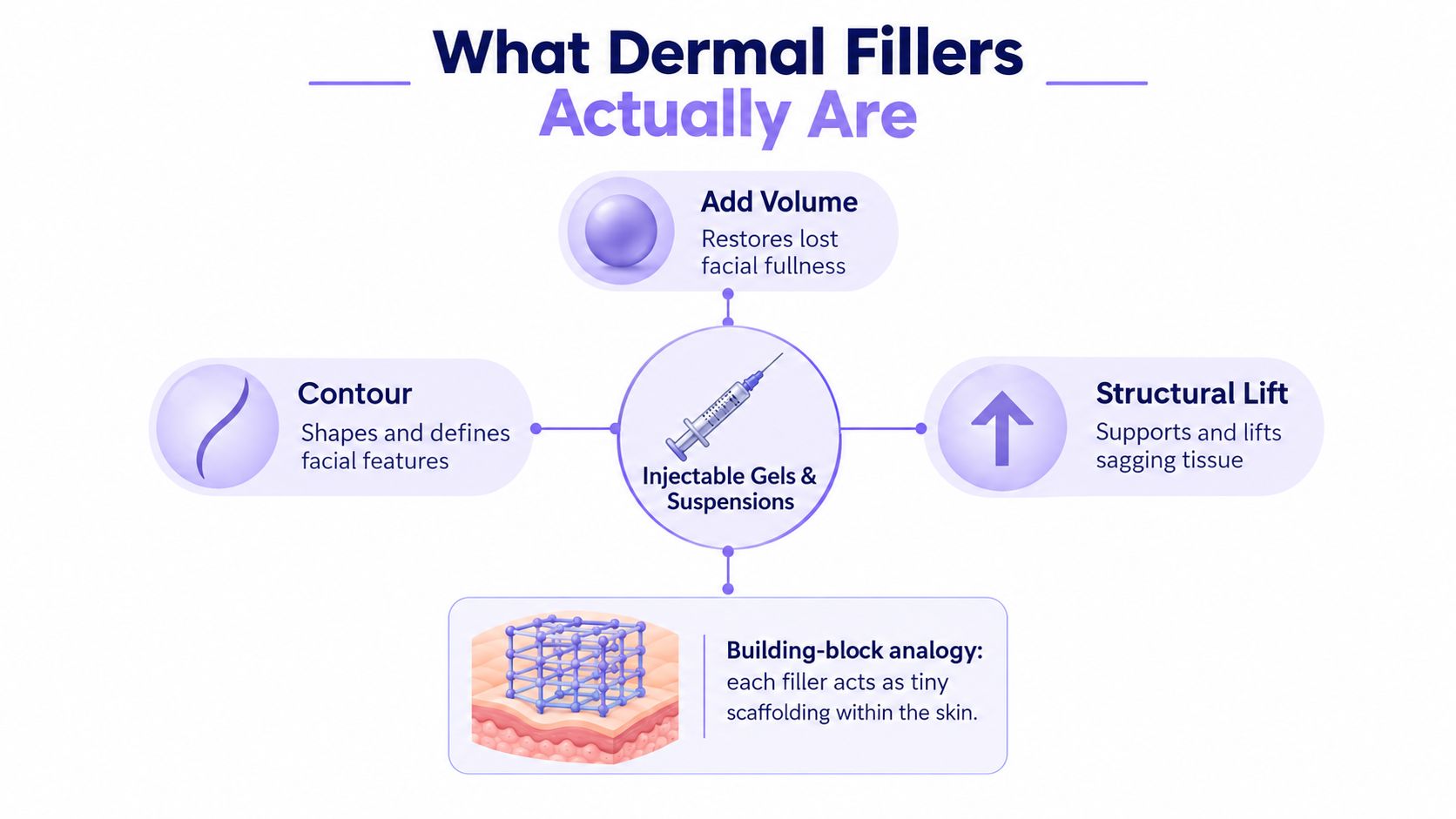
They work a bit like scaffolding beneath a building. Some are light and temporary, others are denser and last longer. The useful question is not only what they add, but what happens if the result is too much, too little, or goes wrong.
Not the same as anti-wrinkle injections or skin boosters
Anti-wrinkle injections relax muscle activity. Fillers add structure. Skin boosters sit in a different category again, and are usually used more for hydration and skin quality than for obvious volumising.
That distinction matters in clinic, because patients often ask for one treatment when the underlying need is another. A line caused by movement may not need volume at all. A hollow cheek may need support. A dry, crepey area may be better approached with a hydrating injectable rather than a shaping product.
Persistence is part of the safety discussion
UK educational guidance distinguishes temporary, semi-permanent, and permanent fillers, and it reports a general consensus that temporary hyaluronic acid products have a more favourable safety profile than permanent fillers, while still carrying risks such as infection, tissue damage, and lasting disability (Health Education England). That is the right frame for consent. A temporary product may be easier to manage if an adverse event develops, and some can be dissolved or otherwise addressed more readily than permanent materials, but no injectable is automatically harmless.
The right filler also depends on anatomy, not just preference. A shallow, fine-line area usually needs a different texture from a deeper structural zone. Good practice starts with a medical assessment, because injectable fillers are medical interventions, not skincare.
The Main Filler Materials Used in the UK
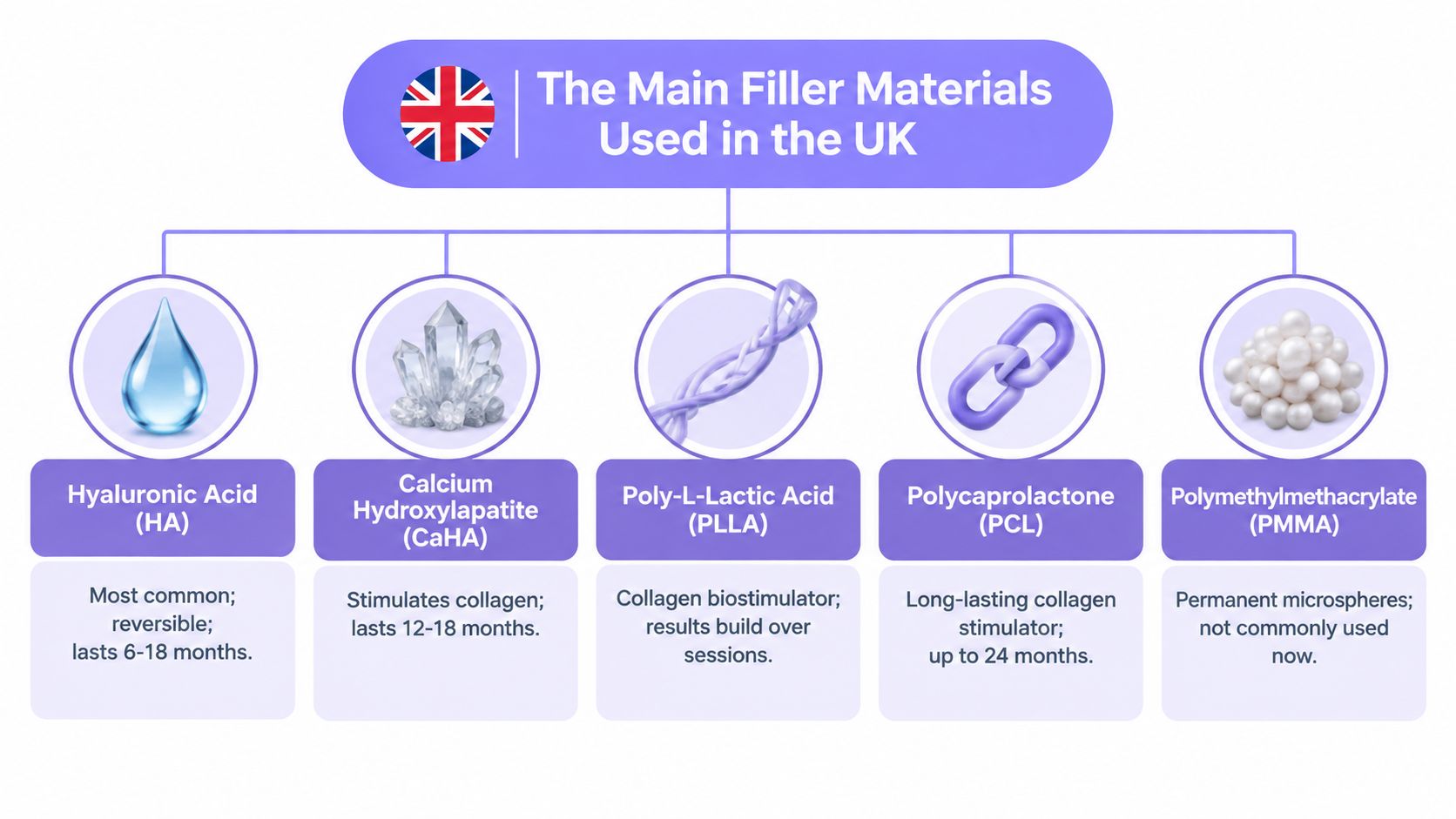
Hyaluronic Acid
Hyaluronic acid, or HA, is the most familiar temporary filler. It is a gel that attracts and holds water, so it works like a soft, flexible cushion under the skin. That makes it useful where a clinician wants added volume with tissue that still needs to move naturally.
Its main practical advantage is reversibility. In appropriate clinical circumstances, injected hyaluronidase can break down HA if swelling persists, nodules develop, or vascular compromise is suspected. That rescue pathway is one reason many clinicians and patients begin with HA.
Calcium Hydroxylapatite
Calcium hydroxylapatite, or CaHA, is a denser material than HA and is used where more structural support is needed, such as deeper contouring. It gives a firmer result than a soft gel filler, which can suit areas that need shape rather than simple hydration.
CaHA is not dissolved in the same way as HA. It can still cause bruising, swelling, nodules, infection, granulomas, and delayed inflammatory reactions, and it shares the broader complication profile seen across filler types (2026 review).
Poly-L-Lactic Acid
Poly-L-lactic acid, or PLLA, is better thought of as a collagen stimulator than a simple volume gel. It is often described as a biostimulator because the visible effect builds gradually rather than appearing all at once. That slower change can suit patients who want a subtle shift over time.
The main caution is that it is not a product that can be dissolved and reset. If the response is uneven, management can be more complex than with HA, so the treatment choice needs careful consent and experience.
Polycaprolactone
Polycaprolactone, or PCL, is another long-lasting biostimulatory filler. It is designed to support tissue and encourage collagen response, so the feel is generally closer to a structural product than a soft hydrator. In simple terms, it sits at the longer end of the filler family.
Because it is not HA, it does not share the same enzymatic reversal option. That matters if a complication develops, especially in a sensitive facial area where rescue choices may be limited.
Polymethylmethacrylate and other permanent materials
Polymethylmethacrylate, or PMMA, is a permanent filler material. It leaves microspheres in tissue rather than behaving like a temporary gel that fades away. Some older permanent or hybrid products may also include silicone-based or other long-lasting materials.
The key concern is removal. If a permanent filler causes nodules, migration, infection, or inflammatory reactions, it can be substantially more difficult to remove than a temporary product. That does not make every permanent filler unsafe, but it changes the risk conversation before treatment.
Judge each product on its composition, purpose, and rescue plan for the area being treated, not on longevity claims alone.
Comparing the Main Types Side by Side
A comparison table is useful because “filler” stops being a vague label and becomes a clinical choice. Longevity ranges vary with formulation, amount injected, anatomy, and injection depth, so no table can replace a proper consultation.
UK Dermal Filler Categories at a Glance
| Filler material | Typical longevity | Reversibility or rescue pathway | Common complications | UK availability note |
|---|---|---|---|---|
| HA | Temporary, often months rather than years | Can often be treated with hyaluronidase in appropriate clinical circumstances | Bruising, swelling, nodules, infection, vascular occlusion | Widely used in UK practice |
| CaHA | Longer than basic HA in many settings | No HA-style enzymatic dissolve pathway | Bruising, swelling, vascular occlusion, infection, nodules, granulomas, delayed inflammatory reactions | Used in selected facial areas |
| PLLA | Gradual, longer-term effect | Rescue is not the same as HA reversal | Nodules, uneven response, delayed inflammatory issues | Used as a biostimulator rather than a simple volume gel |
| PCL | Longer-lasting | No HA-style enzymatic dissolve pathway | Swelling, nodules, inflammatory reactions | Less commonly discussed by patients than HA |
| PMMA | Permanent | Removal can be difficult if complications arise | Migration, nodules, infection, chronic inflammation | Not commonly chosen when reversibility is a priority |
The most important row is the first one. HA is uniquely important because its rescue pathway is more direct. That does not make it risk-free, and it certainly doesn't make it the right answer for everyone.
If you want a clinic-facing reference that sits alongside patient education, the dermatology clinical notes resource can help frame how clinicians document material choice, tissue response and follow-up. The useful habit for patients is simpler, ask the injector to explain not only the intended result, but also the rescue plan.
Takeaway: reversibility is about what happens if things go wrong, not a promise that things won't go wrong.
How Clinicians Choose a Filler
A good consultation starts with the face, not the product brochure. Clinicians assess anatomy, skin quality, medical history, previous filler use, and what the patient wants to change. Product choice comes after that, because different regions need different tissue behaviour.
Texture, support and the facial area
A softer, lower-cohesivity gel is generally better suited to finer work, where a heavy or stiff product could look obvious under the skin. A higher-cohesivity or higher-elasticity product is used when structural projection is needed. That's why cheeks, jawline, temples, tear troughs and lips are not treated as interchangeable zones.
The injection plane matters too. A product placed too superficially can become visible or palpable. A product placed too far down, or in the wrong vascular territory, carries a different set of problems. Technique is part of the treatment, not an afterthought.
Why a clinician may say no
A medically-led clinician can decide not to inject at all. That may happen if the area is unsuitable, if the risk is too high, if the patient's expectations aren't realistic, or if another treatment would make more sense. A refusal can be the safest outcome in the room.
NHS guidance warns that filler complications may include infection, nerve damage and blindness, and it advises patients to avoid practitioners who have completed only a short training course (NHS guidance). That is a practical reminder that the injector's competence matters as much as the product. A trained clinician should also know when vascular occlusion is a concern and act quickly if it is suspected.
UK Regulation and What It Means for Patients
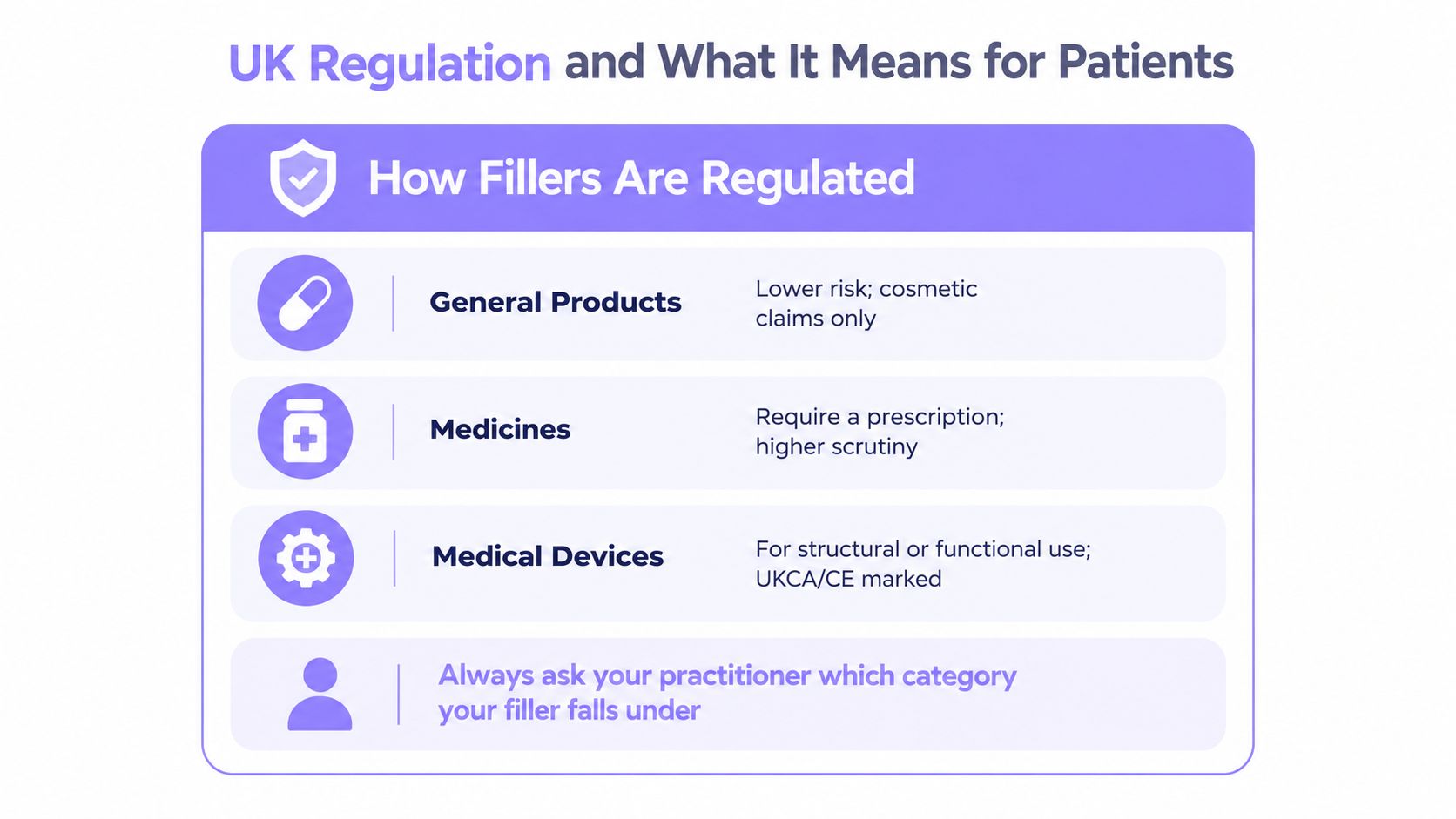
A filler appointment is not governed by the product label alone. UK regulation depends on what the filler is and what it claims to do. Some products are treated as general products, some as medicines, and some as medical devices. A filler making medical claims is expected to fall within the medical-device framework, with government material indicating that these products are expected to be treated as Class III devices under implantable-device classification (UK Government and MHRA position).
Why the label alone is not enough
A product containing lidocaine may attract additional medicines regulation. That does not make every filler a prescribed medication. The prescription-only medicines framework generally applies to medicines, not medical devices, and most fillers are not the same as botulinum toxin, which is prescription-only (UK Government consultation outcome).
An online pharmacy should not treat dermal filler like an ordinary parcel of prescribed medication. A UK-registered pharmacy may support medicines governance, but injectable filler still requires an appropriate consultation, setting and clinical oversight. Ask who assessed you, who will manage complications, and whether the product can be traced by brand and batch.
Licensing is tightening, but not uniform
The UK Government announced in 2025 that facial dermal fillers and lip fillers would come under stricter local-authority licensing, including requirements for safety, training and insurance. This sits alongside professional regulation and clinic governance, rather than replacing them.
Patients checking provider standards can use practical guidance on how to register with CQC. Regulation also matters to rescue planning: before treatment, ask what can be dissolved or removed if the product causes a problem, and who would provide that care. Reversibility should form part of informed consent, not an afterthought.
Warning Signs and Pre-Treatment Checklist
After filler treatment, some symptoms need urgent review. Disproportionate pain, skin blanching followed by dusky discolouration, marked swelling, visual disturbance, fever, or persistent nodules should not be managed as routine aftercare messages. If symptoms are severe, delayed, or worsening, the patient needs prompt clinical assessment.
If the skin changes colour, the pain escalates, or vision changes, treat it as urgent.
In England, the Botulinum Toxin and Cosmetic Fillers (Children) Act 2021 made it a criminal offence from 1 October 2021 to administer a dermal filler by subcutaneous, submucous or intradermal injection for a cosmetic purpose to anyone under 18 (government guidance). Legitimate providers should not bypass identity checks, and they should not treat age verification as a box-ticking exercise.
A sensible pre-treatment checklist includes:
- Clinician registration: check who is prescribing, injecting, and supervising.
- Face-to-face assessment: make sure a proper clinical assessment happens where needed.
- Exact product details: ask for the brand name, formulation, and batch or lot number.
- Regulatory category: ask whether it is a medical device, medicine, or general product.
- Rescue plan: ask what happens if vascular occlusion, swelling, or nodules develop.
- Aftercare: get written instructions and a clear contact route.
For a patient-friendly rundown of what good aftercare usually covers, see these dermal filler aftercare instructions.
Choosing Safely and the Limits of This Guide
The safest filler choice isn't always the longest-lasting one. Reversibility, traceability, and clinician competence matter just as much as the material itself. UK regulation is improving, but patients still need to ask direct questions and expect clear answers. If you're comparing options with a clinician, look at the anatomy, the rescue plan, and the setting, not just the product name. For wider clinical context, you can also review medical aesthetic training options and how much fillers cost alongside your consultation notes.
This content is for informational purposes only and does not constitute medical advice. Always consult a qualified healthcare professional before starting or changing any treatment.
If you're considering treatment, XO can help you understand the practical differences between filler types and what to ask at consultation. Visit XO to explore medically guided information and services, then speak with a qualified professional before making any decision.


0 comments