


The popular advice is simple: eat less, exercise more, and aim to lose 2 stone in 2 months. Clinically, that target needs more careful handling. Losing 2 stone, approximately 12.7 kg, in 8 weeks means averaging about 1.6 kg per week, which is substantially faster than the usual NHS safe-rate guidance.
That doesn't make the goal impossible for every patient. It does mean the approach matters. For most adults, this isn't a routine self-directed diet target. It's closer to a rapid-loss pathway that may require assessment, structured nutrition, prescribed medication in selected cases, and ongoing clinical oversight.
Reviewed by: UK healthcare professional
Review date: 25 September 2026
This content is for informational purposes only and does not constitute medical advice. Always consult a qualified healthcare professional before starting or changing any treatment.
Table of Contents
- The Clinical Reality of Rapid Weight Loss
- Engineering the Caloric and Macronutrient Deficit
- Exercise Programming to Protect Lean Muscle
- The Role of Supervised Prescription Treatments
- Clinical Monitoring and Behavioural Safeguards
- Executing the 8-Week Protocol in the Real World
The Clinical Reality of Rapid Weight Loss
A target of 2 stone in 2 months is not a standard diet goal. Clinically, it is a rapid-loss intervention that demands more than willpower and calorie counting. The NHS describes a safe and sustainable rate of weight loss as about 0.5 to 1 kg per week. Over 8 weeks, that is roughly 4 to 8 kg, or about 0.6 to 1.3 stone, rather than 2 stone. The NHS also advises people not to lose weight suddenly and recommends around 150 minutes of activity per week alongside calorie reduction. Those figures are set out in the NHS guidance on overweight and obesity.
That gap matters. A loss of 12.7 kg in 8 weeks means a faster rate than routine NHS guidance supports, so the key question is whether the result is mostly fat loss, with muscle preserved and nutrition maintained, or whether the person becomes depleted, weak and harder to treat.
Why the scale can move quickly
The first drop on the scale is often misleading. Glycogen and fluid change quickly when carbohydrate intake falls, so early progress can look faster than true fat loss. As restriction continues, appetite, activity and fluid balance also shift, which changes the pace again.
A severe deficit increases the risk of lean tissue loss. That is a clinical problem, not just a cosmetic one. Muscle supports strength, mobility and day-to-day function, so a plan that lowers body weight but leaves someone tired, weak or unable to maintain the result has missed the point.
Practical rule: Treat 2 stone in 2 months as a medically demanding target, not a normal expectation from a general diet plan.
The UK context makes the pressure clear. In 2023 to 2024, 64.5% of adults in England were overweight or living with obesity, while obesity alone affected 26.2% of men and 26.9% of women, according to the UK Government obesity profile. The same source reports that 45% of adults were trying to lose weight in the 2022 Health Survey for England. High demand for weight loss does not make an aggressive target safe on its own.
NICE says very-low-energy diets below 800 kcal per day should be used only within a specialist service, for people with obesity who have a clinically assessed need to lose weight rapidly. They should last no more than 12 weeks. That is the line between supervised treatment and internet dieting, meal skipping or extreme restriction.
Engineering the Caloric and Macronutrient Deficit
Losing 2 stone in 2 months means creating a deficit large enough to produce roughly 1.6 kg of weekly weight loss. That is a demanding physiological target, not a calculation to pursue in isolation. Total Daily Energy Expenditure, or TDEE, includes resting energy needs, movement, exercise and the energy used to digest food. Online calculators offer a starting estimate, but they cannot fully account for medical conditions, medication, body composition or changing activity levels.
Weight loss also becomes less predictable as the plan continues. Body weight, appetite, spontaneous movement and fluid balance change, so a fixed calorie deficit does not create a fixed weekly result. Chasing the target through increasingly severe restriction can increase fatigue and lean tissue loss without improving the quality of the weight lost.
What a structured plan should contain
Protein deserves deliberate planning during energy restriction because it supports the retention and repair of lean tissue. A clinician or registered dietitian should set intake according to body size, kidney health, activity and the rest of the diet, rather than applying one universal gram target. The XO Medical guide to protein intake for weight loss explains the role of protein, but it cannot replace individual assessment.
Meals should provide nutritional coverage as well as fewer calories:
- Protein foods: Choose eggs, fish, poultry, lean meat, tofu, beans, lentils, yoghurt or cottage cheese according to preference and tolerance.
- Fibre-rich carbohydrates: Include vegetables, fruit, oats, potatoes, brown rice and wholegrain bread to support fullness and regularity.
- Essential fats: Keep measured portions of nuts, seeds, olive oil and oily fish instead of removing fat altogether.
- Micronutrient coverage: Restrictive diets can create gaps in vitamins, minerals and electrolytes. Supplementation should follow clinical assessment, particularly if a very-low-energy diet is being considered.
The practical trade-off is clear: reducing energy intake may accelerate scale weight loss, but poor food selection can leave the patient undernourished, weak and less able to maintain normal function.
Why very-low-energy diets are different
NICE restricts diets below 800 kcal per day to specialist services for people with obesity who have a clinically assessed need to lose weight rapidly. They should be time-limited and supported by clinical oversight, rather than copied from an online meal plan.
A specialist programme may include nutritionally complete formula products, medication review, planned food reintroduction and monitoring. Removing the clinical framework while keeping the calorie level creates nutritional and medical risks.
For general background on energy balance, the 2026 weight loss guide with BionicGym provides educational context. It should not be treated as a prescription for an aggressive diet.
Exercise Programming to Protect Lean Muscle
Exercise during rapid weight loss should support the diet, not punish the body. Long periods of exhausting cardio can increase fatigue and hunger, particularly when food intake is already reduced. Resistance training provides a more direct signal to retain strength and muscle, provided the programme matches the person's fitness, health and recovery capacity.
Put resistance work first
A sensible structure includes full-body resistance sessions using controlled movements such as squats, hinges, presses, pulls and carries. Beginners can start with machines or bodyweight variations. Experienced lifters may maintain familiar exercises, but a rapid-loss phase isn't the time to chase personal records.
Progression can mean improving technique, maintaining the same load with better control, or completing planned repetitions without excessive fatigue. It doesn't always mean adding weight. Recovery is part of the programme, especially when sleep, energy and appetite are under pressure.

Strength training should preserve function. If your form deteriorates, your recovery worsens or ordinary activity becomes unusually difficult, reduce the demand and seek professional advice.
Walking and other low-intensity movement can increase daily activity without adding the same recovery burden as hard intervals. The XO guide on whether walking tones the legs discusses how walking fits into a broader activity routine. It shouldn't be treated as a standalone solution for a rapid target.
Use cardio selectively
Cardiovascular exercise remains useful for fitness and health. Choose activities you can recover from, such as brisk walking, cycling or swimming, and keep intensity appropriate to your current conditioning. A talkable pace may be more sustainable than repeated maximal efforts when calories are restricted.
Non-exercise activity thermogenesis, known as NEAT, includes movement outside formal workouts. Walking for errands, taking stairs where appropriate and breaking up prolonged sitting can help maintain activity without turning every day into a training session. Avoid compensating for exercise with uncontrolled eating or by becoming sedentary for the rest of the day.
A practical muscle-preservation framework looks like this:
- Resistance training: Prioritise technique and consistent exposure to whole-body movements.
- Low-intensity activity: Add walking or similar movement according to tolerance.
- Recovery: Protect sleep and allow easier days.
- Adjustment: Reduce training if dizziness, unusual weakness, persistent exhaustion or worsening performance develops.
For a focused discussion of retaining lean tissue during weight loss, see Weight Method's 2026 muscle loss guide.
The Role of Supervised Prescription Treatments
Prescription weight-loss medicines can alter the practical experience of dieting by reducing appetite and, for some medicines, affecting glucose regulation. They don't remove the need for nutrition, movement or follow-up. They also don't make a 2-stone target automatically appropriate.
In the UK, medicines such as liraglutide, semaglutide and tirzepatide are prescription-only treatments. UK parliamentary material summarising MHRA enforcement states that these medicines can't be advertised to the general public or supplied without a valid prescription, as explained in this parliamentary response on weight-management medicines.
Eligibility depends on clinical assessment
NICE sets eligibility thresholds for some prescription weight-management medicines, including an initial BMI of at least 35 kg/m² alongside at least one weight-related comorbidity. Access therefore depends on clinical assessment, medical history and the specific medicine, rather than an automatic online purchase.
NICE also states that medication should be used with a reduced-calorie diet and increased physical activity. It sets review rules for stopping treatment when the medicine isn't producing an adequate response. These safeguards are important because prescribed medication is a treatment pathway, not a cosmetic shortcut.
| Medication class | Primary mechanism | Standard review period | Regulatory status |
|---|---|---|---|
| GLP-1 receptor agonists | Appetite regulation and effects on glucose control | Medicine-specific clinical review | Prescription-only treatment |
| Other approved weight-management medicines | Medicine-specific effects on appetite, absorption or metabolism | Medicine-specific clinical review | Prescription-only treatment |
The table is deliberately broad. The appropriate medicine, dose, contraindications, interactions and review schedule must come from the prescriber. A regulated online pharmacy should require a proper consultation rather than treating a questionnaire as an automatic route to supply.
Medication creates new nutritional responsibilities
Recent UK evidence reports that 1.6 million adults used weight-loss drugs in the past year, including 910,000 who used them exclusively for weight loss, according to UCL's report on weight-loss drug use. Cambridge researchers have warned that people prescribed these medicines may not receive enough nutritional guidance to support safe and sustainable weight loss.
Reduced appetite can make it harder to eat adequate protein, fibre, fluids and micronutrients. Nausea or other side effects can narrow food choices further. Prescriber follow-up should therefore consider symptoms, intake, hydration, strength and the ability to maintain the treatment plan.
A UK-registered pharmacy regulated by the GPhC should operate within prescribing and dispensing requirements. That applies whether the service is in person or online. A service offering an assessment, prescribed medication and follow-up is materially different from a website supplying medicine without a valid prescription.
Clinical Monitoring and Behavioural Safeguards
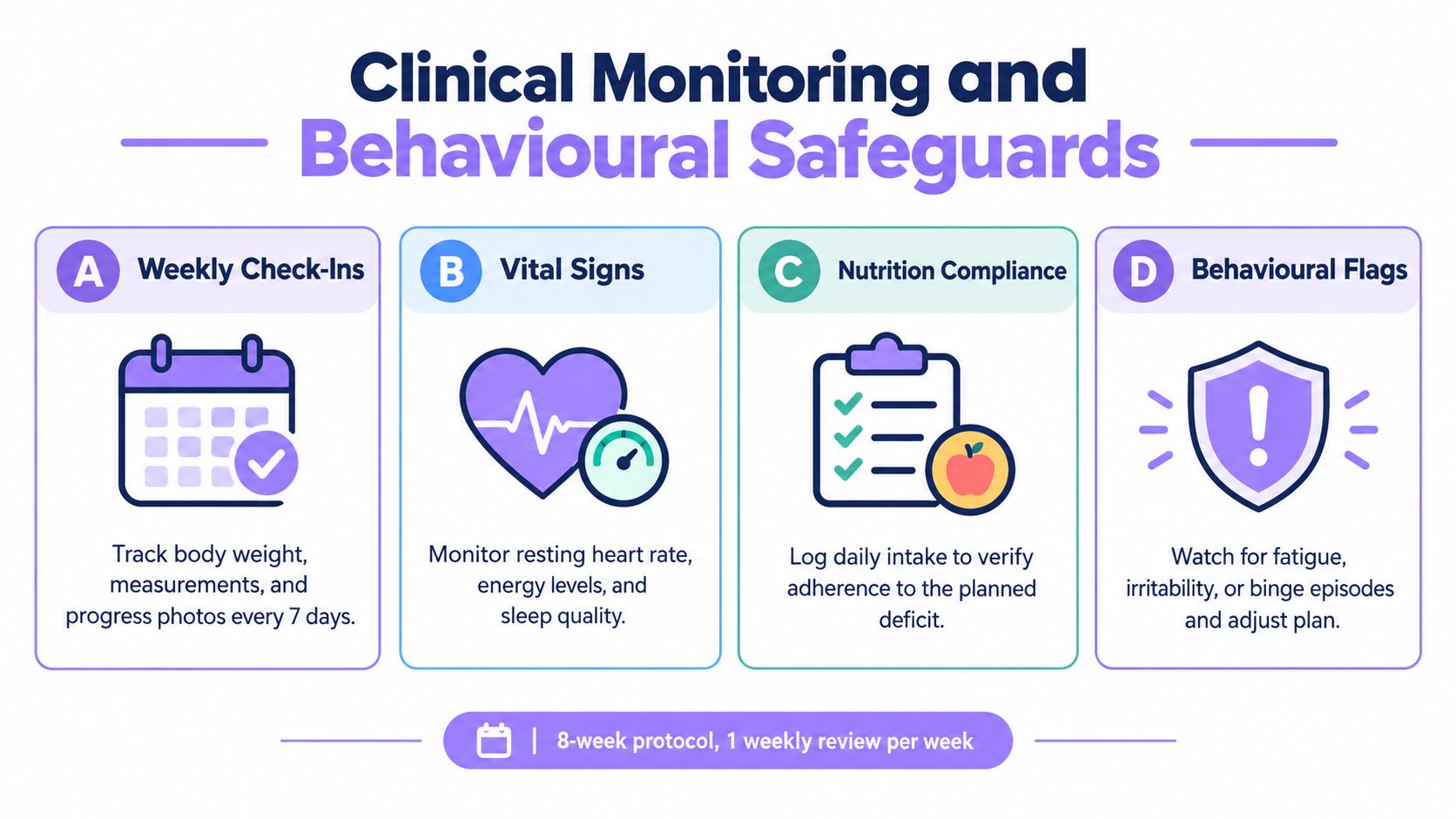
The scale is only one measurement. During a demanding weight-loss phase, changes in energy, sleep, mood, resting heart rate, exercise tolerance and digestive symptoms can provide useful context. A sudden deterioration in wellbeing should prompt a review rather than a decision to restrict food further.
A weekly review should answer practical questions
Record weight consistently under similar conditions, but avoid interpreting every change as fat loss or fat gain. Also review whether meals are providing enough protein and fibre, whether fluids are adequate, and whether training remains manageable.
Look for warning signs such as persistent dizziness, fainting, confusion, severe weakness, repeated vomiting, inability to keep fluids down or symptoms suggestive of gallbladder problems. These symptoms require medical attention. Don't try to correct them by adding more exercise or further cutting food.
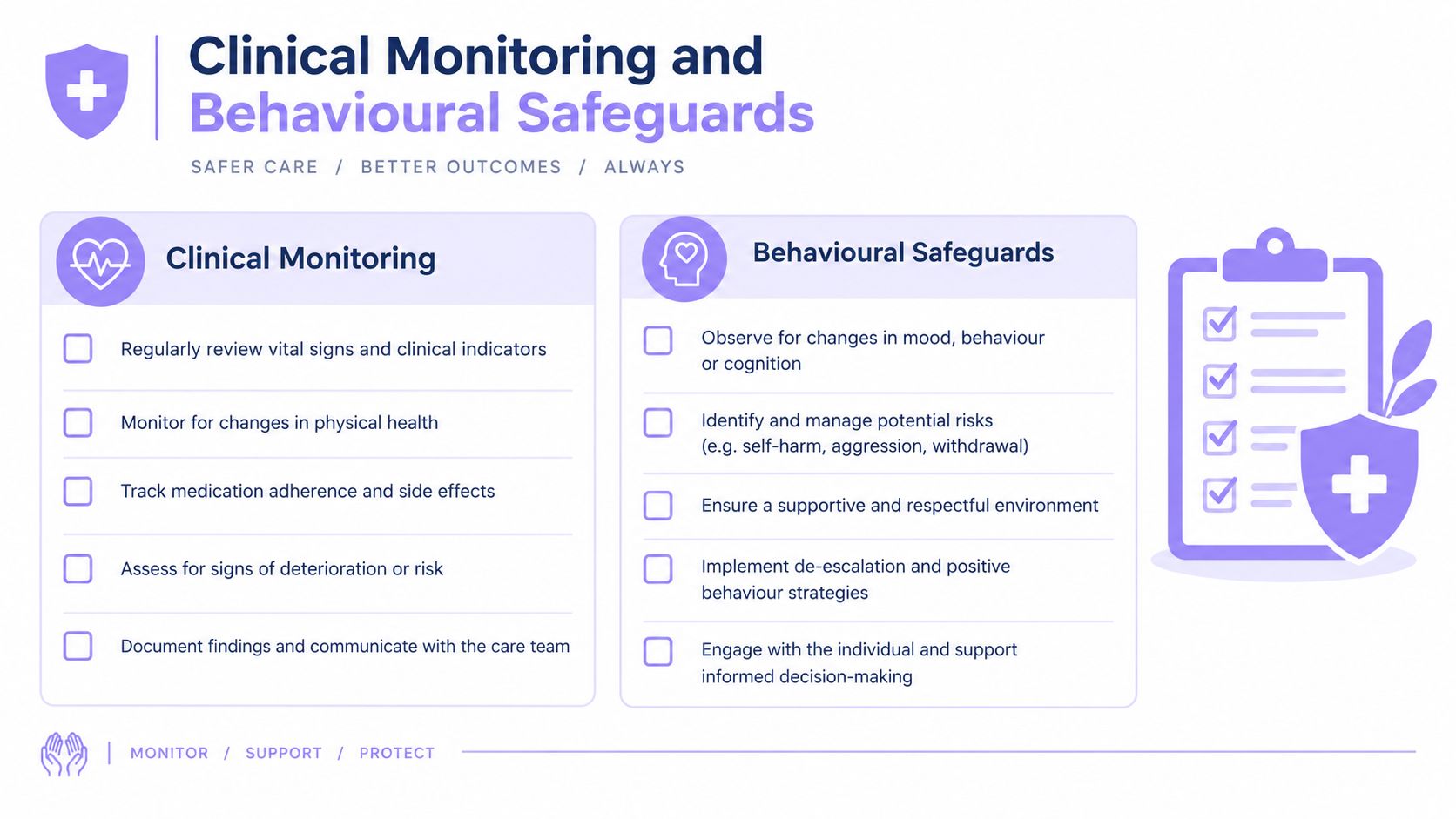
Behaviour also needs monitoring. Aggressive restriction can encourage an all-or-nothing cycle, where a difficult meal leads to guilt, further restriction and then loss of control. A better approach uses planned meals, flexible food choices and a response to lapses that returns to the next ordinary meal.
If the plan is making you hide food, fear eating, binge, purge or exercise compulsively, the priority is no longer the target weight. Speak to a qualified healthcare professional.
NICE sets treatment review rules for weight-management medicines. Its guidance says treatment should be stopped when a patient hasn't lost at least 5% of initial body weight within the specified review period, ensuring that medication continues only where it's clinically effective. The details vary by medicine, so patients should follow the prescriber's review schedule in the NICE guide to prescribing medicines for overweight and obesity.
For a broader discussion of expected problems and treatment-related symptoms, medically grounded weight management can provide useful educational context. Patients using an online pharmacy can also review weight-loss medication side effects, but new or severe symptoms should be discussed with the prescribing team.
Executing the 8-Week Protocol in the Real World
A safe real-world plan is less dramatic than social media promises. It uses repeatable meals, manageable movement and regular review, rather than trying to create the entire deficit through starvation or punishing exercise.
One practical week might look like this:
- Monday: Protein-based breakfast, vegetable-rich lunch and a balanced evening meal. Complete a short full-body resistance session if energy and technique are sound.
- Tuesday: Use a brisk walk or another comfortable cardiovascular activity. Keep meals structured, with protein included at each main meal.
- Wednesday: Take an active recovery day. Prepare meals in advance, check fluids and review hunger, sleep and energy.
- Thursday: Repeat resistance training with controlled movements. Stop short of failure if recovery is poor.
- Friday: Use low-intensity movement and a planned meal that fits normal social circumstances, rather than compensating by skipping food.
- Saturday: Complete a longer gentle walk or suitable cardio session if tolerated. Include carbohydrate foods around activity when they support performance.
- Sunday: Rest, plan the coming meals and complete the weekly review. Note symptoms, adherence, strength and general wellbeing, not just scale weight.
This is a framework, not a personal prescription. Calorie intake, protein requirements, exercise selection and medication suitability depend on factors such as current weight, medical conditions, pregnancy status, eating-disorder history, kidney health and prescribed medicines.
The NHS Low Calorie Diet Programme provides a useful example of why context matters. In an early pilot involving eligible people with type 2 diabetes, average losses were 7.2 kg after 1 month and 13.4 kg after 2 months, as reported in this account of the NHS diabetes diet programme. Those results came from selected patients receiving tightly controlled diet support. They aren't a general-population benchmark for unsupervised dieting.
Seek professional support before starting an aggressive plan, particularly if you have a long-term condition, take regular medication, have a history of disordered eating, or are considering a very-low-energy diet. If you're exploring an online pharmacy, verify that it uses UK-registered clinicians, requires a valid consultation and prescription where appropriate, and provides follow-up rather than treating delivery as the end of care.
XO Medical is a UK-registered online pharmacy and telehealth service offering clinician-led consultations and, where clinically appropriate, prescribed weight-management treatment. Visit XO to review its online healthcare services and understand how assessment, prescribing and follow-up are handled.


0 comments