


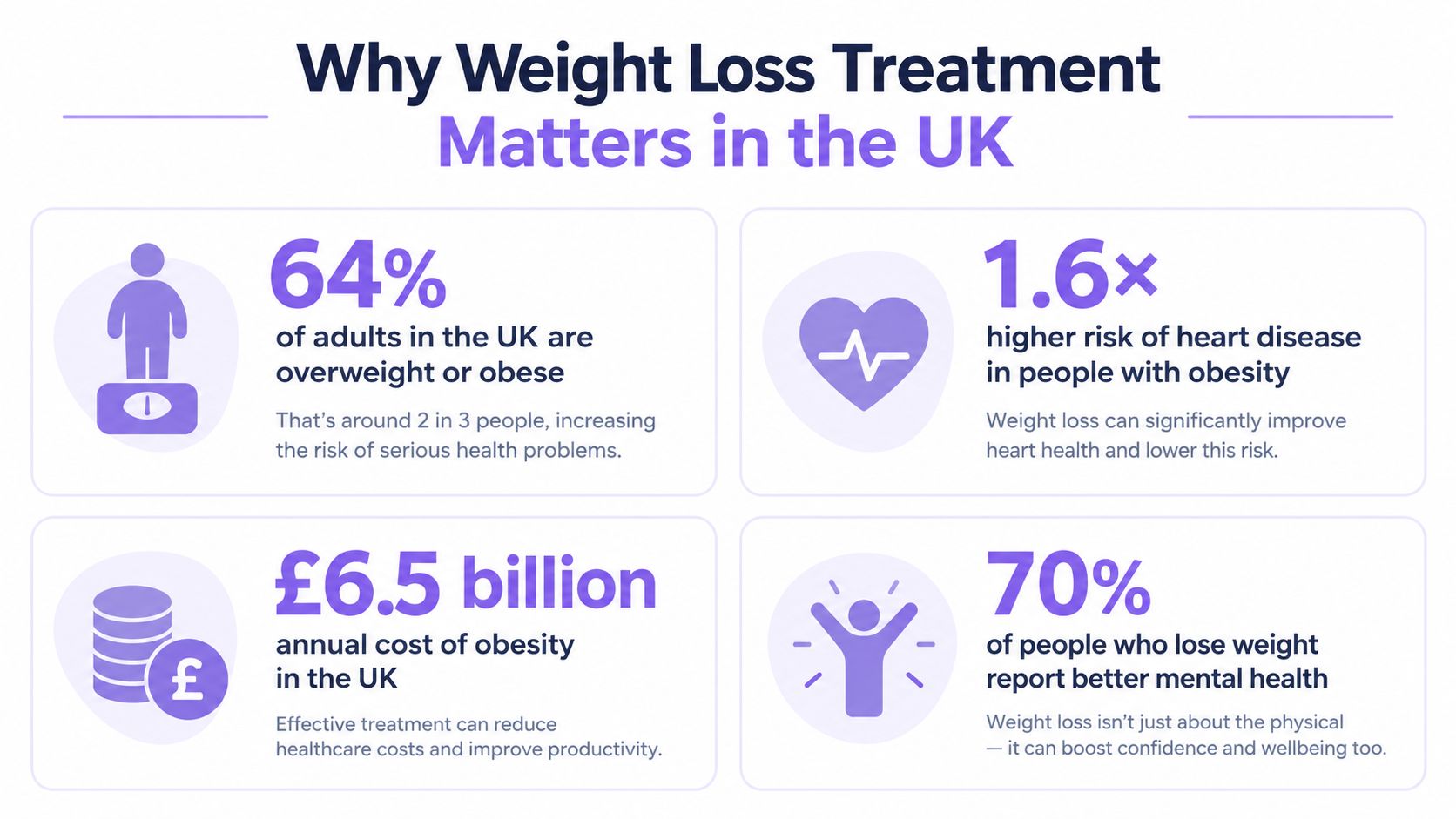
In England, 64% of adults were overweight or living with obesity in 2022, including 29% living with obesity. That's why clinically supervised weight-loss treatment has become part of routine NHS and private care in the UK, although access still depends on eligibility, local services and a qualified prescriber.
You may be researching weight loss treatment UK options after repeated attempts to lose weight, a new diagnosis such as type 2 diabetes, or a conversation with your GP about obesity-related health risks. You may also be comparing an NHS referral with an online pharmacy and wondering whether a private consultation can lead to treatment.
The answer isn't “which injection works best?” A safe decision depends on your health, BMI, medicines, relevant medical history, treatment goals and access to follow-up. This guide explains the main prescription options, how NHS and private routes differ, and what to check before using a prescription-only treatment.
Important: This content is for informational purposes only and does not constitute medical advice. Always consult a qualified healthcare professional before starting or changing any treatment.
Table of Contents
- Why Weight Loss Treatment Matters in the UK
- How Modern Weight Loss Medicines Work
- Prescription Options Available in the UK
- How UK Prescribing Pathways Work in Practice
- NHS Eligibility and Private Access Compared
- Safety, Side Effects and Prescriber Oversight
- Costs, Support and Choosing a Regulated Provider
- Practical Next Steps and Common Questions
Why Weight Loss Treatment Matters in the UK
A person considering treatment today may have tried structured diets, exercise plans and commercial programmes, yet still find weight difficult to manage. That experience is common, and it doesn't mean lifestyle change is irrelevant. It means obesity can involve biological, psychological, social and environmental factors that sometimes require more support than willpower alone.
The Health Survey for England 2022 data found that 64% of adults were overweight or living with obesity, while 29% were living with obesity. Obesity affected 14% of adults aged 16 to 24, compared with 36% of those aged 55 to 64 and 35% of those aged 65 to 74. Men were more likely than women to be overweight or living with obesity overall, at 67% compared with 61%.
The same survey found that 15% of children aged 2 to 15 were living with obesity, and 27% were overweight or living with obesity. These figures describe a long-term population-health issue, not a short-lived cosmetic trend.
From lifestyle support to clinical care
Modern weight management usually combines three elements:
- Lifestyle support: Food choices, physical activity, sleep, behaviour change and practical help with maintaining progress.
- Prescription medicines: Treatments that can reduce appetite, increase fullness or affect how dietary fat is absorbed.
- A prescribing pathway: Assessment, eligibility checks, dose adjustments, monitoring and review.
Historical figures help explain why clinical services are under pressure. Parliamentary analysis of Health Survey data reported that the proportion of adults who were overweight or living with obesity increased from 52.9% in 1993 to 64.3% in 2022, while the proportion living with obesity rose from 14.9% to 28.9% over the same period. The Parliamentary analysis also found a 12 percentage point difference in combined overweight and obesity prevalence between adults in the most deprived areas and those in the least deprived areas.
That inequality matters when comparing treatment routes. A medicine may be clinically appropriate, yet a person can still face waiting lists, limited local provision or the financial barrier of private care. The practical question is therefore not only whether treatment exists, but whether the patient can access safe, properly supervised care.
How Modern Weight Loss Medicines Work
The simplest way to understand newer weight-loss medicines is to think about the body's appetite feedback system. After eating, the gut releases hormones that help the brain recognise nutrients, increase fullness and regulate blood glucose. Medicines based on GLP-1, or on both GIP and GLP-1, use some of these biological signals to influence appetite and metabolism.
GLP-1 receptor agonists can help people feel full sooner and stay full for longer. They can also slow the movement of food from the stomach into the intestine and support blood-glucose regulation. Tirzepatide acts on GIP and GLP-1 pathways, so it's described as a dual incretin medicine.
A thermostat is a useful analogy. It doesn't force a room to a particular temperature instantly. It senses conditions, makes gradual adjustments and responds to feedback. Appetite medicines don't remove the need to choose food or move regularly. They can, however, alter hunger and satiety signals so that those behaviours become more manageable for some patients.
Why gradual dosing matters
These medicines are generally introduced at a lower dose and increased according to the product instructions and clinical response. Gradual escalation can help the prescriber balance appetite effects with tolerability, particularly gastrointestinal symptoms such as nausea, vomiting, diarrhoea, constipation or reflux.
Orlistat works differently. It's an oral medicine that reduces the amount of dietary fat absorbed in the gut. Its effects and side-effect pattern differ from injectable incretin medicines, so a consultation should consider the person's preferences, medical history and ability to follow the required dietary approach.
The NICE practical guide to medicines for weight management makes clear that prescription medicines are used alongside a reduced-calorie diet and increased physical activity. They're not replacements for broader weight-management support.
A prescription-only treatment can't lawfully be supplied by a legitimate pharmacy without a valid prescription based on an appropriate clinical assessment. An online pharmacy should involve an appropriately qualified prescriber, not just take payment for a medicine selected by the patient.
Some people also find it useful to plan convenient, filling foods around appetite changes. For general nutrition ideas, plant-based protein snacks for GLP-1 may provide a practical starting point, but it isn't a substitute for advice from a dietitian or prescriber. For a plain-English overview of the UK clinical context, see GLP-1 medication in the UK.
Prescription Options Available in the UK
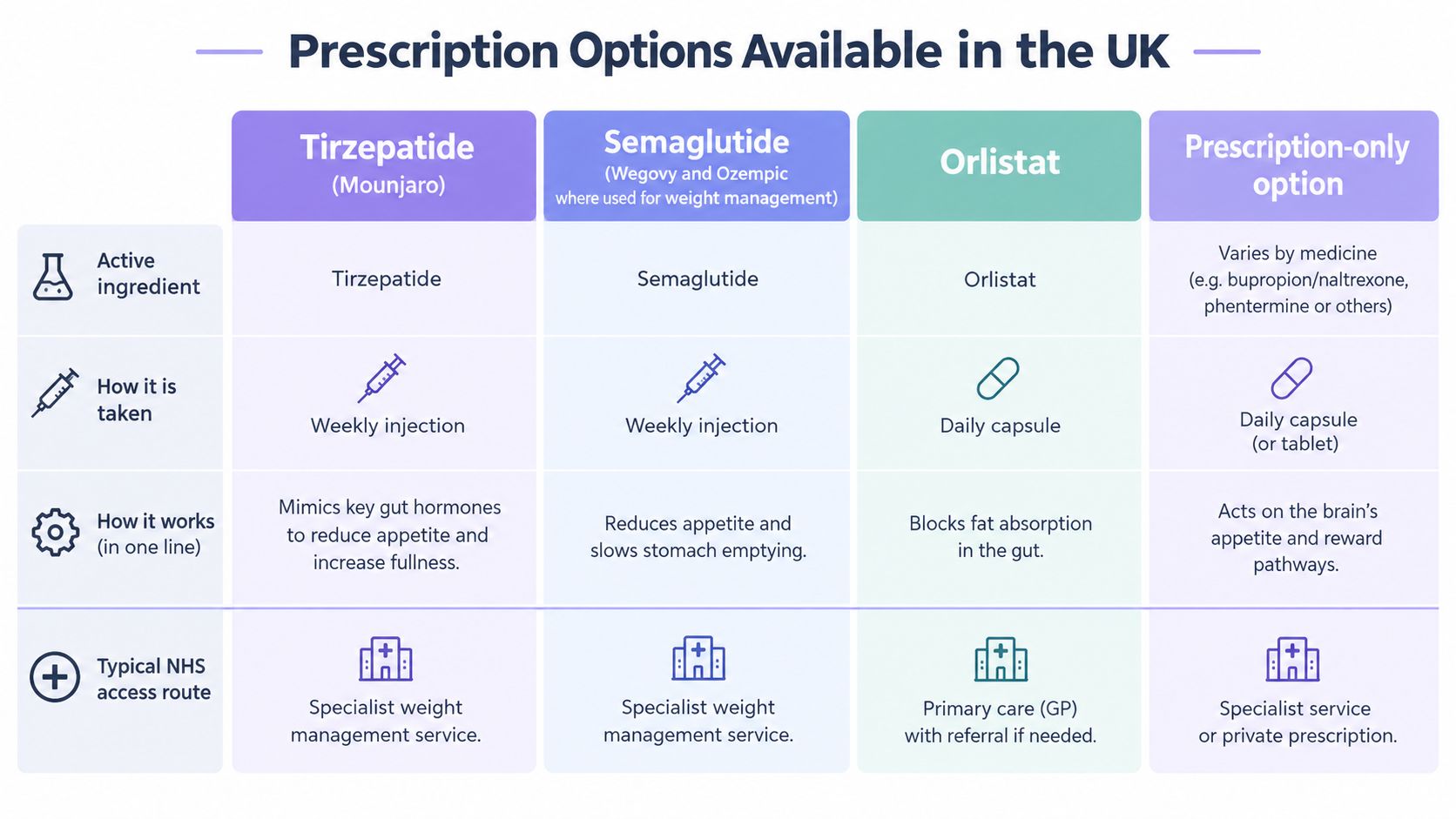
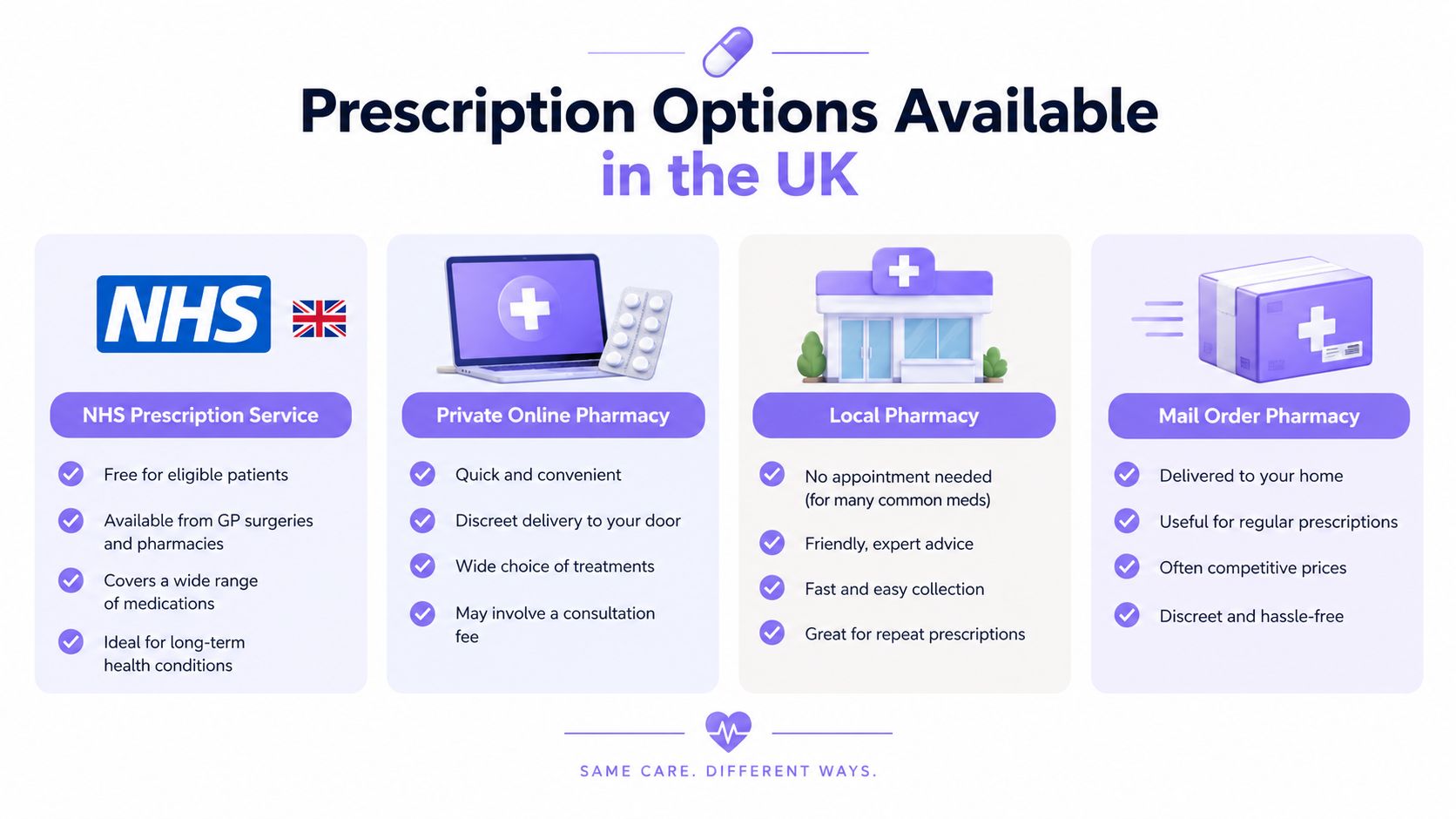
The main medicines a UK patient may hear about include tirzepatide, semaglutide and orlistat. They don't work in the same way, and a brand name doesn't determine whether treatment is suitable for a particular person.
NICE's committee review found that tirzepatide at 5 mg, 10 mg and 15 mg was statistically superior to diet and exercise alone across assessed outcomes. It also found that the 10 mg and 15 mg doses were statistically superior to semaglutide for achieving at least 5% weight loss in the whole trial population. However, NICE reported that no direct head-to-head clinical trial comparing tirzepatide with semaglutide had been identified. The comparison therefore relies on indirect evidence and shouldn't be treated as a universal ranking.
The NICE committee discussion supports a more careful consultation. The prescriber should consider licensed indication, BMI, related conditions, contraindications, side effects, dose response, treatment goals and the patient's ability to attend follow-up.
| Medicine | Class | NICE status | Typical delivery |
|---|---|---|---|
| Tirzepatide, Mounjaro | Dual GIP and GLP-1 receptor agonist | Recommended for eligible adults within the relevant pathway | Usually weekly injection, with clinical dose escalation |
| Semaglutide, Wegovy | GLP-1 receptor agonist | Recommended for eligible adults within the relevant pathway | Usually weekly injection, alongside diet and activity support |
| Semaglutide, Ozempic | GLP-1 receptor agonist licensed primarily for diabetes care | Use depends on the licensed indication and clinical assessment | Injection under prescriber direction |
| Orlistat | Intestinal lipase inhibitor | An established oral option in appropriate circumstances | Oral capsule with dietary guidance |
What about emerging treatments?
Medicines still in clinical trials, awaiting UK regulatory decisions or not authorised for weight management shouldn't be presented as available treatment. A clinical trial result isn't the same as an MHRA authorisation, a NICE recommendation or a medicine that a UK pharmacy can lawfully dispense.
For patients, the useful question is not “which medicine has the largest trial result?” It's “which licensed option is clinically appropriate, obtainable through a regulated route and supported by monitoring?” That approach avoids treating indirect comparisons as personal predictions.
How UK Prescribing Pathways Work in Practice
A regulated pathway starts with assessment, not with a product choice. Whether the first contact is a GP, specialist service or private clinician, the prescriber needs enough information to decide whether treatment is appropriate and safe.
The assessment and prescribing sequence
- The concern is discussed. The patient explains their weight-management goals, previous approaches, current symptoms and relevant conditions.
- Eligibility and safety are reviewed. The clinician checks BMI, medical history, current medicines, allergies, pregnancy status where relevant and possible contraindications.
- The route is identified. The patient may be referred to an NHS specialist weight-management service, managed through primary care where local arrangements permit, or assessed privately.
- The prescription is clinically reviewed and dispensed. A UK-registered pharmacy supplies the medicine only after the prescription has been authorised.
- Follow-up continues. The clinical team reviews response, side effects, dose changes, adherence and whether treatment should continue.
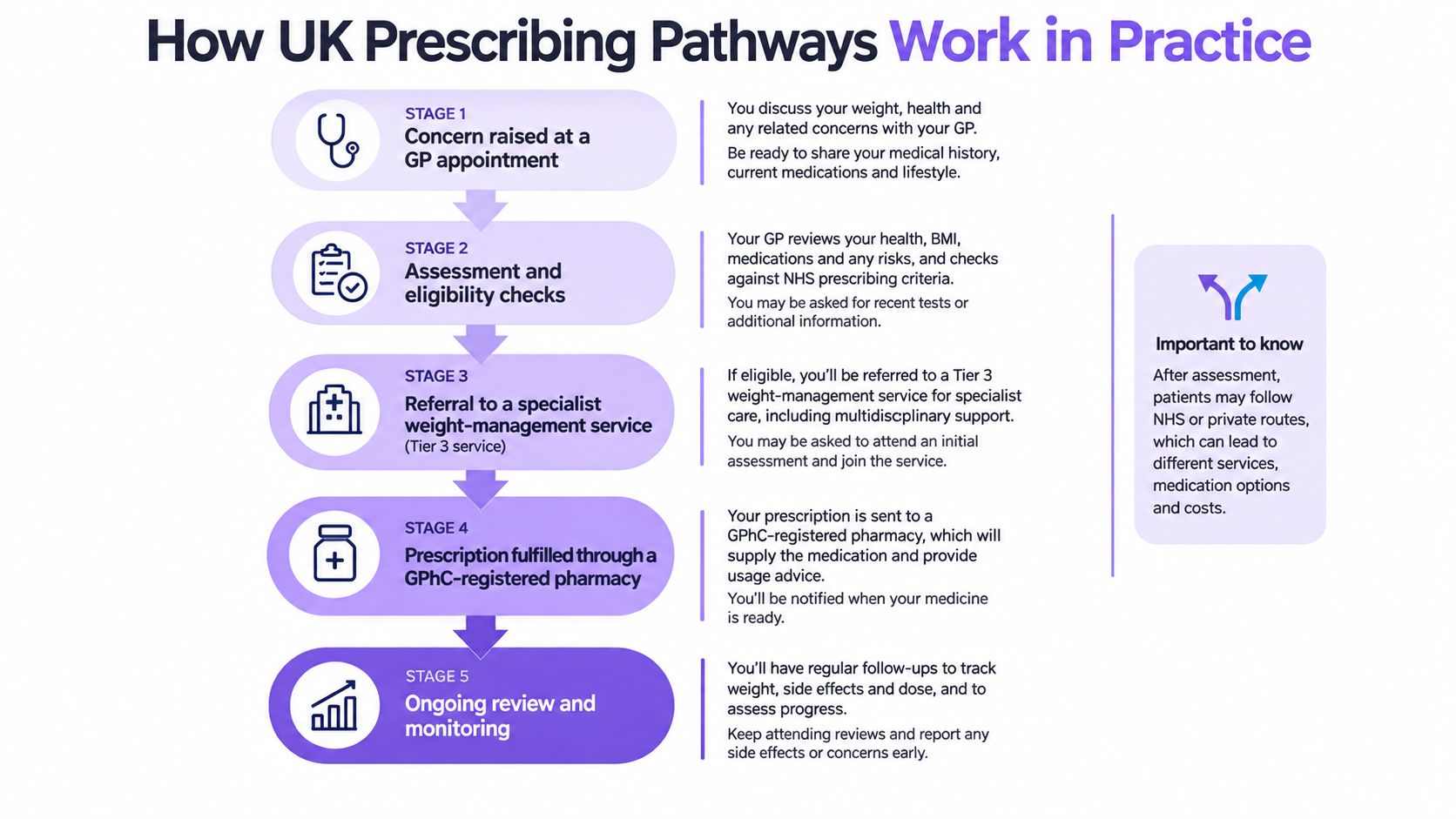
A specialist weight-management service may include more intensive dietary, behavioural and clinical support. “Tier 3” is commonly used for specialist multidisciplinary weight management, while “Tier 4” generally relates to highly specialist care such as bariatric surgery. Availability varies locally, and a referral doesn't guarantee that a particular medicine will be offered immediately.
What online care should involve
A private online consultation typically includes a health questionnaire, identity checks, medical-history review and an individual decision by a qualified prescriber. If treatment is authorised, the pharmacy dispenses it under its normal governance arrangements, followed by instructions and a process for asking questions or reporting problems.
Medically supervised care means documented clinical assessment and ongoing oversight. It doesn't mean that a short form automatically leads to medication. The NHS England guidance on weight-management injections states that tirzepatide may be prescribed through a specialist service when a healthcare professional considers it appropriate.
NHS Eligibility and Private Access Compared
NICE recommendation and NHS access are related, but they aren't identical. NICE sets evidence-based recommendations and eligibility criteria. Local NHS organisations then organise services, establish pathways and manage delivery through Integrated Care Boards.
For tirzepatide, NICE recommends treatment for adults with an initial BMI of at least 35 kg/m² and at least one weight-related comorbidity. Examples include hypertension, dyslipidaemia, obstructive sleep apnoea, cardiovascular disease and type 2 diabetes. Treatment should be combined with a reduced-calorie diet and increased physical activity, and delivered through an appropriate weight-management service.
NHS England explains that access may be through a specialist weight-management service when a healthcare professional considers it appropriate. Primary-care access may apply to people with a BMI of 35 or above, adjusted for ethnicity, who have four of the listed weight-related conditions, depending on the local commissioning model.
Ethnicity-adjusted thresholds
NICE identifies lower BMI thresholds, usually reduced by 2.5 kg/m², for people from South Asian, Chinese, other Asian, Middle Eastern, Black African or African-Caribbean ethnic backgrounds. This adjustment exists because health risks associated with excess weight can arise at lower BMI levels in some ethnic groups.
BMI is only one part of the assessment. A clinician should also consider waist measurement where appropriate, related conditions, current medicines, mental health, eating patterns, pregnancy plans and previous treatment response.
A NICE recommendation means a treatment should be funded within the relevant NHS framework. It doesn't mean every eligible person receives a prescription immediately from their own GP surgery.
Why access can still be difficult
NICE's equality assessment identifies geographical variation in NHS weight-management provision. In some areas, limited access to intensive Tier 3 services can prevent people from progressing to more specialist care, including Tier 4 bariatric surgery. People who can't access specialist NHS services may only be able to obtain medicines privately, which creates a greater barrier for those on lower incomes. The NICE guidance on medicines and surgery sets out this wider access context.
Private online prescribing may offer a different route, but it doesn't turn an unsuitable medicine into a suitable one. A private clinician still needs to assess eligibility, risks and treatment goals, and an NHS prescription can't be secured just because a private clinician has recommended treatment.
Safety, Side Effects and Prescriber Oversight
The most common practical problems with GLP-1 and dual incretin medicines involve the gastrointestinal system. Nausea, vomiting, diarrhoea, constipation, abdominal discomfort and reflux can occur, particularly when treatment starts or the dose increases. A prescriber should explain what may be expected, how to maintain hydration and when symptoms need review.
Pregnancy and breastfeeding require particular clinical consideration, and these medicines may be unsuitable in certain circumstances. The prescriber also needs to check previous thyroid problems, pancreatitis risk, gallbladder disease, kidney function where relevant, diabetes treatment and possible interactions with other medicines.
Monitoring is part of treatment
A safe service should have a plan for:
- Dose escalation: Increasing only when clinically appropriate and tolerated.
- Treatment response: Reviewing appetite, weight-management progress and functional health goals.
- Adverse effects: Providing a clear route for urgent and routine concerns.
- Medicine governance: Following pharmacy procedures, MHRA safety information and recall processes.
Severe or persistent vomiting, intense abdominal pain, signs of dehydration, breathing difficulty, facial swelling or other sudden serious symptoms require urgent medical assessment. Call emergency services for a life-threatening reaction.
A GPhC-registered pharmacy should operate with documented clinical governance and a Superintendent Pharmacist. A one-off questionnaire without meaningful review doesn't provide the same safeguard as a proper prescribing process. For a broader explanation of possible problems and what to discuss with a clinician, see weight-loss medication side effects.
Costs, Support and Choosing a Regulated Provider
Private treatment costs vary by medicine, dose, consultation model, dispensing arrangements and follow-up. Because prices change, compare what the quoted fee includes rather than judging a service by the medicine price alone.
A credible service should explain whether the package includes:
- Clinical assessment: A qualified prescriber reviews the patient rather than approving treatment automatically.
- Dose management: The service explains how escalation and changes are handled.
- Follow-up: Patients know how to contact the clinical team about side effects or treatment questions.
- Pharmacy governance: The dispensing pharmacy is identifiable and registered with the GPhC.
- Transparent terms: Pricing, delivery, cancellation and complaint procedures are easy to find.
XO Medical is one example of a UK-registered online pharmacy and telehealth service. Its process uses an online health questionnaire and clinician assessment before prescription and dispensing, with pharmacist checks, clinician support and tracked next-day delivery. XO Clinic in Wakefield is separate and offers in-person aesthetics care, including Botox, dermal fillers, skin boosters and polynucleotides, sometimes described as salmon DNA, rather than functioning as the same online pharmacy service.
Readers comparing wider health services may also find this guide on how to compare longevity programmes useful because it focuses on evaluating clinical support, governance and what a programme includes. For online weight-management information specific to XO Medical's service model, see online weight-loss medication.
Never rely on a website that sells prescription-only treatment without a proper clinical assessment, hides its pharmacy details or makes guaranteed claims. A regulated service should make it possible to verify the pharmacy, prescriber arrangements and complaints process.
Practical Next Steps and Common Questions
Before a consultation, write down your current medicines, relevant diagnoses, previous weight-management attempts and the outcome you want from treatment. Ask:
- Eligibility: Which clinical criteria apply to me?
- Monitoring: Who reviews side effects and treatment response?
- Dose changes: How will escalation or stopping be managed?
- Support: What dietary and physical-activity guidance is available?
- Continuity: How do repeat prescriptions and follow-up work?
Common questions
Can I use an injection without another health condition?
NHS eligibility for tirzepatide includes BMI and weight-related comorbidity criteria. Private prescribing also requires an individual clinical assessment, so treatment isn't automatic.
How do repeat prescriptions work?
A prescriber should review whether continued treatment remains appropriate before authorising a repeat. Don't assume that a previous prescription guarantees future supply.
What does discreet delivery mean?
It generally refers to delivery in packaging that doesn't identify the medicine externally. Confirm the service's delivery and storage instructions before ordering.
When should I contact my GP?
Contact your GP if you have new symptoms, worsening health, concerns about existing medicines or difficulty accessing appropriate care. Seek urgent help for serious or rapidly developing symptoms.
Weight loss treatment works best as part of a longer-term plan that includes appropriate nutrition, activity and clinical review. A qualified UK healthcare professional can help you decide whether treatment is suitable and which route is safest.
XO offers clinician-reviewed weight-management assessments through XO Medical, a UK-registered online pharmacy, and in-person care through XO Clinic in Wakefield. Visit XO to review the available services and start with an appropriate clinical consultation rather than requesting medication automatically.


0 comments