


Would you tell a clinician everything they need to know if you weren't sure who else could read your answers? That question explains why patient confidentiality is important: people share sensitive details only when they trust those details will be protected, and clinicians can only judge risk accurately when they have the full picture.
Hold back a symptom, a medicine or a relevant part of your history, and the person assessing you is working from an incomplete record. A consultation works like a jigsaw puzzle: the more pieces missing, the harder it is to see what the image shows.
Confidentiality is what makes honest disclosure feel safe enough to happen.
Table of Contents
- Why Confidentiality Matters in Plain Terms
- What Counts as Confidential Health Information
- How Disclosure Fears Affect Care and Safety
- Where Confidentiality Applies in Telehealth, Pharmacy and Clinics
- When Information Can Be Shared Without Consent
- Check Your Provider Before You Share
- Frequently Asked Questions
Why Confidentiality Matters in Plain Terms
Patient confidentiality matters because people need to trust that sensitive information will be protected before sharing the details clinicians need to assess risk and prescribe safely. It protects both the person seeking help and the quality of the information used to care for them.
Confidentiality is the duty to keep information about someone's health, treatment and identity private, and disclose it only for a justified purpose. It covers conversations as well as records, whether care happens online, in a pharmacy or in a consulting room.
Five reasons patient confidentiality matters
| Reason | What it protects | Basis |
|---|---|---|
| Trust in care | Willingness to disclose sensitive information | NHS England public attitudes research, 2024 |
| Clinical safety | A complete history for accurate diagnosis and prescribing | GMC ethical and legal duties of confidentiality |
| Legal duty | Information used only for justified purposes | Common-law duty of confidence and UK GDPR |
| Personal dignity | Control over sensitive conditions such as sexual or mental health | GMC guidance and Caldicott Principles |
| Public confidence in data | Limits on who can access identifiable information | Caldicott Principles |
In a 2024 survey of more than 2,200 people, NHS England's public attitudes survey found that 83% trusted the NHS to keep their patient data secure, while 72% trusted the NHS overall. These findings show that confidence in information handling is measurable, although they don't establish that confidentiality alone causes trust.
Privacy supports a useful clinical record
A consultation isn't just a list of symptoms. Medication use, reproductive history, mental-health concerns and lifestyle factors can change how a clinician interprets those symptoms or assesses treatment suitability.
If a patient leaves out something sensitive, a carefully written record can still be incomplete. Protecting the conversation helps the clinician obtain information that might otherwise remain unspoken.
Practical takeaway: Confidentiality protects your dignity and helps your clinician build a more accurate picture of your health.
Legal detail differs across England, Wales, Scotland and Northern Ireland. This guide focuses on England, alongside UK-wide principles where they apply.
What Counts as Confidential Health Information
Information given in the context of healthcare can be confidential even when nobody has signed a separate confidentiality agreement. Think of it as a sealed letter in a locked drawer: its protection comes from where it came from and who it's intended for, not from a confidential label alone.
The same expectation applies when information passes from patient to clinician during a consultation.

Confidential information includes:
- Clinical details, such as symptoms, diagnoses, medical history and test results.
- Consultation records, including online answers, photographs and follow-up messages.
- Treatment information, including medication and prescription records.
- Linked personal details, such as an address, telephone number or delivery information associated with care.
Confidentiality and data protection aren't identical
Confidentiality concerns whether information may be disclosed and to whom. Data protection governs how personal information is collected, stored, used and shared.
Health information is special-category data: the government's information-sharing consensus statement explains that providers need an Article 6 lawful basis, such as consent, contract, legal obligation or public task, and an additional Article 9 condition. Where information is also subject to a duty of confidence, providers must separately establish how that duty is satisfied or lawfully set aside.
Technical protection supports these duties but doesn't replace them. Ciphar's explanation of encryption strategies for sensitive health data offers background on protecting digital information; encryption alone doesn't decide whether someone is entitled to receive it.
For a further introduction to the topic, the following video provides another viewing option.
A familiar example
Say a family member phones a pharmacy to ask whether your prescription was collected. Staff shouldn't confirm the details merely because the caller knows your name or address; they need appropriate authority or another lawful justification.
Removing a name isn't always enough to anonymise a record either. A distinctive combination of details may still identify someone, so providers must assess identification risk rather than assume an unlabelled record is anonymous.
How Disclosure Fears Affect Care and Safety
A patient may worry that a sensitive answer will appear on a shared screen, reach a relative or be passed to someone outside their care. They may then edit what they say, minimise a symptom or postpone the appointment.
The General Medical Council's ethical and legal duties of confidentiality recognise that patients may avoid seeking medical help or under-report symptoms if they fear disclosure without consent or control over what is shared. An incomplete history can then weaken diagnosis, risk assessment, prescribing decisions and safeguarding.
This process explains why confidentiality is a clinical-safety issue, not just an administrative responsibility.
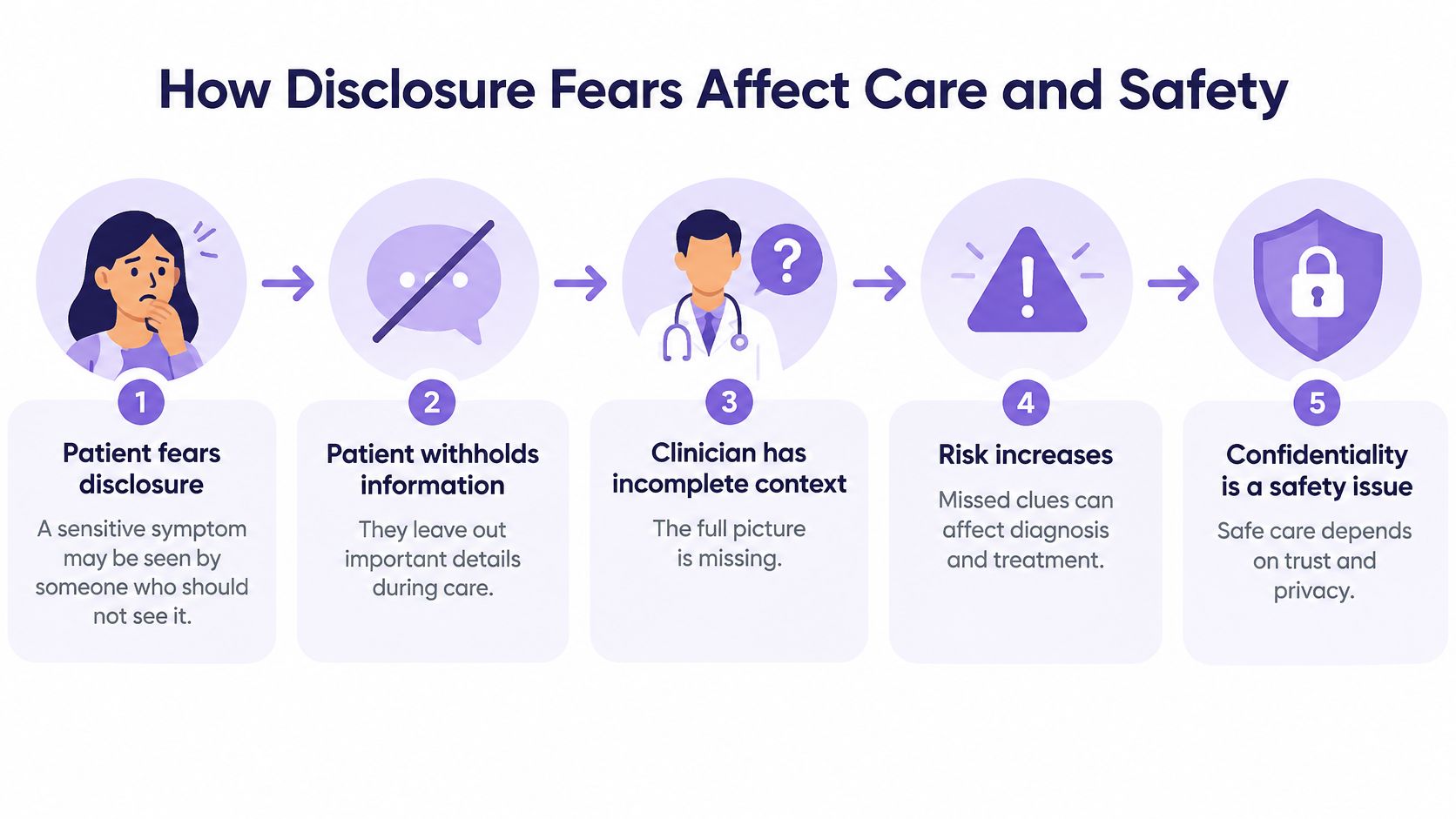
How missing details can affect an assessment
Consider these hypothetical situations:
- Sexual health: Someone leaves out a symptom because they're concerned a partner might see the consultation.
- Mental health: A patient minimises their history before a medicine is considered because they fear being judged.
- Menopause or weight management: Embarrassment leads someone to downplay symptoms that would help explain their concerns.
- ADHD or hair loss: A patient gives a shortened account because they don't want others to know they're seeking help.
These examples don't mean every omission changes treatment. They show why clinicians need a setting in which patients can answer accurately without unnecessary exposure.
A 2025 rapid systematic review of public understanding of health-data security.pdf) found that understanding was generally poor, while concerns included misuse, commercial access and data breaches. Providers therefore need to explain safeguards in language patients can use, rather than expect technical assurances to settle every concern.
What helps patients speak openly
Before sensitive questions, staff should explain how answers will be used and obtain consent where required. Services should also restrict access to appropriate staff and arrange conversations so unauthorised people can't overhear or view them.
A patient shouldn't have to understand a provider's software to understand who can read their consultation.
The same applies to ongoing digital care. Our educational guide to remote patient monitoring provides context for care that continues beyond an appointment.
Authentication, staff permissions, message handling and follow-up processes all need confidentiality built in. These are general safety principles, not advice about any individual's diagnosis or treatment.
Where Confidentiality Applies in Telehealth, Pharmacy and Clinics
Confidentiality by care setting
| Setting | Typical information handled | Main safeguard |
|---|---|---|
| Online pharmacy and telehealth | Online consultation answers, medical history, prescription records and tracked delivery | Clinician review and restricted staff access |
| UK-registered pharmacy | Dispensing records, medicine queries and delivery details | Pharmacist oversight and need-to-know access |
| Private aesthetics or medical clinic | Consultation notes, treatment records and follow-up messages | Clinician-led records and discreet communication |
| NHS GP surgery | Full medical record, referrals and test results | Caldicott Principles and statutory controls |
| Mental health or sexual health service | Symptoms, sensitive history and referral letters | Heightened access controls and consent-based sharing |
Online consultations and pharmacy care
At XO, prescription care starts with an online consultation in which you answer health questions about your condition and medical history. A clinician reviews your consultation before any treatment is prescribed, and a qualified independent prescriber assesses your case and checks that treatment is safe and appropriate before approving a prescription.
Completing a form doesn't establish eligibility for prescription-only treatment. Prescriber oversight remains necessary, and a clinician may need further information before deciding whether prescribing is appropriate.
Our guide to a UK online doctor consultation explains the consultation process. Clinicians need access to the assessment, while dispensing staff need the information necessary to prepare and supply prescribed medication.
In a UK-registered pharmacy, a medicine query may involve the pharmacist, while delivery arrangements may involve administrative staff. Those roles don't require identical access, and a third party's interest in someone's medication doesn't authorise disclosure.
Private clinics and NHS services
An in-person aesthetics clinic offering botox, dermal fillers, skin boosters and polynucleotides (salmon DNA) handles sensitive information too. Consultation notes, treatment photographs and aftercare messages require purposeful access, just as medical records do.
Botox is a prescription-only medicine and requires an appropriate prescribing assessment. Mentioning aesthetic treatments here doesn't establish their suitability for any individual or suggest that different products have the same regulatory status.
Discretion also involves ordinary working practices:
- Private check-in: Staff should avoid announcing treatment details across reception.
- Telephone conversations: Calls should take place where others can't hear confidential information.
- Follow-up messages: Staff should confirm suitable contact arrangements rather than assume a shared telephone is private.
An NHS GP surgery may share relevant records with professionals involved in direct care. In mental health and sexual health services, particularly sensitive records need carefully controlled access; patients can ask how the particular service handles referrals and consent rather than assume every record is visible to every clinician.
The care setting changes, but practical checks remain important. Registration, appropriate staffing and clear communication processes are more useful indicators than a promise of complete secrecy.
When Information Can Be Shared Without Consent
UK patient confidentiality is a strong legal and ethical duty, but it isn't absolute. Appropriate sharing can protect a patient or fulfil a legal obligation, while unjustified disclosure remains unacceptable.
The distinction is between purposeful, governed sharing and access merely because someone wants information.
When disclosure can occur and what limits it
| Situation | Usual basis | Limit |
|---|---|---|
| Direct care by the treating team | Shared on a need-to-know basis | Only what the role requires |
| Patient consent | Shared with explicit permission | Scope set by the patient |
| Legal requirement | Disclosure required by statute | Limited to what the law requires |
| Notifiable infectious disease reported by laboratories | Health Protection (Notification) Regulations 2010 | Limited to the notification |
| Serious risk or safeguarding | Public-interest test applied case by case | Proportionate to the risk, not automatic |
| Third-party request, such as family or employer | No lawful basis unless consent or law applies | Withheld unless a lawful basis applies |
The UK Health Security Agency's confidential patient information guidance explains that laboratories in England must report certain notifiable infectious diseases under the Health Protection (Notification) Regulations 2010, and that the Health Services (Control of Patient Information) Regulations 2002 can permit particular information uses for defined purposes.
The decision needs justification
Before disclosure, the responsible professional should establish:
- The lawful basis, including the position under confidentiality law.
- The purpose, identifying why the recipient needs the information.
- The necessary information, excluding unrelated details.
- The record of the decision, so the reasoning can be reviewed.
Direct-care sharing doesn't always require a fresh explicit consent form. Professionals must consider the circumstances, patients' reasonable expectations and any objections, rather than treat all sharing as either automatically permitted or automatically prohibited.
Only 45% of respondents to NHS England's General Practice Data for Planning and Research public survey agreed that it was acceptable to give approved individuals outside the NHS access to patient data. The associated Caldicott framework balances protection with the equally important duty to share information for an individual's care.
Serious risk isn't an automatic exception
Government guidance on information sharing in NHS continuing healthcare recognises consent, legal requirements, significant public interest and, where relevant, the best interests of someone lacking capacity as potential grounds for sharing. Safeguarding decisions require a proportionate assessment of the circumstances, not an assumption that any concern permits unrestricted disclosure.
A pharmacist shouldn't reveal consultation records or medication details merely because someone asks. Patients can request a clear explanation of who receives their information, for what purpose and under what authority.
Check Your Provider Before You Share
A patient who trusts a provider describes their health fully: the medicines they already take, the symptoms they find embarrassing, the detail that changes which treatment is safe. A patient who doubts confidentiality gives half-answers, and the consultation that follows is built on incomplete information. That difference is worth testing before you send medical history, photographs or identity documents to an online pharmacy, telehealth service or clinic.
Keep the provider's answers alongside its privacy notice, so you can compare what it promises with how its consultation works.
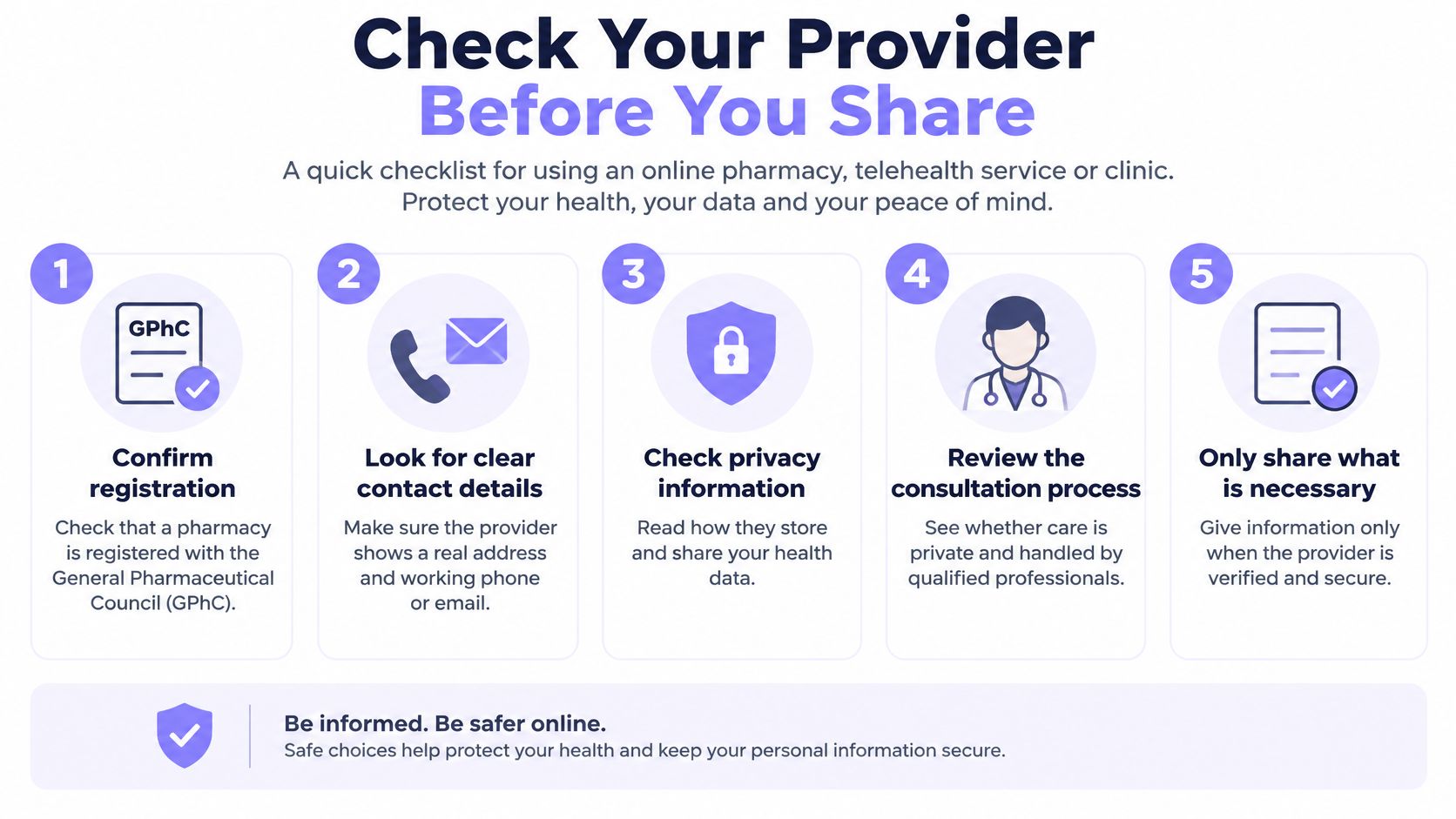
Verify identity and clinical responsibility
- Confirm registration directly. Check the pharmacy's entry on the General Pharmaceutical Council register, including its name and address. Our pharmacy, XO Medical, is regulated by the GPhC under pharmacy number 9012710; verify that entry independently rather than relying only on a badge displayed on a website. A badge image can be copied, while a register entry is maintained by the regulator itself.
- Identify who reviews and dispenses. Our prescriptions are reviewed by UK clinicians, and all prescriptions are dispensed from our registered pharmacy. Apply the same question to any service: establish who is responsible for assessment, prescribing and answering medicine queries, and check that clear contact details are available. If a website cannot say who handles each stage, that gap in accountability is itself an answer.
- Examine data handling. Read the privacy notice before submitting sensitive details. Look for explanations of record access, secure communication, delivery information and sharing with other organisations, including your GP. A request for relevant medical history supports safe prescribing, while unexplained collection of unrelated details deserves a question before you proceed.
Check purpose, access and accountability
- Apply the Caldicott questions. The Caldicott Principles require justified purposes, necessary use, minimum disclosure and strict need-to-know access. Work through them for each recipient, including administrative staff and delivery providers; supplying a parcel doesn't require access to an entire consultation record.
- Use your information rights. Ask how your information is used, who receives it and how to request a copy of your personal data under UK GDPR. Keep a record of the request and response. Access rights can have lawful limitations, so seek an explanation if material is withheld.
- Record answers before deciding. Compare registration details, clinical responsibility, contact arrangements and privacy explanations alongside patient comments. Our guide to reading UK online pharmacy reviews explains how to weigh reviews against these more direct checks.
Before submitting: Check what will appear in emails, text messages and delivery notifications, particularly if other people use your devices. A privacy-conscious service should let you control how it contacts you.
XO's website also provides background health information, though educational material doesn't replace an individual assessment. If a symptom or treatment question is pressing, speak to a GP or pharmacist rather than delay care while comparing websites.
This content is for informational purposes only and does not constitute medical advice. Always consult a qualified healthcare professional before starting or changing any treatment.
Frequently Asked Questions
Can my GP share my information with my employer?
An employer's request doesn't, by itself, justify disclosure. Your GP would ordinarily need your consent or another lawful justification, and any information supplied should be limited to the authorised purpose rather than automatically include your full medical record.
You can ask what a proposed report will contain and who will receive it.
Can a pharmacy tell my partner about my prescription?
Being your partner or family member doesn't automatically entitle someone to prescription information. A pharmacy needs your permission, appropriate authority or another lawful justification before confirming confidential details.
If you want someone to collect medication or speak on your behalf, ask the pharmacy how to arrange this.
Does confidentiality stop when someone dies?
The duty of confidence generally continues after death. Access to a deceased person's records involves specific rules and isn't automatically available to every relative.
Direct questions about a particular record to the healthcare provider or a legal adviser, who can explain the relevant access route.
Is anonymised data still protected?
Anonymised information isn't treated in the same way as identifiable personal data. However, removing obvious identifiers doesn't necessarily make information anonymous, and providers need to consider whether someone could still be recognised.
Replacing a name with a code is not necessarily anonymisation.
What if I think my information was misused?
Raise the concern with the provider first and keep relevant messages or documents. Ask what happened, which information was involved and what action the provider is taking.
For data-protection concerns, contact the Information Commissioner's Office. Concerns about professional conduct may also be appropriate for the GPhC or General Medical Council, depending on who was involved.
These answers provide general information and don't determine the legal or clinical position in an individual circumstance.
XO offers online pharmacy and telehealth care through XO Medical, alongside in-person care through XO Clinic. Visit XO to explore its health information and consultation processes, and use the checks above to clarify how your information will be handled before sharing sensitive details.


0 comments