


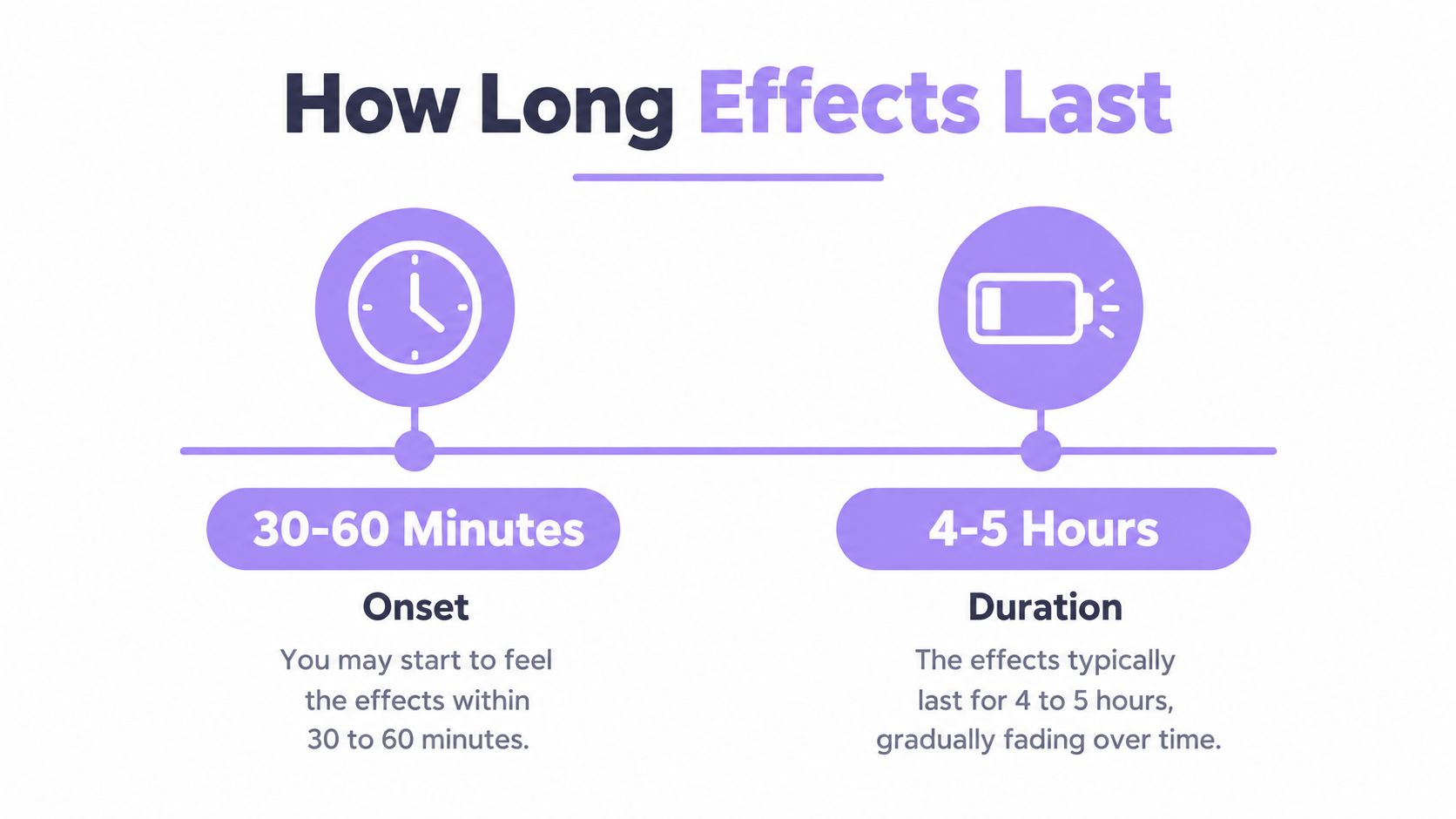
Sildenafil is usually taken about 1 hour before sex and typically begins working within 30 to 60 minutes. In fasted patients, UK product information recorded a median onset of 25 minutes, so the medicine doesn't run on one exact stopwatch.
That difference matters when you're looking for how long sildenafil takes to work after your first prescribed dose. Some people notice a response earlier, while others need more time because of food, anxiety, alcohol, the prescribed dose, or insufficient sexual stimulation. Sildenafil supports the body's natural erection process. It doesn't create sexual desire or cause an automatic erection.
This guide explains what a UK patient can realistically expect, how to plan a dose, why the effect can appear late or seem weaker, and when a prescriber should review your treatment. It provides general information only, not personal medical advice.
Table of Contents
- The Short Answer to When Sildenafil Starts Working
- How Sildenafil Works in the Body
- Factors That Change How Quickly Sildenafil Works
- How Long the Effects of Sildenafil Last
- Why Sildenafil Can Seem Not to Work
- Safety, Eligibility, and UK Prescription Rules
- Key Takeaways for Planning Your Dose
The Short Answer to When Sildenafil Starts Working
About one hour before planned sexual activity is the practical NHS starting point for taking sildenafil. UK patient information gives a usual working window of 30 to 60 minutes, although a heavy meal can delay absorption. The NHS guidance on sildenafil supports the one-hour plan, while the UK patient leaflet describes this broader timing window.
The detailed clinical evidence shows why one number can mislead. In a penile plethysmography study described in the UK Summary of Product Characteristics, the median time to erections sufficient for intercourse was 25 minutes in fasted patients, with a range of 12 to 37 minutes. These results came from controlled testing, so they are a useful guide rather than a promise about your first dose.
Practical rule: Use 60 minutes as a planning point, not a guaranteed start time.
Food is one part of the timing picture. A substantial meal may slow the tablet's absorption, while sexual stimulation is needed for sildenafil to support an erection. Anxiety, alcohol, your prescribed dose, general health, and other medicines can also affect the response.
A slower start does not automatically mean treatment has failed. The tablet may still be entering your bloodstream, or arousal may not yet have triggered the natural process sildenafil supports. Some people need more than one correctly timed attempt before they can judge how well it works for them.
Do not take an extra tablet because you have not noticed an effect yet. Sildenafil improves the body's response to sexual stimulation. It does not create desire or produce an automatic erection, so the timing window depends on both absorption and the circumstances in which you take it.
How Sildenafil Works in the Body
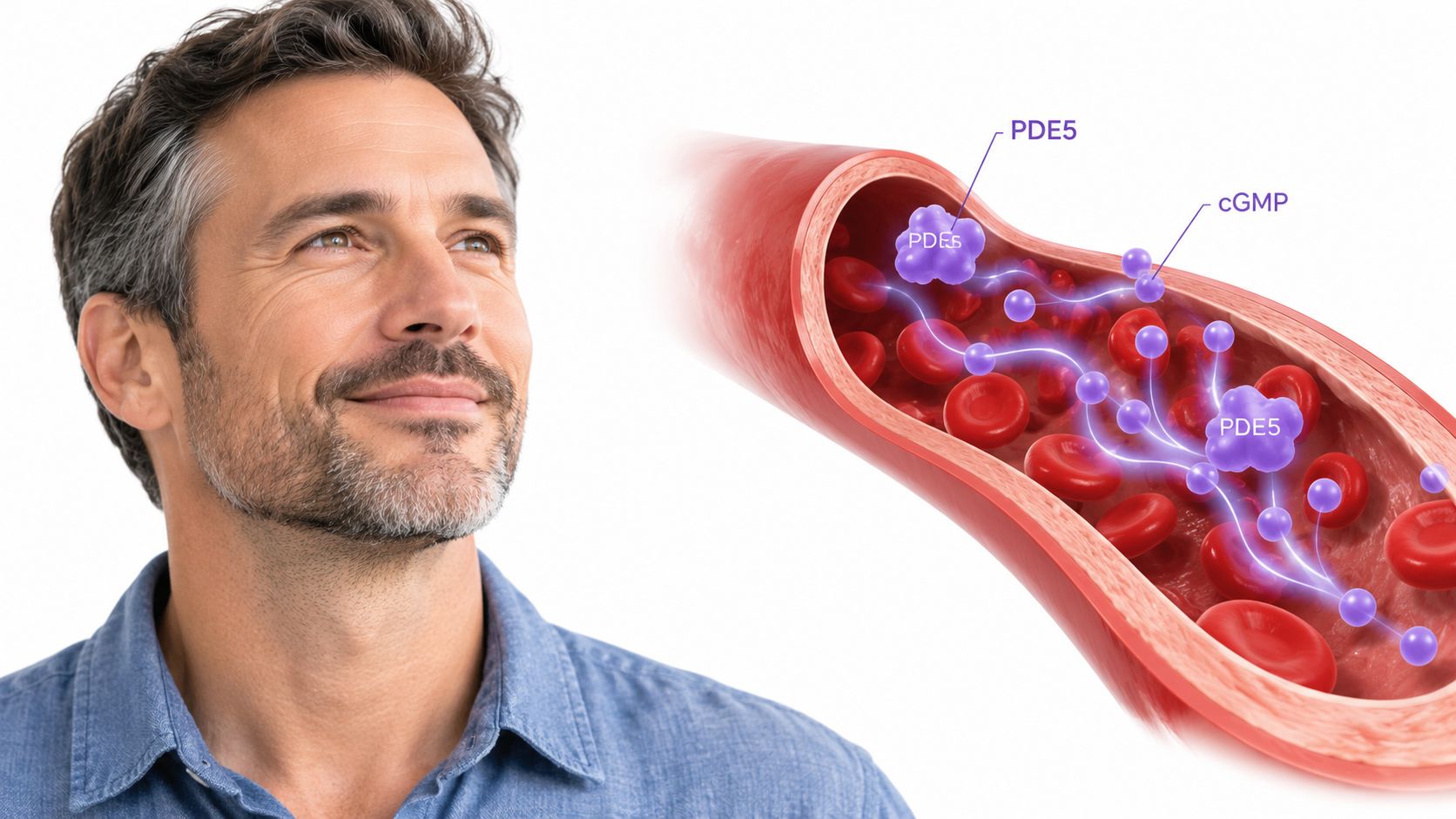
Sildenafil is a phosphodiesterase type 5 inhibitor, often shortened to a PDE5 inhibitor. During sexual arousal, nerves release nitric oxide in erectile tissue. This starts the production of cyclic guanosine monophosphate, or cGMP, which relaxes smooth muscle and allows more blood to enter the penis.
PDE5 normally breaks down cGMP. Sildenafil slows that breakdown, allowing cGMP to remain active for longer while stimulation continues. The medicine therefore improves the penis's response to arousal. It does not start the process by itself.
Why stimulation is required
Sexual stimulation helps the body release enough nitric oxide to activate the cGMP pathway. Sildenafil cannot replace arousal, attraction, touch, or psychological readiness. A person may take the prescribed dose and still not get an erection if they feel rushed, anxious, distracted, or insufficiently stimulated.
The same mechanism explains why sildenafil does not cause a continuous erection. It increases responsiveness while the natural process is active, then the erection usually subsides when stimulation stops. A persistent or painful erection is not an expected effect and requires urgent medical assessment.
Absorption and peak concentration
After you swallow the tablet, sildenafil passes through the gut into the bloodstream. UK patient information states that, in fasted patients, maximum plasma concentrations are reached within 30 to 120 minutes, with a median of 60 minutes. This describes the medicine's blood concentration, not a guaranteed time for an erection.
The useful clinical picture is a timing window. Controlled evidence found a median onset of 25 minutes in fasted patients, while the medicine can support erections for up to 5 hours. Food, dose, absorption, and sexual stimulation all affect where an individual response falls within that window.
Sildenafil is cleared more quickly than tadalafil, which helps explain its several-hour response period rather than an all-day effect. The strength of the result depends on how much medicine reaches the bloodstream and whether the natural erectile pathway is active.
Factors That Change How Quickly Sildenafil Works
Two people can take the same prescribed medicine and notice a different onset. The most useful way to understand this is to separate absorption, drug exposure, and arousal.
Food and timing
A heavy meal, particularly one high in fat, can slow the movement of sildenafil from the gut into the bloodstream. The UK patient leaflet specifically warns that the medicine may take longer after a heavy meal. If you want the timing to be more predictable, follow your prescriber's directions and avoid taking it immediately after a substantial dinner.
Alcohol creates a different problem. It can make arousal and erection more difficult, while also increasing the chance of dizziness or light-headedness. The issue is not just whether alcohol changes absorption. Drinking can work against the physiological response that sildenafil needs. For a plain-language explanation, see how alcohol can affect sex and erectile function.
Dose and individual response
The prescribed dose is chosen after considering your health, other medicines, side effects, and response. A higher dose isn't automatically better or faster, and you mustn't increase the dose without speaking to the prescriber. Some people respond adequately to a lower dose, while others need a clinician-led adjustment.
Age, liver function, kidney function, body composition, gut absorption, and other medicines can all alter exposure. Older adults and people with liver or kidney impairment may need particular care because the medicine can remain active for longer or cause more pronounced effects. Certain interacting medicines can also change sildenafil levels.
Mental and physical context
Anxiety, depression, relationship tension, tiredness, and performance pressure can all reduce sexual arousal. Sildenafil may still be present in the body, but the biological signal it amplifies may be too weak to produce a satisfactory erection. Persistent erectile dysfunction can also be associated with other health conditions, so repeated difficulties deserve a clinical review rather than repeated self-adjustment.
| Factor | Effect on onset | Effect on strength |
|---|---|---|
| Heavy meal | May slow the response | May make the peak feel less predictable |
| Sexual stimulation | Activates the pathway | Essential for an erection to occur |
| Alcohol | Can make the response feel slower or less reliable | May weaken erection quality and increase dizziness |
| Prescribed dose | Varies by person and clinical context | Affects the response and side-effect balance |
| Age, liver or kidney impairment | May alter clearance and timing | May increase exposure and adverse effects |
| Anxiety or depression | Can delay effective arousal | May reduce the response despite the medicine being active |
| Other medicines | May alter sildenafil levels | May require a lower dose, monitoring, or avoidance |
How Long the Effects of Sildenafil Last
Sildenafil's effect is a window, not a fixed appointment. In fasted patients, clinical information records an erection response 4 to 5 hours after dosing, while a Highland NHS erectile dysfunction guideline describes sildenafil as potentially effective for up to 6 hours. The timing varies with food, dose, metabolism, and sexual stimulation.
These figures describe the period when an erection may be easier to achieve with arousal. They do not mean that you will have a continuous erection for several hours.
What the duration means in practice
The medicine supports the body's response to sexual stimulation. It does not create arousal by itself. During the response window, an erection may develop more readily and remain firmer while stimulation continues. When stimulation stops, the erection should normally settle.
The UK Summary of Product Characteristics, mentioned earlier, reports an erection response 4 to 5 hours after dosing. That gives a more realistic expectation than treating 60 minutes as a precise deadline. A heavy meal may delay the start, while the prescribed dose and individual metabolism can affect how noticeable or sustained the response feels.
A higher prescribed dose can increase sildenafil exposure and may also increase side effects. A lower dose may feel less pronounced. One experience does not show that your dose should change, so speak with the prescriber before making adjustments.
The following video provides general educational context about sildenafil use and timing. It does not replace an assessment by a UK prescriber.
Take sildenafil only as prescribed, and do not exceed the recommended daily dose. Planning within the expected response window can help, but the window is not a guarantee. Read more about how long Viagra lasts for further patient-focused context.
Why Sildenafil Can Seem Not to Work
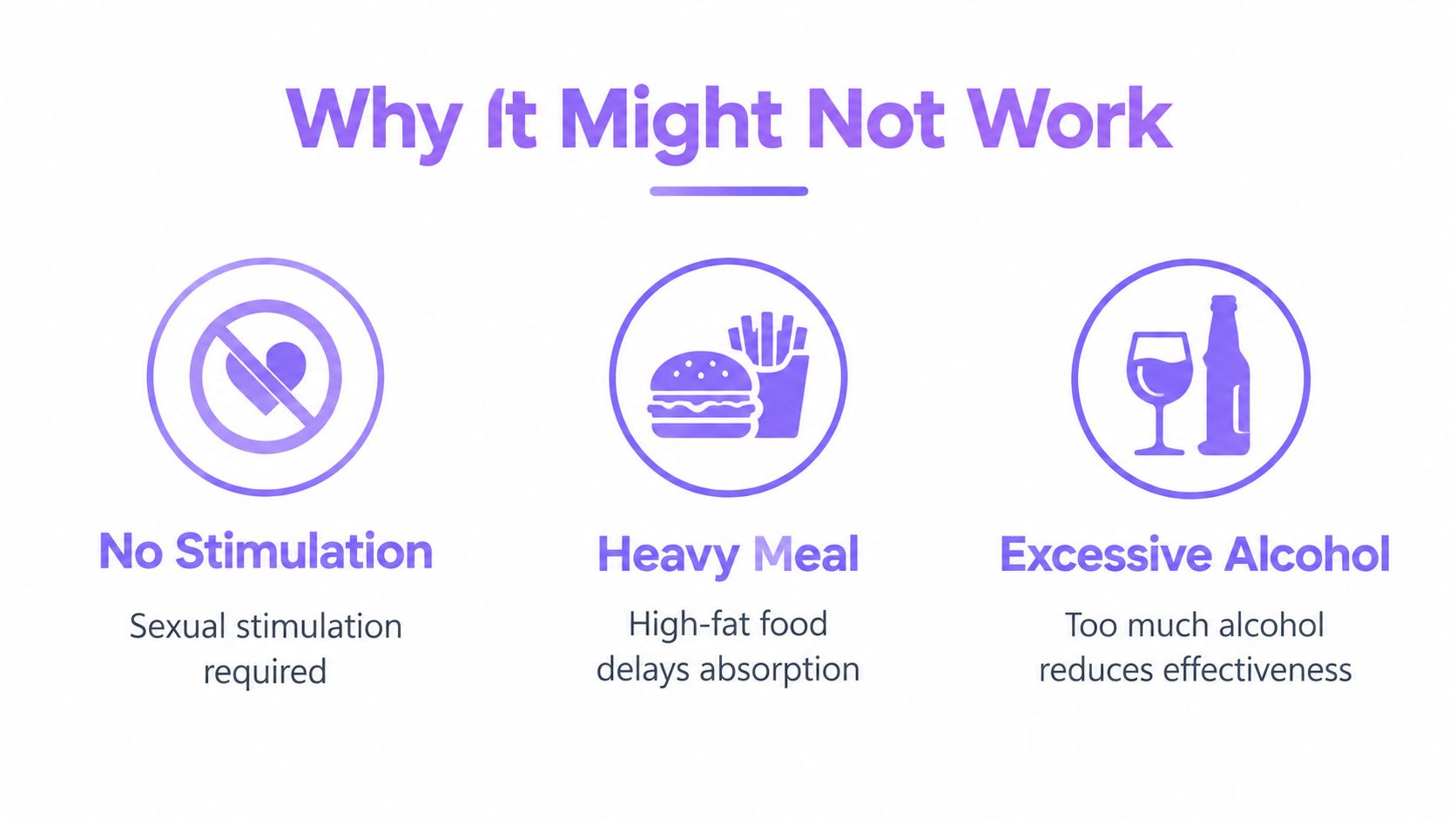
A first unsuccessful attempt often reflects the circumstances rather than a complete lack of drug activity. The most common explanation is that sildenafil was taken without enough sexual stimulation. Because it strengthens a natural arousal pathway, it can't create an erection in the absence of that starting signal.
Food is another frequent source of confusion. Taking the tablet during or shortly after a large, fatty meal may delay absorption, so the expected response arrives later than planned. If you conclude that the medicine has failed before allowing enough time, you may misread delayed onset as treatment failure.
Check the circumstances before changing the dose
Anxiety and performance pressure can interrupt arousal even when blood flow is responding normally. Excessive alcohol can also reduce erection quality and make side effects more noticeable. Taking sildenafil too late, particularly after a heavy meal, creates a timing problem that increasing the dose won't necessarily solve.
Before a prescriber changes treatment, consider the context of the attempt:
- Stimulation: Was there enough time and privacy for sexual arousal to develop?
- Food: Was the tablet taken after a heavy meal?
- Alcohol: Had alcohol made arousal or erection more difficult?
- Timing: Did you allow a reasonable period for absorption?
- Health: Could stress, depression, another condition, or another medicine be contributing?
Don't repeat a dose on the same day because the first attempt was disappointing. If the medicine doesn't work on several properly timed occasions, speak with the prescriber. They may review the dose, check interactions, assess cardiovascular health, and consider whether another cause of erectile dysfunction needs attention.
A single disappointing attempt gives limited information. A repeated pattern is a reason for clinical review.
Safety, Eligibility, and UK Prescription Rules
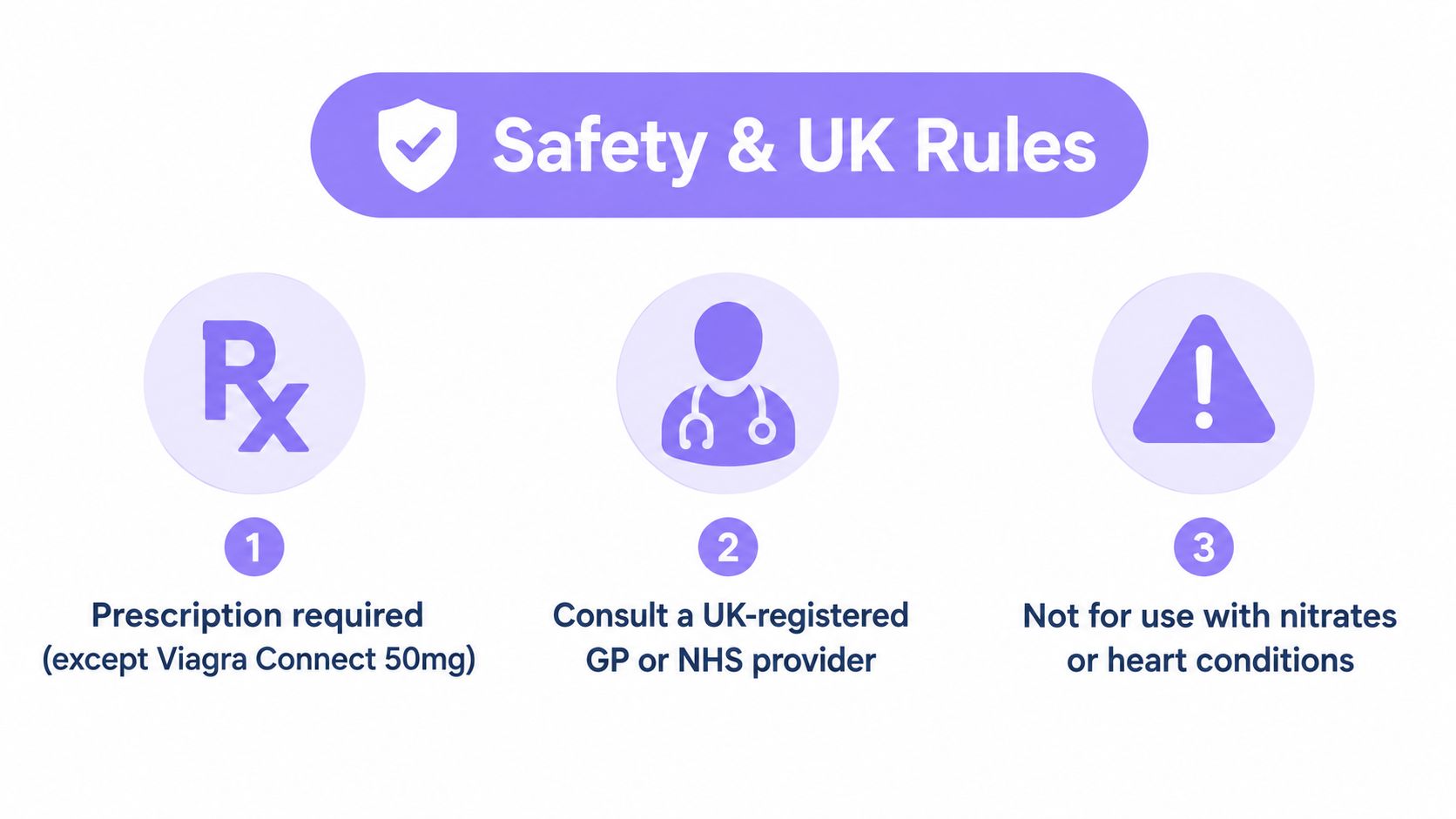
Sildenafil is a prescription-only treatment in the UK, except for Viagra Connect 50 mg, which a pharmacist may supply after checking whether it is suitable. A GP, NHS clinician, or other appropriate UK-registered prescriber can issue a prescription, including through a regulated online pharmacy. The service should display its registration details and carry out a proper clinical assessment rather than provide automatic access.
The key safety check is whether you use nitrates for angina. Sildenafil must not be combined with nitrates, nicorandil, or riociguat, because the combination can cause a dangerous drop in blood pressure. Give the prescriber a complete list of your medicines, including occasional treatments.
Medicines and conditions requiring review
Alpha-blockers, some antifungal medicines, macrolide antibiotics, and HIV protease inhibitors can interact with sildenafil. Depending on the medicine and your health, a clinician may lower the dose or advise against treatment.
Ask for medical advice before using sildenafil if you have chest pain, recently experienced a heart attack or stroke, have low blood pressure, or have liver or kidney impairment. A known penile deformity also requires assessment. If severe cardiovascular disease has made sexual activity unsafe, do not obtain sildenafil without discussing it with a clinician.
Choosing a regulated route
An unregulated website may provide unreliable information about a tablet's identity, strength, storage, or contamination risk. It may also skip checks for interactions and conditions that make sildenafil unsafe. Refer to the NHS information on sildenafil cited earlier, then obtain treatment through a GP, NHS service, or a UK-registered pharmacy regulated by the GPhC.
For further context on the usual strength and clinical considerations, read the educational guide to sildenafil 50 mg. XO Medical is an example of a regulated online pharmacy pathway in which a UK-registered clinician assesses whether prescribed medication is appropriate. An in-person aesthetics clinic offering botox, dermal fillers, skin boosters, and polynucleotides (salmon DNA) is a different service and does not replace a sexual health assessment.
Key Takeaways for Planning Your Dose
Use a timing window rather than a fixed promise. If sildenafil has been prescribed for you, the usual planning point is about 1 hour before sex, with many people expecting an effect within 30 to 60 minutes. A light meal or an empty stomach may make onset more predictable than taking it after a heavy meal, but follow the directions supplied with your prescription.
Sexual stimulation is essential. Sildenafil doesn't work as an automatic erection medicine, and it doesn't increase desire by itself. If the first attempt is disappointing, check the timing, food, alcohol, privacy, and arousal context before assuming the medicine is ineffective.
A practical checklist
- Take only the prescribed dose. Don't increase the strength or take another tablet because onset feels slow.
- Plan ahead. Allow time for absorption before expecting a reliable response.
- Consider the meal. A heavy meal can delay the effect, so avoid using a large dinner as the test of whether the medicine works.
- Limit alcohol. Alcohol can undermine erection quality and make dizziness more likely.
- Allow for your health profile. Age, liver or kidney impairment, anxiety, depression, and other medicines can alter the result.
- Use sexual stimulation. The medicine supports arousal. It doesn't replace it.
In the UK, sildenafil remains subject to prescription and pharmacy controls, except for Viagra Connect 50 mg supplied after a pharmacist's assessment. Tell the prescriber if you use nitrates, nicorandil, or riociguat. A UK-registered prescriber should also consider your cardiovascular fitness and whether sexual activity is appropriate for you.
Seek urgent medical attention for severe symptoms, including chest pain, fainting, sudden vision changes, or an erection that doesn't settle. Suspected side effects can be reported through the MHRA Yellow Card scheme. If the first dose under-delivers, arrange a review rather than changing the dose yourself.
Reviewed by: Qualified UK healthcare professional
Review date: 29 September 2026
This content is for informational purposes only and does not constitute medical advice. Always consult a qualified healthcare professional before starting or changing any treatment.
XO Medical provides clinician-led online pharmacy assessments for adults considering prescribed treatments, including sexual health medicines, through a GPhC-regulated pharmacy pathway. Visit XO to learn how the assessment works and discuss your options with a UK-registered clinician.


0 comments